



Exercice de coup de langue n°1

Lesson time: (4min 36sec)
John O'Neill présente le coup de langue, l'équivalent pour le saxophoniste de l'archet du violoniste, utilisé pour attaquer les notes avec précision et façonner ton phrasé, et l'une des compétences les plus difficiles à maîtriser.
Course preview
This lesson is part of the course The Saxophone Method Vol. 1 : les techniques de base
Watch a preview of the full course below.
Lesson transcript:
Mastering Tonguing for Saxophone Players
Tonguing is one of the most important skills to master for every saxophone player. The tongue is like the saxophone player's equivalent of the violinist's bow. It enables you to:
- Start notes precisely
- Repeat notes quickly and efficiently
- Create subtle variations of phrasing
Unfortunately, it's also one of the most difficult skills to acquire. Part of the reason for that is that you can't see what I'm doing, and I can't see what you're doing. We're both kind of working with our eyes shut. However, over the years that I've been teaching, I have devised an effective way of teaching people to tongue.
The Ventriloquist Exercise
My first teacher, Don Rendell, used to tell me that tonguing was like ventriloquism, and he was absolutely right. When I first started teaching, I would go into all kinds of complicated descriptions of what the tongue was doing. As the years went by, I came back to Don's idea of tonguing being like ventriloquism.
Here's the exercise:
-
Stand in front of a mirror.
-
Take a note, let's say the B that we've been playing already.
-
Sing that note as if you were a ventriloquist:
- Attempt to do this without moving your lips, teeth, or jaw.
"Do, do, do, do, do."
Using the mirror, observe how much movement there is. It may be impossible to have no movement, but try to keep it to an absolute minimum.
Notable Points During the Exercise:
- The "do" sound is produced not by the tip of your tongue, but just behind the tip.
- The tongue moves as little as possible.
- The tongue moves as gently as possible, so it's not like this: "do, do, do," but more like: "do, do, do."
I'm moving my hand across to remind myself to maintain the line. Earlier, when we were playing long notes, I talked about the importance of drawing a line. Keep that in mind as you do the ventriloquist exercise:
"Do, do, do, do."
Final Thoughts
Although you hear distinct notes, I want you to think of this as one breath because it is one breath. It's almost like thinking of it as one continuous sound.
Don't confuse trying to keep the action of the tongue gentle with playing or singing more quietly. This is a common misunderstanding. The gentleness of the tongue's action is completely distinct from the volume of the sound, whether you're singing or playing.
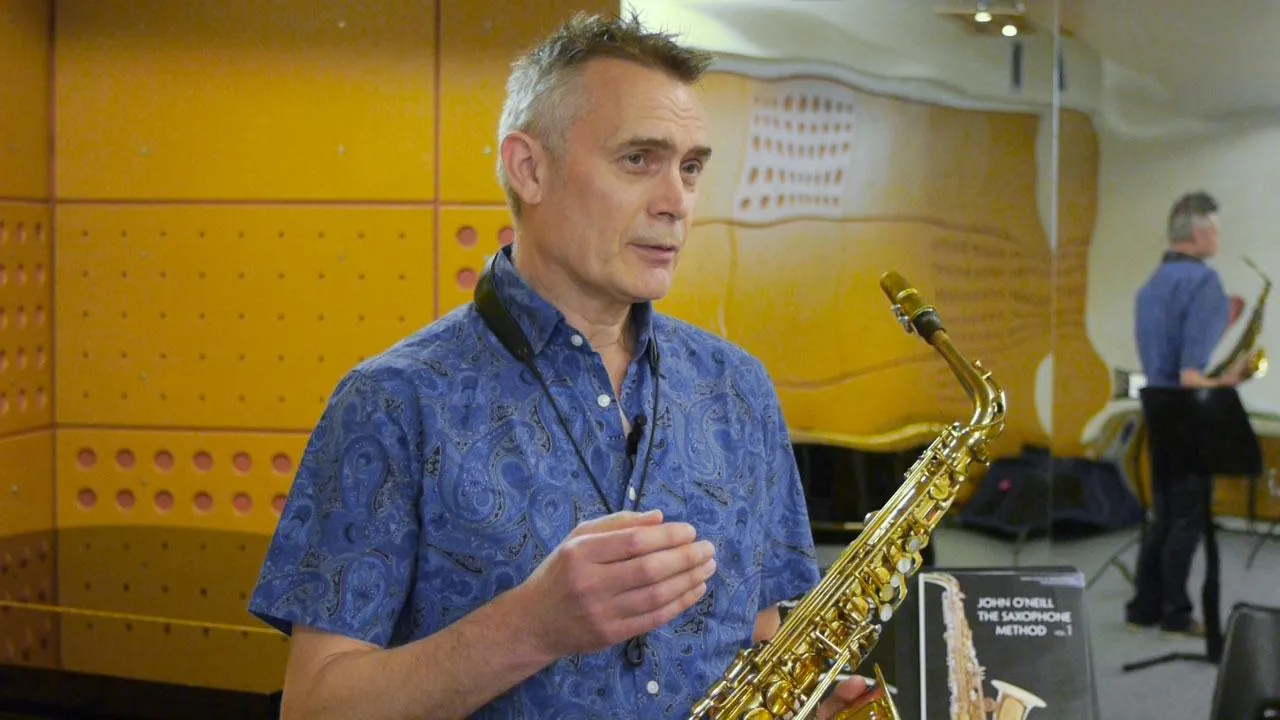
About the instructor
John O'Neill est le saxophoniste à l'origine de The Jazz Method for Saxophone, la série publiée par Schott qui a appris à improviser à toute une génération de musiciens à travers le monde. Publiée pour la première fois en 1991, elle reste l'une des méthodes de jazz les plus vendues jamais écrites, aux côtés de ses méthodes complémentaires pour clarinette et flûte.Il est venu au saxophone à vingt ans, alors qu'il étudiait le français et l'allemand au Trinity College d'Oxford, après avoir entendu John Coltrane. Il a ensuite étudié avec le grand ténor britannique Don Rendell et a appris l'improvisation auprès de Lee Konitz, Warne Marsh et Peter Ind, héritiers directs du légendaire pédagogue Lennie Tristano. Musicien professionnel depuis 1979, il est spécialisé dans le jazz et la bossa nova et s'est produit dans les plus grandes salles de Londres, dont le Ronnie Scott's, tout en composant de la musique pour le cinéma, la télévision, le théâtre et la danse.Enseignant diplômé fort de décennies d'expérience, John a enseigné le saxophone, la clarinette et la flûte en privé et dans des écoles, dans le cadre du cursus de jazz du Trinity College of Music de Londres et lors de stages d'été en Espagne et en République tchèque. Il continue de se produire et d'enseigner depuis son domicile au nord de Londres. read more