



Fixer l'anche sur le bec
Lesson time: (5min 43sec)
John O'Neill montre la partie la plus délicate de la préparation du saxophone : fixer l'anche sur le bec et la positionner correctement.
Course preview
This lesson is part of the course The Saxophone Method Vol. 1 : les techniques de base
Watch a preview of the full course below.
Lesson transcript:
Fitting the Reed to the Mouthpiece
So, this is the most difficult part of the process: fitting the reed to the mouthpiece. This can be done with the reed, crook, and mouthpiece already assembled.
Why Separate the Crook and Mouthpiece?
The only problem with that is:
- You've got the saxophone in one hand and you're trying to look to see where you are.
- It can be quite challenging.
So sometimes I recommend this method: I know it sounds strange, but after putting the mouthpiece on the crook, you then take the crook off again.
The Question of Assembly
You might ask, "Why didn't you just put the mouthpiece on the crook first?" That's because putting the mouthpiece on the crook is a matter of avoiding damage to this part.
- If you can put the mouthpiece on the crook carefully without damaging it, great!
- Then you don't need to put the crook onto the saxophone first.
However, the big advantage of putting the crook there before you fit the mouthpiece is that:
- The crook is held in place as you put the mouthpiece on.
- It's not a problem to untighten that screw again and then set the saxophone down.
This method is particularly easier to work with, especially for small children.
Preparing the Reed
Imagine I've had that reed in my mouth for a while; it's good and wet. You can do this in various ways:
- Sometimes you can just slip the ligature over the reed.
- Alternatively, you can have the ligature already on and slide the reed in that way, which is maybe safer.
Important Tips
- Make sure the ligature is behind this part of the mouthpiece.
- Do not allow the ligature to overlap, because then it's not doing its job properly.
- On this particular model of reed (a Van Doren traditional reed), there's a little line I use as a rough guide for where I have my ligature.
Adjusting the Ligature
The trick to this process is:
- Don't untighten the ligature screws too much so that those screws are still somewhat snug.
- This allows the ligature to hold the reed in place while you adjust it.
Fine Adjustments
Now, I'm going to show you a side view.
- The first thing I want to do is get the reed level with the lip of the mouthpiece.
- I'm using my right hand to wiggle it up and down until it is level.
Once I'm happy with the height, I'll turn it around and check it from a straight-on angle.
- If it's not quite straight, I'll wiggle it over slightly using my thumbs, ensuring that I don't touch the tip (as it's very fragile).
Final Adjustments
Now that I'm satisfied the reed is straight and at the right height, I'm ready for my final adjustment.
- I'll nip those screws up just a little bit, and then I'm good to go.
Holding the Saxophone
When I pick up the saxophone, I always try to get a good grip around the bell. This is important because:
- I try to avoid gripping it higher up, as there's more chance of damaging the keys.
- There's also a greater risk of losing my grip on the saxophone.
So, with my fully assembled crook, mouthpiece, and reed, I can now reinsert that and tighten the screw up, ready to play.
About the instructor
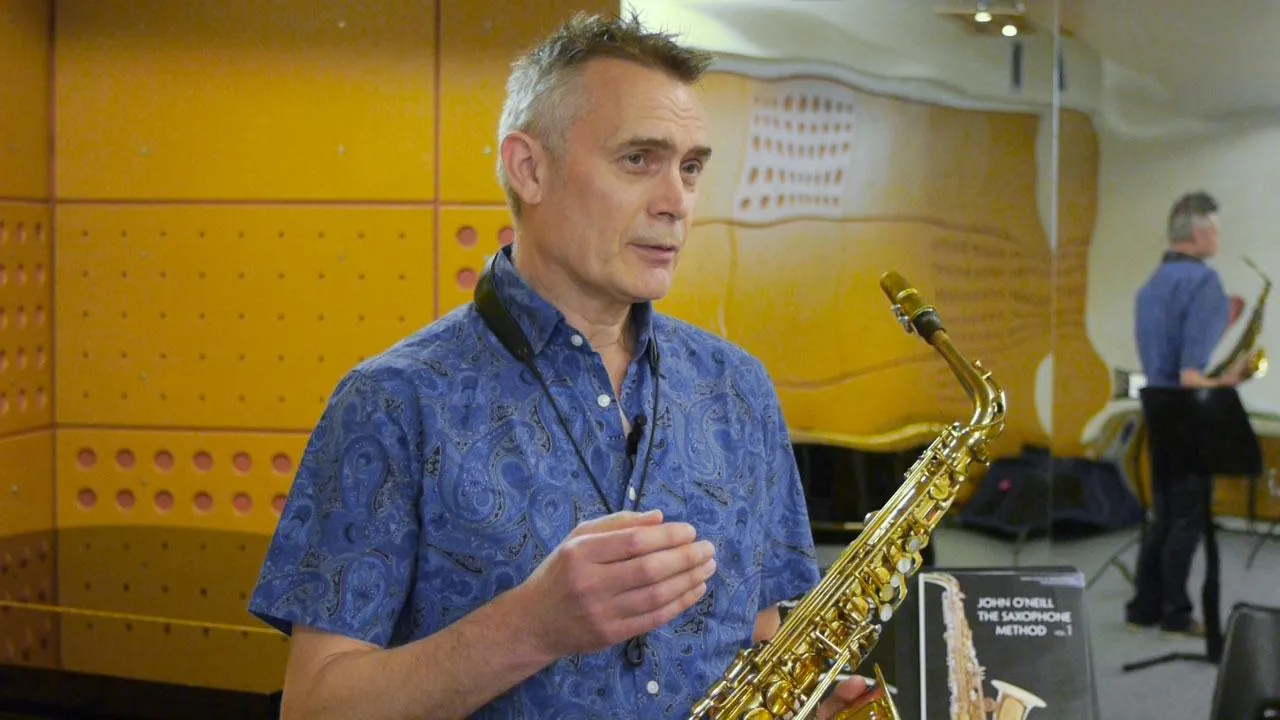
John O'Neill est le saxophoniste à l'origine de The Jazz Method for Saxophone, la série publiée par Schott qui a appris à improviser à toute une génération de musiciens à travers le monde. Publiée pour la première fois en 1991, elle reste l'une des méthodes de jazz les plus vendues jamais écrites, aux côtés de ses méthodes complémentaires pour clarinette et flûte.Il est venu au saxophone à vingt ans, alors qu'il étudiait le français et l'allemand au Trinity College d'Oxford, après avoir entendu John Coltrane. Il a ensuite étudié avec le grand ténor britannique Don Rendell et a appris l'improvisation auprès de Lee Konitz, Warne Marsh et Peter Ind, héritiers directs du légendaire pédagogue Lennie Tristano. Musicien professionnel depuis 1979, il est spécialisé dans le jazz et la bossa nova et s'est produit dans les plus grandes salles de Londres, dont le Ronnie Scott's, tout en composant de la musique pour le cinéma, la télévision, le théâtre et la danse.Enseignant diplômé fort de décennies d'expérience, John a enseigné le saxophone, la clarinette et la flûte en privé et dans des écoles, dans le cadre du cursus de jazz du Trinity College of Music de Londres et lors de stages d'été en Espagne et en République tchèque. Il continue de se produire et d'enseigner depuis son domicile au nord de Londres. read more