



Posture
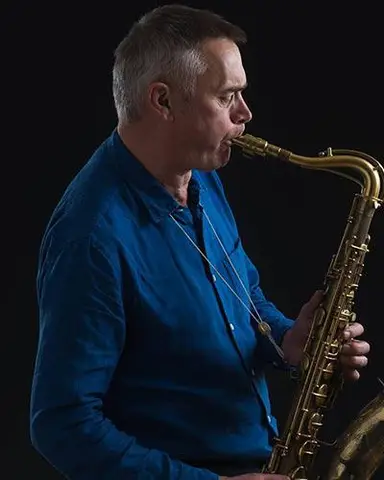
Lesson time: (13min 20sec)
John O'Neill te montre comment te tenir debout, équilibrer ton corps et tenir le saxophone pour que tes poumons puissent se dilater et que tu obtiennes le meilleur son.
Course preview
This lesson is part of the course The Saxophone Method Vol. 1 : les techniques de base
Watch a preview of the full course below.
Lesson transcript:
Saxophone Posture Lesson
In this video, I'm going to start by talking about posture.
Why Is Posture Important?
Because you play the saxophone with your whole body. You are part of the instrument!
- Don't forget, it's your lungs.
- The air is flowing through your throat, and the reed is vibrating inside your mouth.
Think of yourself almost like an organ pipe. When you play, you and the saxophone are in a partnership.
Key Points:
- Getting comfortable with the instrument is crucial.
- Stand properly so your lungs are able to expand.
Standing Position
-
Feet Position:
- Stand with your heels shoulder-width apart.
- My feet are turned out slightly, but that's not important.
- What matters is that the weight is evenly distributed between the two feet.
-
Weight Distribution:
- A little more weight should be on your heels than on the front part of your foot.
-
Knees:
- Bend your knees slightly.
- Straight legs lead to discomfort, either pushing the hips forward (uncomfortable for your lower back) or leaning forward.
Importance of Knees:
- Bending your knees helps you achieve a balanced, comfortable position.
Saxophone Manipulation
The saxophone must come to you, manipulated by your thumbs.
- You don't really hold a saxophone since the weight is supported by the neck strap.
- Your thumbs are crucial in moving the saxophone into position.
Adjusting the Saxophone:
- Left Thumb:
- Pushes to bring the saxophone to position (it often points to the left).
- Right Thumb:
- Goes underneath the thumb rest and pushes forward to bring the instrument closer.
Holding the Saxophone
There are two options for holding an alto saxophone:
-
In Front:
- This is often more comfortable for taller players.
-
At the Side:
- More comfortable for children or smaller people.
- Tip: Tilt the mouthpiece to ensure it aligns properly with your mouth.
Why Tilt?
If you hold the instrument to the side, you must tilt the mouthpiece to ensure it comes into your mouth straight.
Positioning Your Head and Neck
Nodding Down:
The final step involves nodding your head down onto the mouthpiece.
- Adjust the Strap:
- With a slight nod down of my head, the weight of my head presses down onto the mouthpiece.
Importance of Neck Length:
By nodding down, you create a feeling of length at the back of your neck.
- This prevents a hunched feeling that can occur if the strap is too high.
Visualizing Posture
Imagery for Good Posture:
- Imagine standing at the edge of a clear lake, looking at your reflection.
Advantages of Looking Down:
- Promotes an upright posture.
- Reduces shoulder tension.
- Your music stand shouldn't be at eye level to avoid hunching.
The Big Triangle:
- Picture a triangle formed between the top of your head and your shoulders.
- Good posture makes this triangle feel big; bad posture makes it feel small.
Comfort and Balance
Sitting on a Balloon:
When letting your knees bend slightly, imagine sitting on a big balloon behind you.
- This counteracts the downward pull of the saxophone, leading to a balanced posture.
Key Takeaway:
The secret to a comfortable saxophone experience is proper standing position, not buying special straps.
Sitting Position
When sitting down to play:
- Sit forward in the chair to avoid slumping.
- Head Forward and Up:
- Think of your energy going slightly forward.
Position Options:
- You can play the saxophone at the side or positioned between your legs, depending on your setup.
Music Stand Position:
- Keep your music stand low so you can look down comfortably while playing.
Conclusion:
Looking down helps maintain energy and good posture, which is crucial for comfortable and effective saxophone playing.
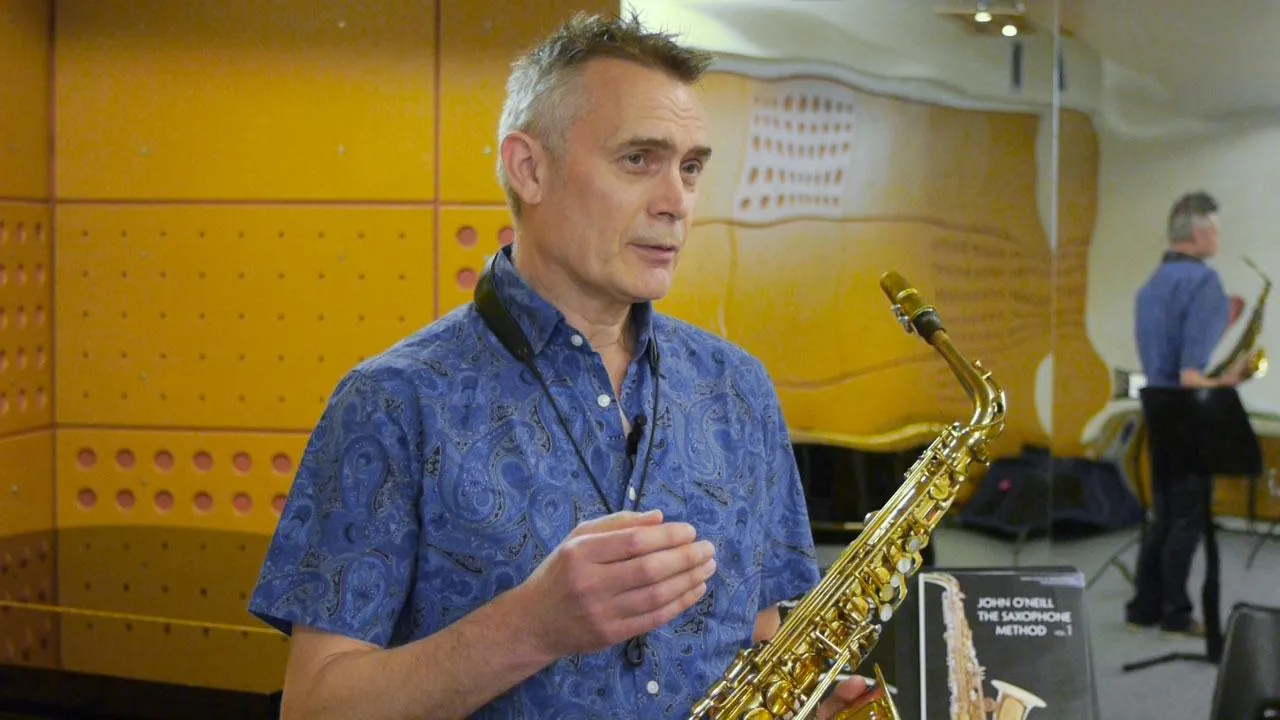
About the instructor
John O'Neill est le saxophoniste à l'origine de The Jazz Method for Saxophone, la série publiée par Schott qui a appris à improviser à toute une génération de musiciens à travers le monde. Publiée pour la première fois en 1991, elle reste l'une des méthodes de jazz les plus vendues jamais écrites, aux côtés de ses méthodes complémentaires pour clarinette et flûte.Il est venu au saxophone à vingt ans, alors qu'il étudiait le français et l'allemand au Trinity College d'Oxford, après avoir entendu John Coltrane. Il a ensuite étudié avec le grand ténor britannique Don Rendell et a appris l'improvisation auprès de Lee Konitz, Warne Marsh et Peter Ind, héritiers directs du légendaire pédagogue Lennie Tristano. Musicien professionnel depuis 1979, il est spécialisé dans le jazz et la bossa nova et s'est produit dans les plus grandes salles de Londres, dont le Ronnie Scott's, tout en composant de la musique pour le cinéma, la télévision, le théâtre et la danse.Enseignant diplômé fort de décennies d'expérience, John a enseigné le saxophone, la clarinette et la flûte en privé et dans des écoles, dans le cadre du cursus de jazz du Trinity College of Music de Londres et lors de stages d'été en Espagne et en République tchèque. Il continue de se produire et d'enseigner depuis son domicile au nord de Londres. read more