



Exercice de respiration n° 3
Lesson time: (2min 29sec)
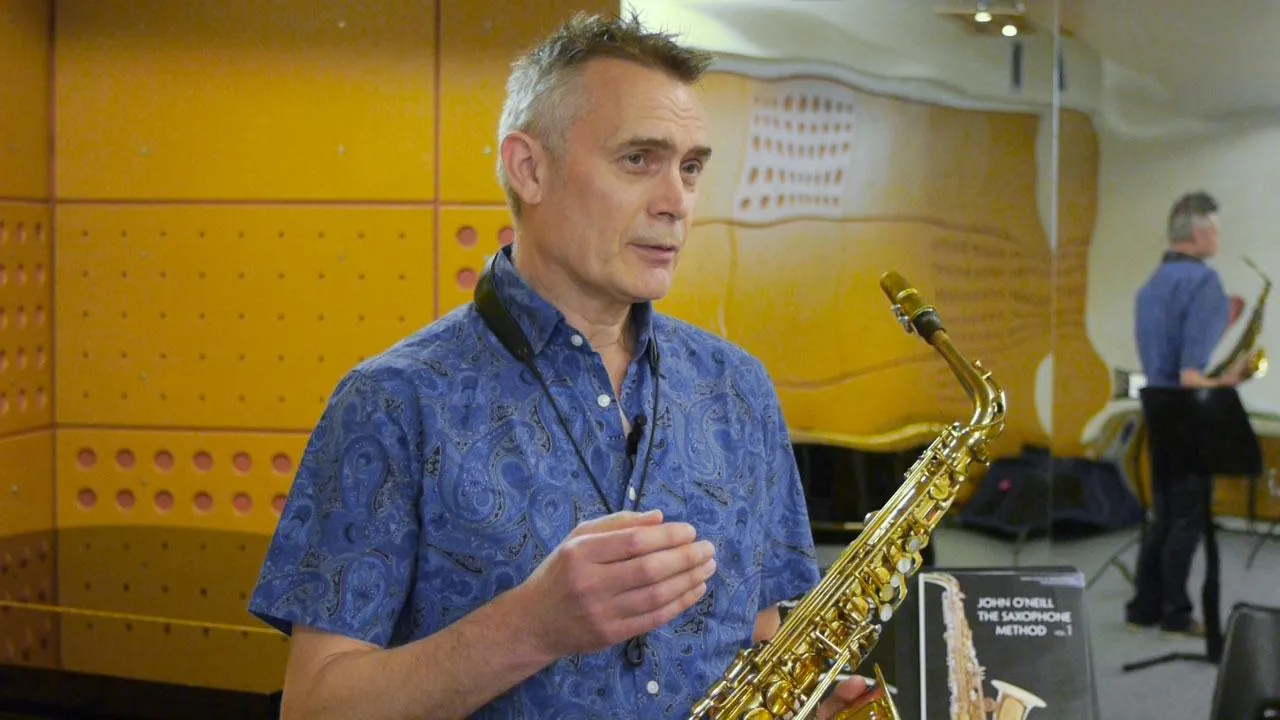
Un troisième exercice de respiration : les paumes posées sur le bas du dos, John O'Neill montre comment sentir le souffle se dilater dans le dos pour un son de saxophone plus stable.
Course preview
This lesson is part of the course The Saxophone Method Vol. 1 : les techniques de base
Watch a preview of the full course below.
Lesson transcript:
Breathing Exercise for Saxophone
So in this next exercise, we're doing the same thing again, but this time I'm positioning my hands so the palms of my hands are on my back like so.
Breathing Technique
-
Breathe In:
- Again, I should feel that my hands are being pushed out.
- This is a little bit more difficult to feel for some people.
-
Feel the Breath:
- You should feel that you're breathing into your hands.
Reflection on Learning
When I first started playing the saxophone, I was always down at the library seeing if I could find any books that would help me understand better what was going on.
A Memorable Book
I remember finding a book called "The Foundations of Singing" by Franklin Kelsey.
- Background:
- This was a book written in the 1920s.
- Franklin Kelsey recommended that when you sing, you imagine that you're breathing in through two holes in the back of your waistcoat.
Of course, that was an age when all gentlemen wore waistcoats, but that image really stuck in my mind.
Visualization Technique
So, you imagine you've got two holes just here, and you're actually taking the breath in through those two holes.
And actually, that really works for me. I can really feel that it's as if I was breathing in through my back. Let me demonstrate that for you just one more time.
-
Breath In:
- Taking the breath in again through the mouth, feeling the hands pushed out.
-
Sound Production:
- Then making your loud, whispered R sound.
Encouragement
And don't be discouraged if when you start doing this, you can't hold your sound for as long as I can. Don't forget, I've been doing this for over 40 years, so I've got pretty good breath control. But you'll get there. Just keep at it. Stay with the exercises.
About the instructor
John O'Neill est le saxophoniste à l'origine de The Jazz Method for Saxophone, la série publiée par Schott qui a appris à improviser à toute une génération de musiciens à travers le monde. Publiée pour la première fois en 1991, elle reste l'une des méthodes de jazz les plus vendues jamais écrites, aux côtés de ses méthodes complémentaires pour clarinette et flûte.Il est venu au saxophone à vingt ans, alors qu'il étudiait le français et l'allemand au Trinity College d'Oxford, après avoir entendu John Coltrane. Il a ensuite étudié avec le grand ténor britannique Don Rendell et a appris l'improvisation auprès de Lee Konitz, Warne Marsh et Peter Ind, héritiers directs du légendaire pédagogue Lennie Tristano. Musicien professionnel depuis 1979, il est spécialisé dans le jazz et la bossa nova et s'est produit dans les plus grandes salles de Londres, dont le Ronnie Scott's, tout en composant de la musique pour le cinéma, la télévision, le théâtre et la danse.Enseignant diplômé fort de décennies d'expérience, John a enseigné le saxophone, la clarinette et la flûte en privé et dans des écoles, dans le cadre du cursus de jazz du Trinity College of Music de Londres et lors de stages d'été en Espagne et en République tchèque. Il continue de se produire et d'enseigner depuis son domicile au nord de Londres. read more