



Exercice de respiration n° 2
Lesson time: (4min 34sec)
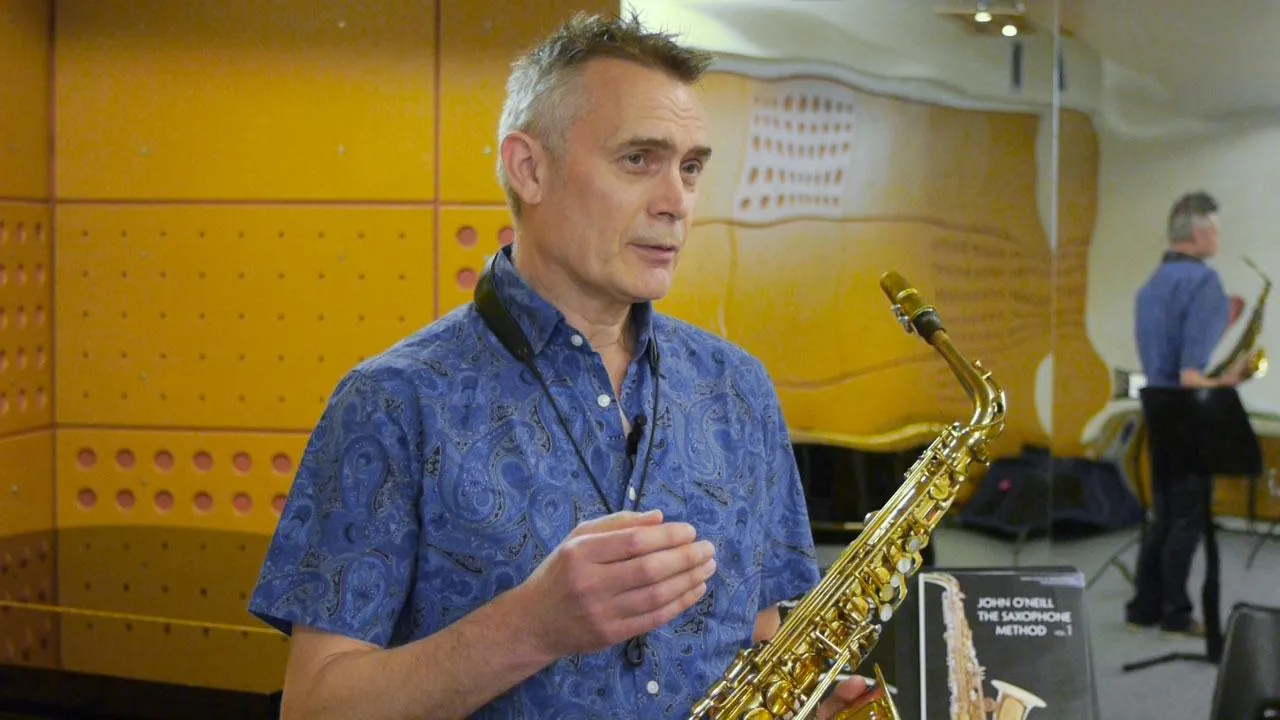
Le deuxième exercice de respiration pour saxophone de John O'Neill, réalisé debout devant un miroir, les mains sur le ventre, pour sentir la respiration et éviter de se crisper.
Course preview
This lesson is part of the course The Saxophone Method Vol. 1 : les techniques de base
Watch a preview of the full course below.
Lesson transcript:
Standing Exercise for Breath Control
So the next exercise involves you standing up in that nice relaxed posture, preferably in front of a mirror so you can actually see what's going on.
Mirror Setup
- If the mirror can be a nice big tall mirror where you can see the whole of the upper half of your body, even better.
Hand Placement
- Place your hands on your stomach, just below your solar plexus.
- Try to do the same thing that you did when you were lying on your back.
Common Breathing Faults
Now, here is where often the problems start. A common fault that I see with beginners is a tendency, when they breathe in, to do it like so.
"That's what I call the anxiety breath."
This breath just doesn't work for playing the saxophone or for any wind instrument for that matter.
Shoulder Awareness
Remember when you were lying on your back, your shoulders didn't go up, did they? When you took the in-breath, the shoulders just stayed exactly where they were.
- Use the mirror: carefully watch your shoulders to see if there's any tendency to lift up.
I think that tendency to lift comes from the misconception that you need large quantities of air to blow the instrument.
"Remember, you don't need to take a lot of air into your body. You certainly do not need to fill your lungs."
Lung Capacity Analogy
Think of your lungs like a petrol tank.
- We're going to operate with our tank somewhere between a quarter and half full but we're never going to fill up.
- We're never going to try to fill to the maximum; that isn't going to help us at all.
Breathing Technique
So, I'm going to take a breath again through my mouth, and it should feel like:
- Almost like a silent breath, like a sip of air rather than a gulp of air.
- I should feel my hands being pushed out very slightly.
Then, you're going to breathe out while making that same whispered "R" sound.
Muscle Engagement
In the course of making that sound, I can feel my core muscles pushing against my hands.
- My hands gradually, gradually, gradually move in towards my center.
- These core muscles are squeezing all the time, but they're squeezing quite gently at first.
By the end of your breath (I'm going to call it a note for the moment), it should feel like those muscles can't pull in anymore.
An Imagery Tool
Imagine you're wringing out a sponge.
- You pick up a sponge that's full of water to achieve a steady trickle.
- You'll squeeze very gently at first, and then harder and harder until you can't squeeze any harder.
The same principle applies here: I'm squeezing gently at first and then gradually harder to sustain the sound at the same level.
Maintaining Sound Quality
- Don't let the sound fade away.
- Keep it strong while keeping the throat nice and relaxed.
The throat muscles are really important when you play the saxophone.
"So we don't want this kind of sound."
Maintain a relaxed open throat for a sound that's strong enough to be heard right across the other side of the room.
- Even though it's a whispered sound, it should be a strong whispered sound.
About the instructor
John O'Neill est le saxophoniste à l'origine de The Jazz Method for Saxophone, la série publiée par Schott qui a appris à improviser à toute une génération de musiciens à travers le monde. Publiée pour la première fois en 1991, elle reste l'une des méthodes de jazz les plus vendues jamais écrites, aux côtés de ses méthodes complémentaires pour clarinette et flûte.Il est venu au saxophone à vingt ans, alors qu'il étudiait le français et l'allemand au Trinity College d'Oxford, après avoir entendu John Coltrane. Il a ensuite étudié avec le grand ténor britannique Don Rendell et a appris l'improvisation auprès de Lee Konitz, Warne Marsh et Peter Ind, héritiers directs du légendaire pédagogue Lennie Tristano. Musicien professionnel depuis 1979, il est spécialisé dans le jazz et la bossa nova et s'est produit dans les plus grandes salles de Londres, dont le Ronnie Scott's, tout en composant de la musique pour le cinéma, la télévision, le théâtre et la danse.Enseignant diplômé fort de décennies d'expérience, John a enseigné le saxophone, la clarinette et la flûte en privé et dans des écoles, dans le cadre du cursus de jazz du Trinity College of Music de Londres et lors de stages d'été en Espagne et en République tchèque. Il continue de se produire et d'enseigner depuis son domicile au nord de Londres. read more