



L'embouchure et ta première note
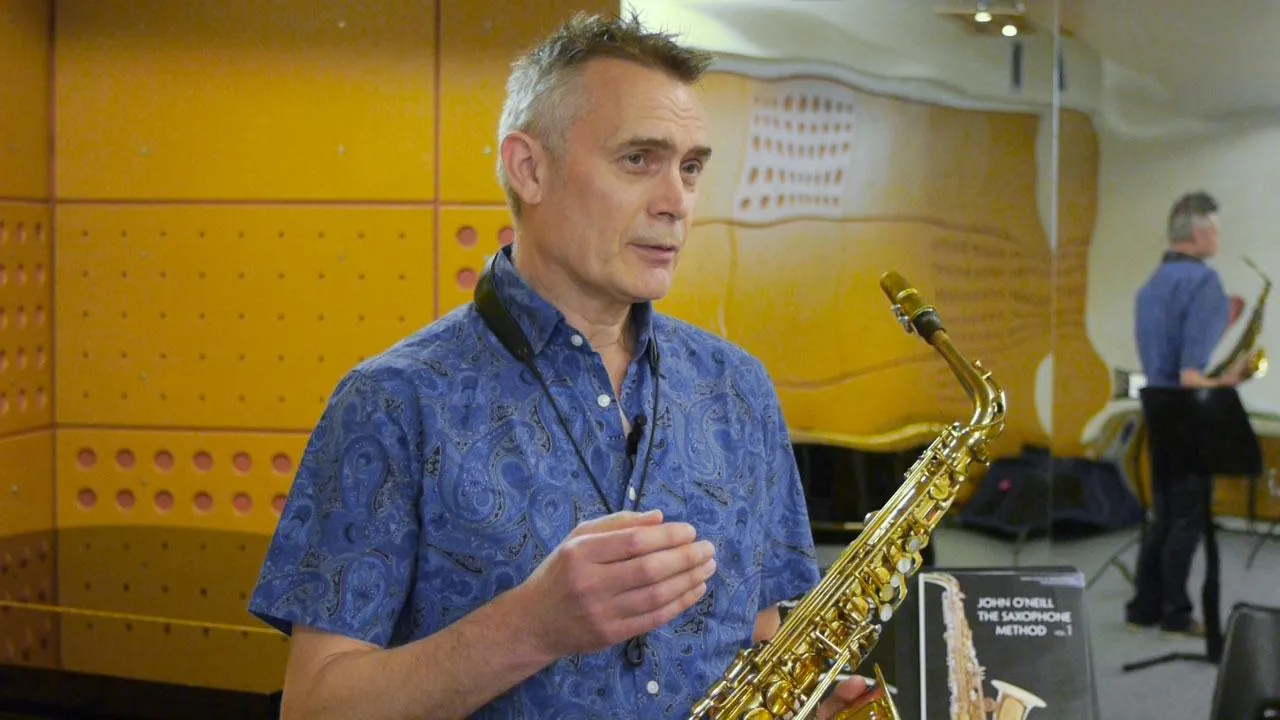
Lesson time: (9min 46sec)
John O'Neill te montre comment former une bonne embouchure de saxophone, en l'imaginant comme un entonnoir pour ton souffle, afin d'obtenir un son propre sur ta première note.
Course preview
This lesson is part of the course The Saxophone Method Vol. 1 : les techniques de base
Watch a preview of the full course below.
Lesson transcript:
Understanding Embouchure
Embouchure is, I believe, a French word that means where a river opens out into the sea. For saxophone players, it's best to think of it as a funnel for your breath.
Importance of Embouchure
What's really important here is to understand that even if you've got your breathing right and mastered those breathing exercises I've already shown you, if you don't get your embouchure right, you can sabotage everything. In this lesson, I'm going to share a few simple and memorable tips to help you create a good embouchure, leading to a good sound.
The Science of Sound Production
One of the first things I explain to my students is the science behind sound production.
- Remember when I talked about different aspects of the mouthpiece?
- I discussed tip opening and the free vibrating length of the reed.
The length from the point where you can no longer see daylight between the reed and the mouthpiece to the end of the mouthpiece represents the free vibrating length of the reed.
Lower Lip Position
To create an effective sound, your lower lip needs to be positioned precisely where that vibration begins.
A common problem I encounter with new students, especially those who have been playing for a while without improving their sound, is that their teeth are perched right on the end of the mouthpiece.
- We all have different bite characteristics.
- A normal bite is when your top teeth are just slightly in front of your lower teeth.
- I have a pronounced overbite, meaning my top teeth protrude a bit more.
For me, this means that to get my lower lip to that ideal point where the reed meets the mouthpiece, I need to position my top teeth a little further forward. So, while you might see a lot of mouthpiece in my mouth, it's not just about that, it's about where my lower lip is positioned.
Key Principles for a Good Embouchure
There are three important principles to remember:
-
Anchor Your Front Teeth
- During our discussion on posture, I mentioned nodding my head down onto the top of the mouthpiece.
- Many people touch their teeth very lightly on the mouthpiece, creating instability.
- We need stability, so your teeth should be firmly anchored on the top of the mouthpiece.
-
Tuck Your Lip In
- Slightly tuck your lip in, and to do this, imagine you're making an "F" or a "TH" sound.
- While there is a school of thought that advocates for a "lip out" embouchure, I recommend the lip-in style for beginners.
-
Mouth Corners In
- The most important principle is to remember that the corners of your mouth must come in towards the center.
- Visualize the shape of your mouth when you whistle; the corners move inward.
Activating Lower Lip Muscles
Your lower lip should be relaxed naturally. If you grab hold of it while completely relaxed, it won't work for playing the saxophone. We need to activate the muscles in the lower lip, which can be done through the muscles at the corners of your mouth.
- The musculature in your face is complex, stretching around your lips, nose, and even up towards the corners of your eyes.
- Think of your mouth corners as an elastic band. When pushed in towards the center, the muscles in the lower lip firm up.
Exercise to Practice Embouchure
I often recommend a practical exercise:
- Push down on your lower lip and try to resist the downward pressure with your finger.
- Turn to the side slightly while doing this, keep your chin down to stretch the area between your lip and chin.
- Maintain resistance with your muscles.
Avoid the Incorrect Approach:
- If your chin pushes up towards your finger, you're not using the muscles correctly, this will not produce a good embouchure or sound.
Applying These Principles on Saxophone
Now that we've covered the three key points, let's think of them as hooks to simplify the learning process:
- Anchor - Visualize an anchor.
- F Shape - Tuck your lip in.
- Whistling - Imagine the feeling of whistling.
Alternative Shapes: If you can't whistle, think of an "O" shape or the sensation of gripping a large straw with your lips.
Remember, the saxophone embouchure relies on your lip muscles, not on your teeth or jaw structure.
Demonstration
Now, I'll demonstrate creating an embouchure and producing a sound.
- Finger the note B with the index finger of your left hand.
- Keep the three crucial points in mind.
- To start, it doesn't matter if you use your tongue, just breathe into the saxophone, aiming to create as long and steady a note as possible.
About the instructor
John O'Neill est le saxophoniste à l'origine de The Jazz Method for Saxophone, la série publiée par Schott qui a appris à improviser à toute une génération de musiciens à travers le monde. Publiée pour la première fois en 1991, elle reste l'une des méthodes de jazz les plus vendues jamais écrites, aux côtés de ses méthodes complémentaires pour clarinette et flûte.Il est venu au saxophone à vingt ans, alors qu'il étudiait le français et l'allemand au Trinity College d'Oxford, après avoir entendu John Coltrane. Il a ensuite étudié avec le grand ténor britannique Don Rendell et a appris l'improvisation auprès de Lee Konitz, Warne Marsh et Peter Ind, héritiers directs du légendaire pédagogue Lennie Tristano. Musicien professionnel depuis 1979, il est spécialisé dans le jazz et la bossa nova et s'est produit dans les plus grandes salles de Londres, dont le Ronnie Scott's, tout en composant de la musique pour le cinéma, la télévision, le théâtre et la danse.Enseignant diplômé fort de décennies d'expérience, John a enseigné le saxophone, la clarinette et la flûte en privé et dans des écoles, dans le cadre du cursus de jazz du Trinity College of Music de Londres et lors de stages d'été en Espagne et en République tchèque. Il continue de se produire et d'enseigner depuis son domicile au nord de Londres. read more