



Développer ton son
Lesson time: (3min 43sec)
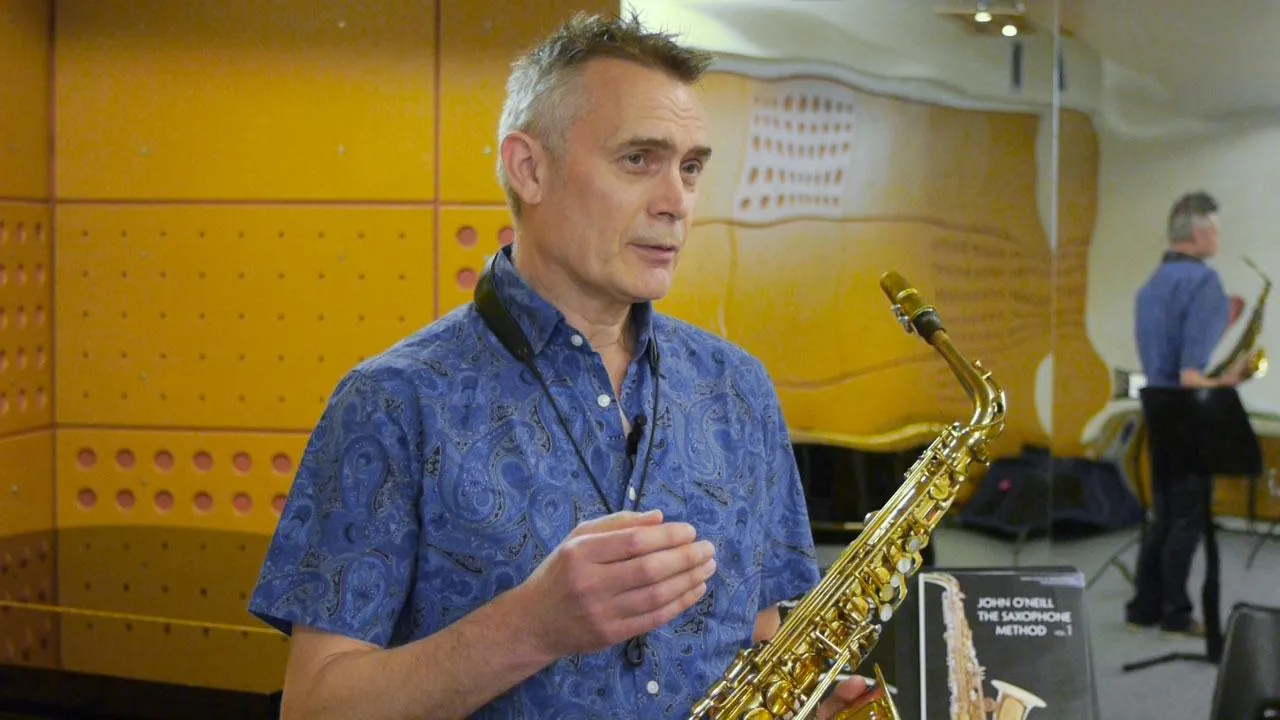
John O'Neill montre comment construire ton son au saxophone dès le premier jour, en commençant chaque séance de travail par des exercices de respiration et quelques minutes de notes tenues.
Course preview
This lesson is part of the course The Saxophone Method Vol. 1 : les techniques de base
Watch a preview of the full course below.
Lesson transcript:
Starting Your Practice Session
I recommend that you start every practice session with long notes in this way: a minimum of two minutes and a maximum of five minutes.
Typically, you might begin with a few minutes of breathing exercises and then follow on to playing the long notes. This approach helps you take what you've learned in the breathing exercises into your playing of the long notes.
Remember: You mustn't forget the importance of the breath and breath control as you go into trying to make your first sounds.
Playing Long Notes
You can do this same exercise of playing long notes by changing the note that you play. Once you're feeling comfortable with B, by all means, try playing a C, A, or G. I wouldn't go any lower than G to begin with.
Tone Production
There's another thing to say about tone production and the quality of the sound that you get. It's really important to listen to as many saxophone players as you can. Sometimes people neglect that, forgetting that you'll only ever produce on the saxophone what you're able to imagine.
When we listen to great players, it helps us to develop a concept of how we want to sound.
Notable Jazz Players
For example, if you listen to some of the most famous jazz players, you'll hear a variety of sounds. Here are a few notable players to consider:
- Johnny Hodges
- Benny Carter
- Charlie Parker
- Lee Konitz
- Art Pepper
- Paul Desmond
- Phil Woods
- Cannonball Adderley
- Ornette Coleman
- David Sanborn
They all make really quite distinctive sounds on the saxophone. Part of your journey is going to be listening to as many different players as possible.
Listening to Classical Players
Don't forget, it's also important to listen to some of the really fine classical players. I could mention people like:
- John Harle
- Martin Robertson
Remember, the saxophone is not just a jazz instrument. Listening to all these different players is going to help you develop your own concept of how you want to sound on the saxophone.
Expanding Your Listening
Additionally, I'd say that it's helpful not just to listen to saxophone players but to listen to good tone on any instrument, especially if it's one that has a roughly similar register to the alto saxophone.
For example:
- Listening to great trumpet players
- Listening to good singers
One of my favorites is Ella Fitzgerald. I think she makes just an incredible sound with her voice, and her voice has a kind of lower-pitched female quality which corresponds with the register of an alto saxophone.
So, listening to Ella can be an inspiration for me in trying to produce a better sound on the saxophone.
About the instructor
John O'Neill est le saxophoniste à l'origine de The Jazz Method for Saxophone, la série publiée par Schott qui a appris à improviser à toute une génération de musiciens à travers le monde. Publiée pour la première fois en 1991, elle reste l'une des méthodes de jazz les plus vendues jamais écrites, aux côtés de ses méthodes complémentaires pour clarinette et flûte.Il est venu au saxophone à vingt ans, alors qu'il étudiait le français et l'allemand au Trinity College d'Oxford, après avoir entendu John Coltrane. Il a ensuite étudié avec le grand ténor britannique Don Rendell et a appris l'improvisation auprès de Lee Konitz, Warne Marsh et Peter Ind, héritiers directs du légendaire pédagogue Lennie Tristano. Musicien professionnel depuis 1979, il est spécialisé dans le jazz et la bossa nova et s'est produit dans les plus grandes salles de Londres, dont le Ronnie Scott's, tout en composant de la musique pour le cinéma, la télévision, le théâtre et la danse.Enseignant diplômé fort de décennies d'expérience, John a enseigné le saxophone, la clarinette et la flûte en privé et dans des écoles, dans le cadre du cursus de jazz du Trinity College of Music de Londres et lors de stages d'été en Espagne et en République tchèque. Il continue de se produire et d'enseigner depuis son domicile au nord de Londres. read more