



Comment assembler ton saxophone
Lesson time: (5min 20sec)
Course preview
This lesson is part of the course The Saxophone Method Vol. 1 : les techniques de base
Watch a preview of the full course below.
Lesson transcript:
How to Assemble the Saxophone
Okay, so now I'm going to show you how to put the saxophone together. Very often what happens is I'm at home teaching. My student comes in, and we've both got our instruments in the cases. I turn around, and their instrument is fully assembled, while I'm still halfway through putting mine together.
I usually say to them, "Why do you think, you know, I've been playing this instrument for 40 years, and you've put your instrument together in about half the time it takes me?"
They kind of sheepishly admit that it's because they didn't really spend enough time paying attention to putting it together.
The Importance of Careful Assembly
The reason it takes me longer than some of my students is because I take great care about putting this together; it needs to be done very precisely.
-
Wetting the Reed
The first thing I do is wet the reed. I put approximately half the scraped-out part, the blade of the reed, in my mouth. While I'm putting the saxophone together, that reed stays in my mouth. Clearly, I'm not going to keep it in my mouth now, because if I do, I can't talk to you properly.So you have to imagine that while I'm putting the saxophone together, that reed stays in my mouth like a thermometer. This is because, as I explained earlier, the reed really needs to be thoroughly moist in order to play properly.
When you first wet a reed, sometimes it actually warps slightly out of shape, meaning it's not a completely straight line. While that reed is warped, it won't play properly. It's not ready to play until, when you look at the reed, that line is straight.
So, the first thing I do is pop the reed in my mouth and leave it there. By the time I finish putting the instrument together, it's ready to play.
-
Attaching the Strap
Next, I'll put my strap on and hook the saxophone onto the strap. -
Inserting the Crook
Now, before you insert the crook, make sure the screw on the right-hand side (not the one on the left) is untightened. The crook should go in very easily with a gentle pushing and slight twisting movement.Please make sure that you don't stress this part of the mechanism. Don't yank it from side to side. I'm doing this very gently, avoiding putting pressure on here. It should go in very easily. If it doesn't, here's a little trick:
- Get a tissue and clean this surface with it.
- Clean the inside surface with the same tissue.
- Run your hand down the side of your nose to collect a little facial grease, which you then smear onto this surface.
This works like a dream! Then you just pop that in like that, and it should go in smoothly.
Lining Up the Crook
Line the crook up with the neck strap rim. You see, the bell is kind of pointing in one direction, and people often think that they should have the crook pointing the same way that the bell is pointing. But actually, if you do that, you need to twist the saxophone to get it to come into your mouth.
If you line it up with this ring, it should come into your mouth at the right angle.
Once you've put the crook in, you can then tighten this screw here.
-
Pushing on the Mouthpiece
Next, I'm going to push the mouthpiece on. How far you push the mouthpiece on is determined by the question of tuning. In other words, the further I push the mouthpiece on, the sharper or higher my note will be. The further off it is, the lower or flatter my note will be.I know from experience roughly where the right place to put this particular mouthpiece is, and you'll find out from experience where the right place to put your mouthpiece is.
About the instructor
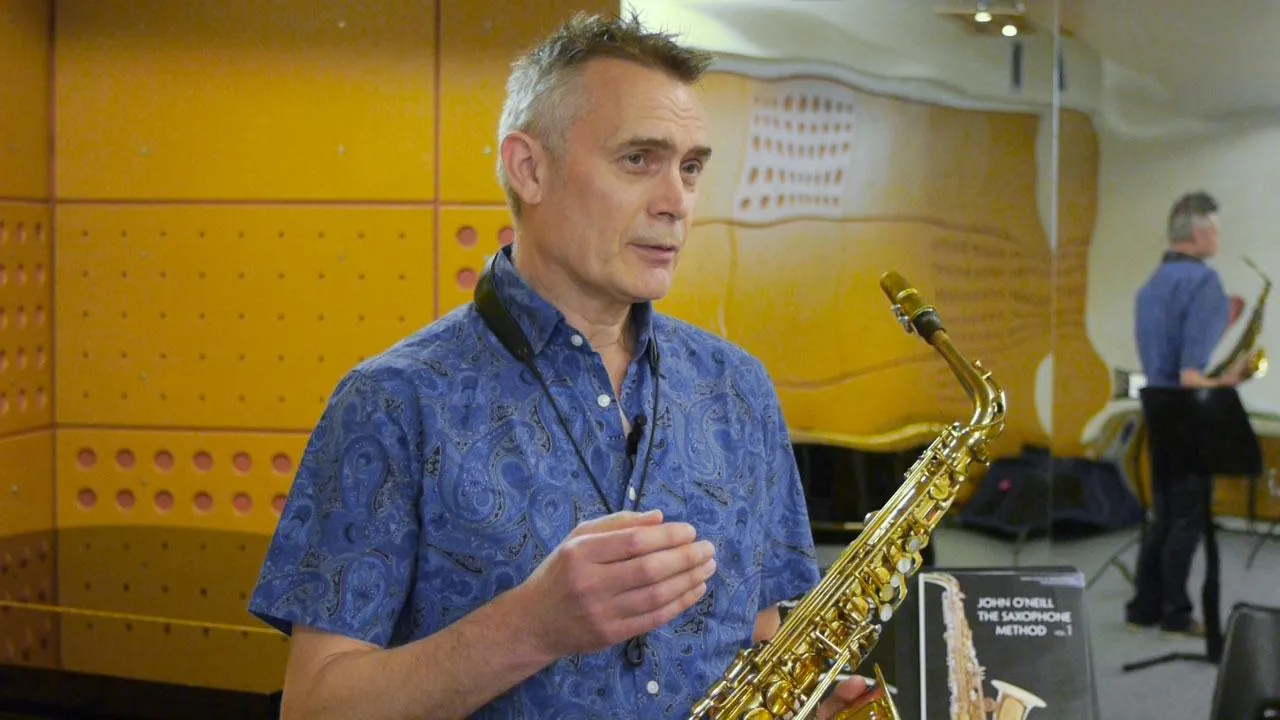
John O'Neill est le saxophoniste à l'origine de The Jazz Method for Saxophone, la série publiée par Schott qui a appris à improviser à toute une génération de musiciens à travers le monde. Publiée pour la première fois en 1991, elle reste l'une des méthodes de jazz les plus vendues jamais écrites, aux côtés de ses méthodes complémentaires pour clarinette et flûte.Il est venu au saxophone à vingt ans, alors qu'il étudiait le français et l'allemand au Trinity College d'Oxford, après avoir entendu John Coltrane. Il a ensuite étudié avec le grand ténor britannique Don Rendell et a appris l'improvisation auprès de Lee Konitz, Warne Marsh et Peter Ind, héritiers directs du légendaire pédagogue Lennie Tristano. Musicien professionnel depuis 1979, il est spécialisé dans le jazz et la bossa nova et s'est produit dans les plus grandes salles de Londres, dont le Ronnie Scott's, tout en composant de la musique pour le cinéma, la télévision, le théâtre et la danse.Enseignant diplômé fort de décennies d'expérience, John a enseigné le saxophone, la clarinette et la flûte en privé et dans des écoles, dans le cadre du cursus de jazz du Trinity College of Music de Londres et lors de stages d'été en Espagne et en République tchèque. Il continue de se produire et d'enseigner depuis son domicile au nord de Londres. read more