



La respiration
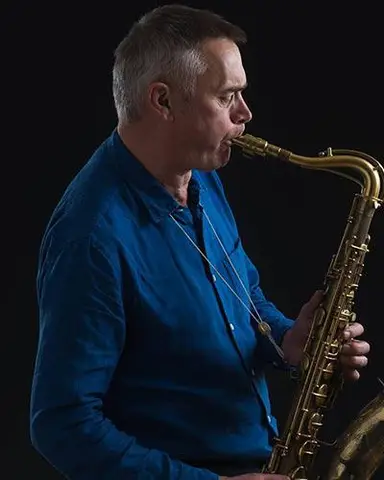
Lesson time: (4min 12sec)
John O'Neill explique pourquoi le saxophone est en réalité un instrument à souffle et pourquoi apprendre à contrôler ta respiration est la clé pour obtenir un bon son.
Course preview
This lesson is part of the course The Saxophone Method Vol. 1 : les techniques de base
Watch a preview of the full course below.
Lesson transcript:
Understanding the Saxophone as a Breath Instrument
The saxophone is a wind instrument. So what does that mean?
It means it's a breath instrument. In fact, I'd really prefer it if they would refer to it as a breath instrument because it focuses you on what the essential thing is:
Learning to control your breath is absolutely key to playing the saxophone.
Common Experiences
Well, maybe some of you have had the experience where your friend says, "Oh, can I play your saxophone?"
They try to blow it and they do something like this:
They go...
And that's a very common experience. The reason they don't get a great sound, of course, is because they're not controlling their breath.
The Balloon Analogy
Think of it like a balloon:
- You blow up a balloon. What happens if you let it go?
- Within a few seconds, the balloon flies around the room and then lands on the floor.
- Now imagine blowing up the same balloon and putting your fingers on the neck of the balloon so the air comes out really slowly.
- Then the balloon gradually, gradually, gradually deflates.
So what we're looking at here is learning to control the breath.
A Common Misconception
A big misconception about playing the saxophone, or any woodwind instrument for that matter, is that you need a large volume of air to make a good sound.
No, you don't need a large volume of air. What you need is to learn to control a small quantity of air.
Don't forget, the sound is being generated from the reed vibrating on the mouthpiece. So even if I take the crook off of the saxophone, I'm still going to get a sound. w
Helpful Imagery
I think there are a couple of images that I tend to use to help people with this idea of controlling small quantities of air:
1. The Birthday Cake
Imagine a birthday cake with 20 candles on it.
- How are you going to blow so that you can blow the candles out in one go?
- This won't work because the candles will flicker, and many of them will still be lit.
What works effectively is this kind of breath. Even a small child can learn to do that.
2. The Floating Feather
Another image I use is imagining a small feather floating down from the ceiling.
- You're blowing to try and keep it in the air.
- It wouldn't work to blow hard.
What you need is a steady exhalation of a small quantity of air.
3. Air Escaping from a Tire
Finally, another image is air escaping from a bicycle or car tire.
- If you press on the valve, it can help you realize that although a small quantity of air is escaping, it's coming out under pressure.
- Imagine pressing on that bicycle tire's valve and getting that little, very concentrated escape of a small quantity of air.
In conclusion, understanding how to control your breath will greatly improve your saxophone playing experience!
About the instructor
John O'Neill est le saxophoniste à l'origine de The Jazz Method for Saxophone, la série publiée par Schott qui a appris à improviser à toute une génération de musiciens à travers le monde. Publiée pour la première fois en 1991, elle reste l'une des méthodes de jazz les plus vendues jamais écrites, aux côtés de ses méthodes complémentaires pour clarinette et flûte.Il est venu au saxophone à vingt ans, alors qu'il étudiait le français et l'allemand au Trinity College d'Oxford, après avoir entendu John Coltrane. Il a ensuite étudié avec le grand ténor britannique Don Rendell et a appris l'improvisation auprès de Lee Konitz, Warne Marsh et Peter Ind, héritiers directs du légendaire pédagogue Lennie Tristano. Musicien professionnel depuis 1979, il est spécialisé dans le jazz et la bossa nova et s'est produit dans les plus grandes salles de Londres, dont le Ronnie Scott's, tout en composant de la musique pour le cinéma, la télévision, le théâtre et la danse.Enseignant diplômé fort de décennies d'expérience, John a enseigné le saxophone, la clarinette et la flûte en privé et dans des écoles, dans le cadre du cursus de jazz du Trinity College of Music de Londres et lors de stages d'été en Espagne et en République tchèque. Il continue de se produire et d'enseigner depuis son domicile au nord de Londres. read more