



Jouer le morceau : 'Green Onions' de Booker T
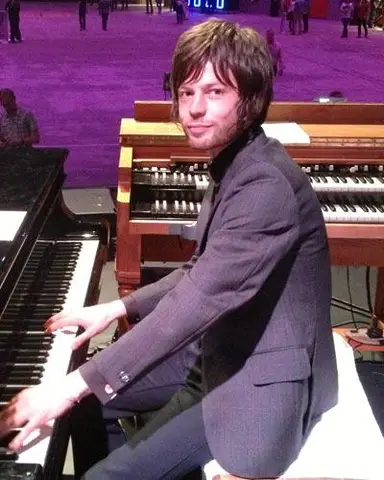
Lesson time: (8min 21sec)
Joe Glossop détaille comment jouer 'Green Onions' de Booker T à l'orgue Hammond, en commençant par le motif de main gauche qui donne son swing au groove.
Course preview
This lesson is part of the course Joue de l'orgue Hammond de façon authentique
Watch a preview of the full course below.
Lesson transcript:
Music Lesson: Green Onions
Introduction
So, green onions, how do we play it? Let's get started with that. The main hook, the main theme is actually led by the left hand. And that's the important thing to get it feeling right.
If you try and lead with the right hand, it just doesn't swing. So at speed, that's how it works.
Left Hand Technique
- Slow It Down: Your thumb is leading this, and you're basically going in the left hand and in the right hand put together, and there it is on the 1.
Transitioning to the 4 Chord
- Fourth Chord: When you go to the 4 (B flat), because we're in the key of F, it doesn't actually play.
- Pattern Change: The bass line is basically the same, but there's no skip. The right hand isn't doing the same thing; it's just moved up, which a lot of people get wrong.
Tip: I think with this tune, it's not that consistent. It kind of changes a bit. He was probably just vibing it on the day, whatever he felt like doing.
Key Changes
- B Flat: So when you move up to the B flat, it's something more like the same up to the C. Now you're very close together here.
Sticky Note: I'm slipping off the F sharp there. The left hand is kind of picking up that little skip. So you don't need to try and put that in with the right hand. Just importantly get that sound.
Main Head Riff
So that's your main head riff there. That's the famous sound, the famous tone. And that's the part.
Musical Structure
With this tune, we're in the key of F. It's a kind of bluesy thing. You can use your blues scale on there. You're walking up, kind of using the minor third.
- Blues Characteristics: It has that kind of bluesy minor thing going on, but it's not completely minor or major. That's kind of the blues, really.
Left Hand Bass Line
The thing you need to get going is the kind of skippy bass line. So you're using your:
- One
- Minor Third
- Four
- Five
Practice Tip: Play really slow.
Right Hand Breakdown
Now, let's look at the right hand on its own:
-
Bluesy Feel: It's kind of bluesy, broken parts of chords. You could think of that as the top of an F7.
-
Chords: You may have 5 and 7 there, and maybe part of a B flat chord (you got 1 and 3 there).
Up to Speed: Together, more up to speed.
Transitioning to B Flat
As you move up to the 4 chord (B flat):
- Bass Line Consistency: Because we're in the key of F, same bass line, but without the skip.
Notation: We're not going as we did on the one; we're just going.
Feel and Variation
-
D Flat and E Flat: In the right hand, we're not actually doing the same thing as we did on the one, there's a slight variation.
-
Common Mistake: A lot of people play just the same thing three times for every chord. That's not really what I did on the record.
Slow It Down: It's kind of a feel thing. You've got to try and catch that swing.
- Emphasis on Intention: It has kind of just a hint at that last. It's not all definite.
Challenges and Tips
-
Vocalizing: Very difficult to vocalize what I mean, but if you listen closely, you'll understand.
-
Five Chord Interference: On the five, you're very close in together. The bass line's kind of interfering with your right hand a bit.
Final Notes
- Bluesy Slip: There's a little bluesy slip off the F there.
Summary: So, obviously we got E flat, F. So, yeah, there you have it, the whole thing.
Next Steps
So let's move on to the lead lines.
About the instructor
Joe Glossop est un claviériste de Sheffield qui s'est fait un nom à l'orgue Hammond. Il occupe actuellement le poste d'organiste dans le groupe de tournée de Tom Jones, et a joué avec Van Morrison et James Hunter, ainsi qu'au piano et au Rhodes. Ses cours permettent de tirer le véritable son Hammond de n'importe quel clavier : le réglage des drawbars, le Leslie, la basse walking à la main gauche, et le vocabulaire d'accompagnement et de solo des traditions de l'orgue soul-jazz, blues et rock, de Jimmy Smith à Booker T. read more