



Fonctionnement du Hammond C3
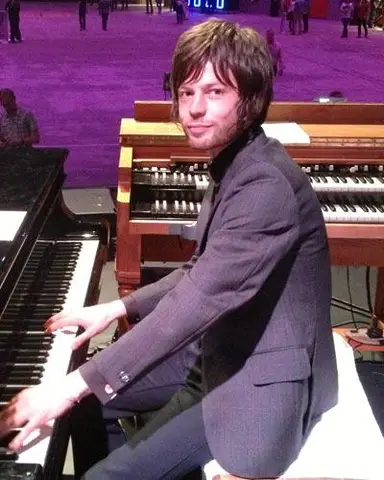
Lesson time: (6min 22sec)
Course preview
This lesson is part of the course Joue de l'orgue Hammond de façon authentique
Watch a preview of the full course below.
Lesson transcript:
Turning On a Hammond C3 Organ
So this is how to turn on a Hammond organ, C3. It's quite a unique process and involves very old technology.
Starting the Organ
-
Starter Motor:
- First, the starter motor has to go on.
- Hear that speeding up?
- Hold that for around 10 seconds or so.
- The tone generator needs a bit of a kick to get going.
- That's what the starter motor does.
-
Flipping to Run:
- When we flip to Run, the whole thing comes to life.
- You can see the Leslie spinning because the organ is sending power down that cable into the speaker.
- Now we can let go.
Turning the organ on achieved!
Organ Keyboards and Manuals
Now, let's come around to the other side.
- On an organ, there are two keyboards.
- If you're a piano player, you'd be familiar with just one.
- With the organ, we call these manuals:
- Top manual
- Bottom manual
Preset Settings
- The presets here look like keys, but they're not.
- They simply select sounds that are pre-programmed in drawbar settings with a different sound on each one.
- These presets are rarely used by most organ players.
Always use:
- BB
- B
These select the drawbars. Although these presets look like keys, they have nothing to do with keys; they don't make a sound by themselves, they're just buttons.
Basic Controls of the C3
The basic controls of a C3:
- Tone Generation: Your tone is created by these drawbars.
- There may seem to be a lot of them right up here, but you actually have four sets of the same thing:
- Two for each manual.
- For example, when you select the B flat preset, you're operating on the first set of drawbars.
- There may seem to be a lot of them right up here, but you actually have four sets of the same thing:
Drawbar Operation
- As you pull them out, that's where your tones come from.
- It's really as simple as that with two sets for each manual:
- Bottom B flat
- Bottom B
Vibrato Controls
Here we have some controls for the vibrato, which adds a vibrato effect to the sound you're using:
- Straight Sound: No vibrato.
- Activated Vibrato:
- You've got a lot of different kinds:
- Chorus vibrato
- Straight vibrato
Commonly Used Setting: C3 vibrato at about 2 o'clock on the switch (Chorus 3).
Note: This has nothing to do with Model C3.
Volume Control
- The switch here is purely for the volume of the whole instrument.
Percussion Settings
- Over here we have percussion settings.
- This adds a bit of an attacky bite to the top of the note.
- You can hear that:
- On, off, on.
Note: You can only use percussion on this set of drawbars in this manual.
- Generally, you reserve this set for your percussion sounds.
- Types of Percussion:
- Third Harmonic: The higher type.
- Second Harmonic: Sounds a bit more woody and rounded.
Both work well in different scenarios, and that's basically it for the interface.
Additional Features
Swell Pedal
- Down here, we have a swell pedal.
- This affects both the volume and changes the tone as you push it in (we're using a valve amplifier).
- You have a lot of expression from open to closed.
Drawbars and Volume
- Keep in mind that the drawbars also affect the volume.
- It's often a compromise; if you change the drawbar setting while keeping the same volume, you'll have to adjust the swell.
Leslie Speaker Control
-
Down here, we have a half-moon switch which controls the speed of the Leslie speaker.
- Two speeds noted: chorale and tremolo (slow and fast).
-
Foot Switch:
- This might be called a brake switch, and it stops the motors entirely, keeping them completely stationary.
- You can see if I press it, they go back to fast again, back to completely stationary.
- This might be called a brake switch, and it stops the motors entirely, keeping them completely stationary.
Note: The bottom rotor takes a lot longer to speed up and slow down, which adds to the organ sound.
Conclusion
So that's your workings, basically. That's how the Hammond C3 organ functions!
About the instructor
Joe Glossop est un claviériste de Sheffield qui s'est fait un nom à l'orgue Hammond. Il occupe actuellement le poste d'organiste dans le groupe de tournée de Tom Jones, et a joué avec Van Morrison et James Hunter, ainsi qu'au piano et au Rhodes. Ses cours permettent de tirer le véritable son Hammond de n'importe quel clavier : le réglage des drawbars, le Leslie, la basse walking à la main gauche, et le vocabulaire d'accompagnement et de solo des traditions de l'orgue soul-jazz, blues et rock, de Jimmy Smith à Booker T. read more