



Introduction to Modes
Lesson time: (6min 9sec)
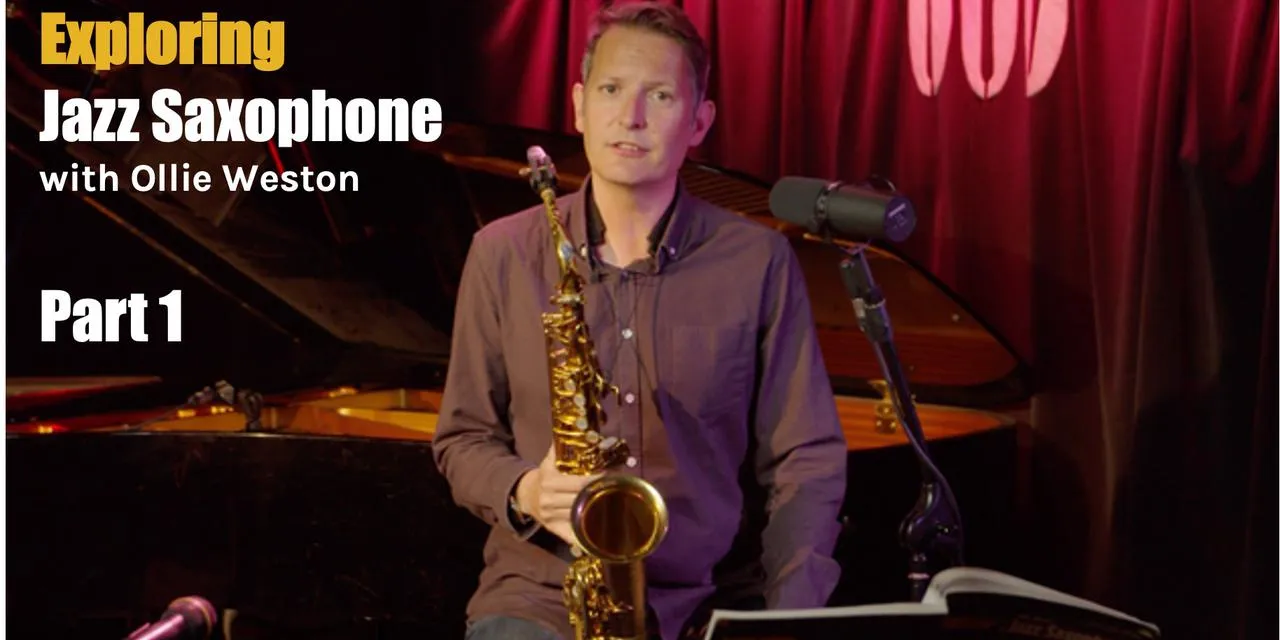
Ollie Weston builds the modes of the C major scale and the seventh chords that come from each one, the groundwork for jazz improvisation.
Course preview
This lesson is part of the course Exploring Jazz Saxophone: Part 1 - Getting Started
Watch a preview of the full course below.
Lesson transcript:
The Modes of the Major Scale
In this lesson, we will build a set of scales and chords that will provide you with more variety and be incredibly useful for your improvisation. This knowledge will enable you to build sequences and understand how chords relate to each other.
Understanding C Major Modes
We are going to learn the modes of C major. The good news is that you won't need any sharps or flats in these scales; they all follow the key signature of C major.
1. C Major Scale
Let's start off with the familiar C major scale. So far, so familiar, hopefully.
- Major 7 Chord (C): I will take my root, third, fifth, and seventh to build a major 7 chord from C.
2. D Dorian
For my second mode, I'll shift the context and start on D this time. I will still play, as it were, on a piano, all the white notes. So, no sharps or flats.
- Playing from D to D: I'll again use my root, third, fifth, and seventh chord tones.
- The Dorian scale is a great fit for a minor seventh chord.
- Although I'm playing notes derived from C major, this scale has a distinct minor tonality.
3. E Phrygian
If I then play my C major scale starting on an E, I get a different scale again.
- Playing from E to E: Again, this doesn't sound like C major either because I've shifted the starting point to E.
- It maintains the minor tonality with E, G (minor third), B (fifth), D (seventh).
- This mode is called the Phrygian mode and is sometimes referred to as the Spanish mode.
- You might hear it in the music of Chick Corea and Miles Davis's "Flamenco Sketches."
4. F Lydian
If I shift my starting point to F but still play with the C major key signature, I get what's called a Lydian scale.
- Playing from F to F: This scale definitely has a major sound.
- It differs from the A major scale by having a sharpened 4th or a sharpened 11th.
- You might recognize this theme, as the Lydian mode has a bright, quirky sound.
5. G Mixolydian
Next, if I play my C major from G to G, we explore the Mixolydian mode.
- Playing from G to G: This is another scale we've studied before.
6. A Aeolian
From the 6th, I'm going to play from A to A.
- Playing from A to A: This is another minor 7 chord with a slightly different character from Dorian, and it's called the Aeolian mode.
7. B Locrian
Finally, the last of our set of major scale modes runs from B to B, and it is the darkest and most minor of all the scales; this is called the Locrian mode.
- Playing from B to B: Its guide tones, chord tones are root, third, and it has a flattened fifth, similar to the blues, and a seventh.
- This scale can be challenging to use as a melodic source, but the Locrian type minor 7 chord does come in very useful, as we'll discover later on.
Summary
From playing without any sharps or flats, I've created a palette of seven different types of chords.
These modes, as the name suggests, have been around much longer than jazz. They are widely used by jazz musicians, but the Greek names, Dorian, Locrian, Mixolydian, and Phrygian, suggest a rich history in music. Modes are also present in medieval church music, with Gregorian chant often based on modal scales.
About the instructor
Since graduating from the Leeds College of Music (BA Hons) and the Guildhall School of Music (Post Graduate Diploma in Performance), Ollie has built a busy and varied career in music. As a saxophonist he has performed in live and studio settings with artists as diverse as Amy Winehouse, Tim Minchin, Bonobo, Frank Turner, the London Jazz Orchestra, the Hackney Colliery Band, the Ambient Jazz Ensemble and the Nelson Riddle Orchestra. He is also the co-leader of the jazz quartet 'Time Is Of The Essence', and composes and arranges material for this and other ensembles. Ollie is active in music education, currently as course leader for the jazz department at the Guildhall School of Music and Drama (junior school), where he runs jazz ensembles, big band and theory classes. He has written a series of 'Exploring Jazz' books for Schott Music that are published worldwide and feature on exam syllabuses in the UK. Ollie has also run workshops for Oxford University, Pro Corda Strings and BABSWE, as well as the Guildhall School of Music summer schools. In his Exploring Jazz Saxophone courses, Ollie takes you from getting started right through to soloing confidently over songs and chord sequences, building the improvising skills that put a real jazz player's vocabulary at your fingertips. read more