



Minor Pentatonic Patterns

With
Ollie WestonOllie Weston shows how to use minor pentatonic patterns over minor seventh chords, drawing on the link between a major scale and its relative minor.
What's in the course
51 lessons (2h 9m) · 1 free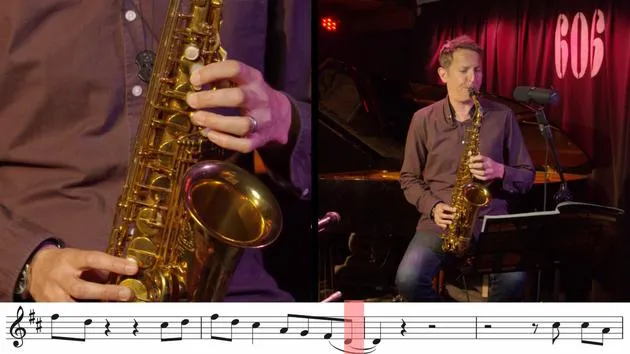
01. Introduction + leaving town demonstration
Free lesson3:02
02. The Blues Scale
2:48
03. Swing Quavers
1:42
04. Combing the Blues Scale and Swing Quavers
3:57
05. Playing through the Blues form using root notes
1:18
06. Writes Your Own Blues
0:59
07. Leaving Town Blues - Improvise
4:13
08. Improvisation recap
0:49
01. Introduction to Minor 7th Chords
3:32
02. Dorian Scale Workout
1:40
03. Minor 7th Chord Lick
2:22
04. Minor Pentatonic Patterns
You are here3:51
05. Minor Pentatonic Workout
1:52
06. Pentatonic vs Blues Scale
1:59
07. So Far so Good - Introduction
1:09
08. So Far so Good - Head
1:37
09. Minor Chord Extensions
2:45
10. Rhythmic Ideas
2:13
11. So Far so Good - Performance with Solo
3:50
01. Introduction to Modes
6:09
02. Diatonic Modes Exercise
4:04
03. Modes with a Static Root
1:58
04. Modes with Static Root Exercise
1:06
05. Modes with Static Root Recap
0:34
06. Phrase Exercise for Modes
1:07
07. Phrase Exercise for Modes (Demonstration)
1:29
08. Song Examples
1:56
09. First Impresssions - Chords and Harmony
4:06
10. First Impresssions - Performance
4:06
11. First Impresssions - Introduction and Analysis
3:30
Lesson transcript
Expanding Your Vocabulary with Minor Seventh Chords
Another way to expand your vocabulary over minor seventh chords is to use a minor pentatonic scale.
Review of Major Pentatonic Scale
We've used major pentatonics in an earlier lesson and we had a pitch map, didn't we?
- 1, 2, 3, 5, and 6.
This was a really useful way to create these pentatonic melodies.
Transitioning to Minor Pentatonic Scale
The good news is that if you've learned your major pentatonic, you've also learned a minor pentatonic.
- In this case, G major shares a key signature with E minor.
If I play my G major pentatonic over a G major chord, it sounds like this:
Instead of starting on G on the 1, I'm actually going to start on 6 on E. The piano will play in the bass on E and it will sound like this:
- I've changed the context of the notes.
- I've transitioned from being in A major key to the relative minor key.
Changing Tonality
The relationship between G and E instantly changes the tonality of my music. I'm playing the same five notes of the pentatonic, but in a completely different sound world.
If I do that again, I think you'll agree it doesn't sound like G major.
Here it is again with the piano.
Understanding the Pentatonic Scale
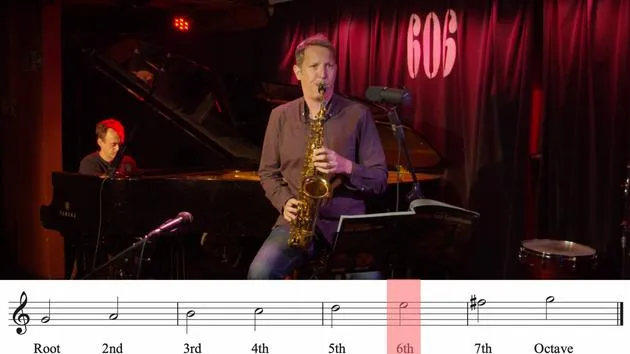
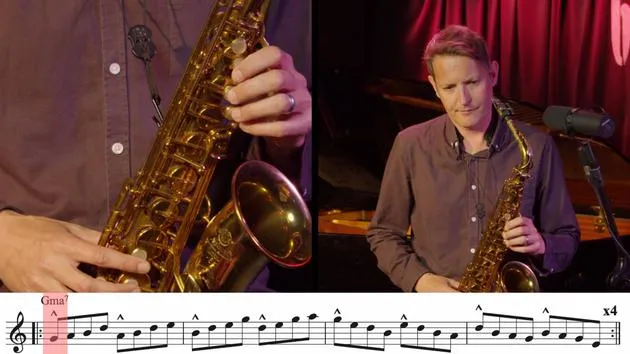
If you look at Figure 3.7, I've written out the five notes of the pentatonic.
- On the top, I've numbered them as they would be in G major: 1, 2, 3, 5, 6.
- Along the bottom, they're numbered as they would appear in E minor:
- 6 (E being 1)
- G being flat 3
- A being 4
- B being 5
- D being 7, and back to E.
This is a different construction of the scale, but those patterns that you learned will work really well over an E minor chord.
Practicing Pentatonic Patterns
Here are some of those patterns over the piano.
Again, using your minor workout backing tracks, you can practice your pentatonic patterns.
- All the phrases that you learn in a major key are very easy to transfer to the minor.
Tips for Practice
- You've got your groups of four.
- You've got some rhythmic ideas.
All these will really help you capture the sound of the minor seventh chord and how to solo effectively over it in jazz.
51 lessons
2h 9m of structured video lessons
Advanced video features
Slow down, loop a passage, follow along
Mobile, tablet & desktop
Practise wherever you are
100% satisfaction guarantee
30-day money-back guarantee
Meet your guru
Meet your guru
Since graduating from the Leeds College of Music (BA Hons) and the Guildhall School of Music (Post Graduate Diploma in Performance), Ollie has built a busy and varied career in music. As a saxophonist he has performed in live and studio settings with artists as diverse as Amy Winehouse, Tim Minchin, Bonobo, Frank Turner, the London Jazz Orchestra, the Hackney Colliery Band, the Ambient Jazz Ensemble and the Nelson Riddle Orchestra. He is also the co-leader of the jazz quartet 'Time Is Of The Essence', and composes and arranges material for this and other ensembles.
Ollie is active in music education, currently as course leader for the jazz department at the Guildhall School of Music and Drama (junior school), where he runs jazz ensembles, big band and theory classes. He has written a series of 'Exploring Jazz' books for Schott Music that are published worldwide and feature on exam syllabuses in the UK. Ollie has also run workshops for Oxford University, Pro Corda Strings and BABSWE, as well as the Guildhall School of Music summer schools.
In his Exploring Jazz Saxophone courses, Ollie takes you from getting started right through to soloing confidently over songs and chord sequences, building the improvising skills that put a real jazz player's vocabulary at your fingertips.







