



Enregistrer une piste guide rythmique simple
Lesson time: (7min 41sec)
Course preview
This lesson is part of the course Composition et production créatives dans Ableton Live
Watch a preview of the full course below.
Lesson transcript:
Setting Up Your Rhythm Track
Okay, so now I know the MIDI works. Before I start jamming in some ideas and figuring out how I'm going to go about making a track here, I'm going to lay down a simple rhythm track. This might not be something that I'll actually end up using, but it will be a good guide for getting something down.
Using the Drum Machine
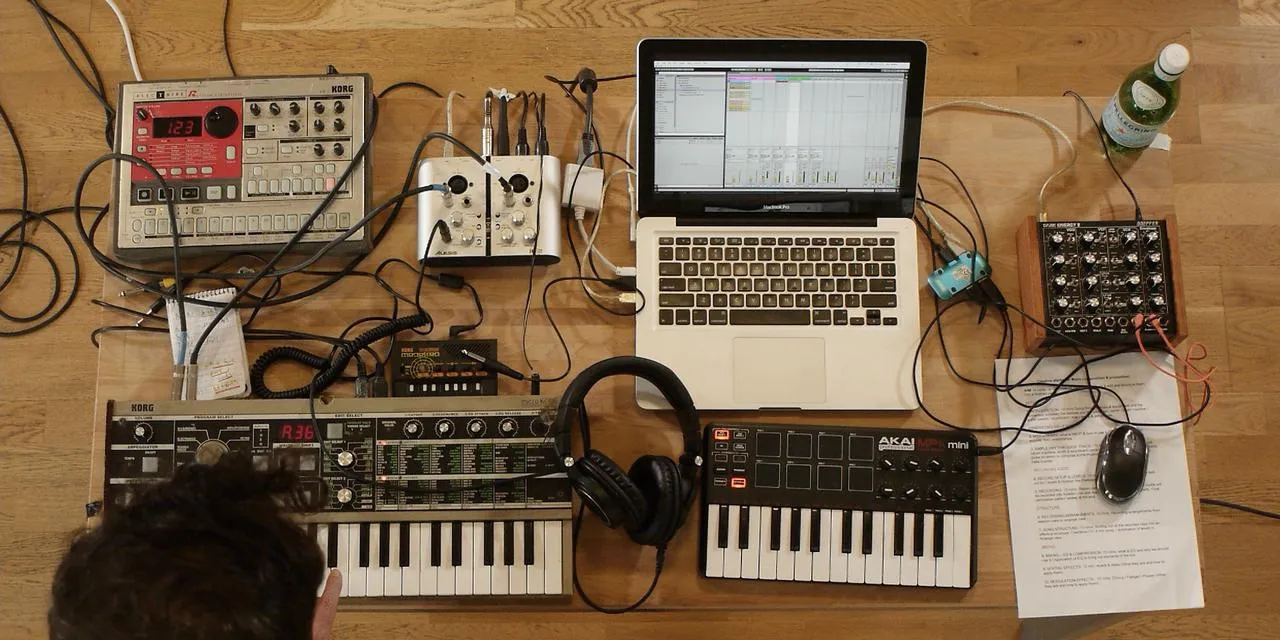
So, I'm going back over to the drum machine. Again, I'm just taking the left and right outputs here, coming into the left and right inputs on my sound card.
What I'm going to do here is:
- Grab a pattern that I've already created on the Electribe.
- Strip it down to its bare elements.
- Record it in.
Then, I can jam with the MIDI here, maybe adding in this synth, the bass synth, and try to get something down.
Playing the Pattern
So, I'm going to play it.
You can see the audio is coming in here. There's no MIDI at the moment because we're not connected up. Inside this particular drum machine is a pattern that moves on every 16th note. I've programmed in some beats here.
Now, obviously, you could use any drum machine for this purpose. What I'm trying to illustrate is to:
- Use a pattern.
- Match the tempo with the tempo that you've got set up in your project.
If you haven't already got anything down yet and you've tested your MIDI, everything works.
Establish a Tempo
I've got here set up at the moment, 123 beats per minute. Every drum machine will have a tempo with its patterns. I'm just going to set the tempo so that it matches the same tempo as in Ableton.
So, I've matched the tempo. Now we're at 123 beats per minute, and Ableton is also at 123 beats per minute.
Simplifying the Drum Pattern
The drum pattern is coming in, but it's very busy, and I'm not necessarily going to use this particular drum track. So, I'm going to strip it down a bit to create a nice, simple guide rhythm to work with.
What I'm going to do now is:
- Mute some of the sounds within this pattern.
- Click on the various different sounds here.
I'm going to take this hi-hat away and this little hi-hat, and for now, we just have a kick drum and a tom sound.
Basic Beat
So, we have a basic kind of four-to-the-floor beat. Again, I might not use it, but it's a little better than working to a metronome.
Preparing to Record
Now, I need to arm the track that I'd like to record the drum pattern into.
- I need an audio track like I've got here as a little pointer.
- It's always worth labeling your tracks before you start any recordings.
That way, the recordings, whether they're MIDI or audio, will have the right name attached to them. So, it's labeled as "Korg Electribe."
I'm going to click Arm, and there's our beat, so the tempo is matched.
Starting the Recording
I'm going to turn on the metronome here, and I have it set at two bars. After eight counts, the recording will begin.
So, let's just start recording. Maybe I'll turn this down a little bit here.
Jamming the Pattern
What I was doing there is just jamming the play button to record that pattern in. The chances are you won't get it bang on, I certainly didn't just then.
What we need to do is open up the audio here and set a start point where we're grabbing the first beat of the recording. Once we've established where that is and got that synced up, it will seamlessly run because it's set to the same tempo, if you remember, in Ableton.
Syncing Up
The Electribe tempo is set to the same tempo as Ableton. So, what I'm going to do is:
- Double-click the audio.
- Zoom in.
- Come to the front of the audio.
You can see here is where the first beat comes in. There's actually a little gap, so I was a little bit late just jamming that in. I want to move my start point to that first beat. Ableton is very good at determining where that position should be.
Final Adjustments
So, effectively, all I need to do here is move the markers and play the beat to double-check.
Once I do that, it sounds like that's matched pretty well. Rather than having to set up a MIDI track, it's very easy just to record in a pattern as audio.
I've stripped it down, so it's very easy to add some more percussion. Maybe I won't end up using it; who knows? But it serves as a good guide track for me to get going with some music.
Looping the Track
Now, I'm going to loop it here, and what I essentially want is two bars, so I've got four beats to a bar. Each beat is highlighted in this darker gray color.
Adjusting the Audio Timing
Now, I'm glad that happened, actually. This drum machine has gone a little bit out, probably because it's a little old and knackered, but these things happen.
What I want to do now is add some hit points to pull this audio back in so that it loops properly.
Let's come and grab a few of these hit points. I can see that this one is slightly off the grid, so I'm just going to move this in. That one looks okay, and let's try it again.
Okay, that section seems to work well. Maybe we'll extend it a little bit.
Conclusion
Okay, good, so that's working well. I'm going to take off my metronome now. This is just going to carry on looping as and when I need it.
Now, I'm going to start to record in some ideas here.
About the instructor
Après un stage auprès de Dave Allen, producteur de Depeche Mode et The Cure, John a eu envie d'étudier la Music Technology à Londres. Sa carrière musicale a décollé après une signature réussie chez CookShop Records, où il a sorti 9 singles et un album en 2007 salué par Q, Uncut et Lowdown Magazine, en plus d'être diffusé sur XFM et Radio One. John a commencé à se former comme ingénieur du son au studio Bonafide en 2005, où il a affiné son talent, avant de fonder Jackdaw Recordings plus tard la même année. Il a collaboré avec de nombreux artistes à succès et, en 2007, a commencé à jouer pour le musicien pop Patrick Wolf, se produisant dans des salles de premier plan au Royaume-Uni et à l'international — dont The Astoria et le Shepherds Bush Empire. Depuis son studio londonien, John compose désormais de la musique, avec deux autres sorties chez CookShop, assure l'ingénierie du son pour des artistes en vue et conçoit le design sonore de publicités télévisées, de films, de pièces de théâtre et de vidéos d'entreprise. Ce mélange rare d'auteur-compositeur, de producteur et d'ingénieur de studio en activité est précisément ce que John apporte à son enseignement. Dans Creative Composition & Production in Ableton Live et Creative Sampling & Production in Ableton Live, il te montre comment il transforme des idées brutes en morceaux finis, prêts à sortir — l'écriture, le sampling, le design sonore et le savoir-faire concret de l'ingénierie derrière un disque professionnel. read more