



Accords et sauts
Lesson time: (8min 37sec)
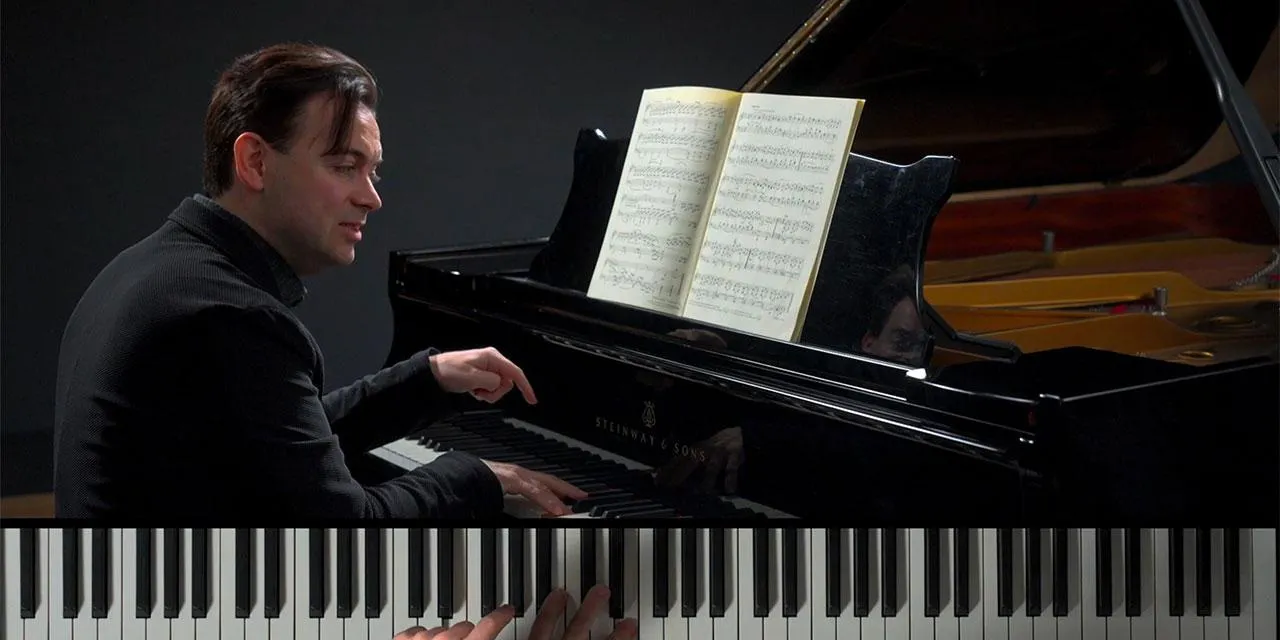
Dans cette vidéo, apprends à jouer les accords répétés des deux mains, au piano, en forte, et en « crescendo », accompagnés de sauts plus larges des deux mains.
Course preview
This lesson is part of the course Maîtrise la Sonate au clair de lune de Beethoven : mouvements I, II et III
Watch a preview of the full course below.
Lesson transcript:
Moonlight Sonata: Exploring the Third Movement
Hello, everyone!
So let's talk about another feature this great third movement of the Moonlight Sonata has to offer.
Recap of Previous Features
- We discussed the broken arpeggio right at the beginning.
- We covered the Alberti bass, in both right hand and left hand.
Dynamic Changes in Bar 43
Now, in Bar 43, there's another feature:
- Beethoven indicates FFF (forte fortissimo) four times.
- See the indications in Bars 41 and 42? He emphasizes four times forte for all these harmonic changes.
This is crucial!
Importance of the Urtext Edition
- It's essential to have the urtext edition, where these features stand out.
- Beethoven clearly wanted a forte and attack on every single harmonic change.
Alberti Bass and Dissonance
In the left hand, we can see:
- We have the Alberti bass repeating again and again, but with a twist.
- There's a bit of dissonance right there that we should emphasize.
Practicing Chords and Jumps
Now, we come to the jumps:
- These chords and jumps in the piano are not that big, but then we have crescendo.
- This is the biggest leap.
For this incredible dominant knife:
- We need not only space, but sometimes even time.
- We really need to hit it properly.
Practice just this:
- Stall, and then do it again.
Music First
This is very important. With all great music, I always say:
- Music first and not the technical difficulty.
- Sometimes a passage doesn't work for a musical reason.
Once you truly feel this incredible harmony, practicing and analyzing these turns become much more enjoyable.
Exploring Discoveries
You'll have incredible fun when you start exploring.
- For instance, we don't have this E until later; it comes here with the seventh and the ninth.
- There's joy in discovering and exploring, transforming it from mere practice into music-making.
Similar Cases Later in the Piece
We have a similar case later in the piece after we had our four fortes.
- We then move to C sharp minor.
- Here, the piano stays, and there is no crescendo, unlike the first time.
Practice Slowly
Practice it really slowly:
- Focus on this jump.
- It's different here, and you might want more declamato, more freedom.
Predictable Patterns
However, there's no crescendo, and there's no discord, only sevenths.
- Beethoven introduces the non-chord right at the beginning, but later on, he doesn't use it as we might expect.
Understanding Neapolitan Chords
Consider this famous Neapolitan chord:
- We encountered it in the first movement several times.
- In Fortissimo during Bar 33, we see it against Forzanti.
Left Hand Rhythmic Figure
This is the first fortissimo in the piece and follows the Alberti bass again with the Neapolitan.
- Pay attention to the rhythmic figure in the left hand.
Changes Over Time
The next time it appears in Bar 128, we notice:
- The Neapolitan is different; this is not a mistake.
- It's a slight change that brings a whole new world of expressivity to the passage.
Syncopated Rhythm Comparison
After that, we have another Neapolitan.
- If you compare it to the first instance, the syncopated rhythm in the left hand occurs earlier.
- The repetition in the first instance spans two bars, but here it's shorter, only one bar, making it more compressed and faster.
Conclusion
This is one of many reasons why Beethoven is such a great composer, if not the greatest of all.
I wish you luck practicing this great piece, and I'll see you in the next lesson where we'll delve into the coda, arpeggi, and the amazing ending over the last two pages of this piece.
See you there!
About the instructor
Les interprétations neuves du répertoire par Dejan Lazić l'ont imposé comme l'un des solistes les plus singuliers et les plus inhabituels de sa génération. Il se produit régulièrement avec les plus grands orchestres du monde, notamment les orchestres symphoniques de Boston et de Chicago, le Budapest Festival Orchestra, le Royal Concertgebouw Orchestra, le London Philharmonic, le Philharmonia Orchestra, le NDR Elbphilharmonie Orchester, ainsi que les orchestres de chambre d'Australie, de Bâle et des Pays-Bas, et il a noué d'étroites collaborations avec des chefs tels que Giovanni Antonini, Iván Fischer, Michael Francis, Andris Nelsons, Ivan Repušić, Thomas Søndergård, Robert Spano, John Storgårds, Krzysztof Urbański et Jan Willem de Vriend. Dejan Lazić a publié de nombreux CD chez Channel Classics et Onyx Classics, ainsi qu'un enregistrement du Triple Concerto de Beethoven pour Sony Classical. Son enregistrement en direct du Concerto pour piano n° 2 de Rachmaninov avec le London Philharmonic Orchestra et Kirill Petrenko a reçu le prix allemand "Echo Klassik". Il jouit également d'un large public en Extrême-Orient et déploie une intense activité de récitaliste et de chambriste, se produisant régulièrement dans de grands festivals internationaux. Les compositions de Dejan Lazić reçoivent une reconnaissance croissante, et il a été engagé comme compositeur par le groupe d'édition Sikorski Music Publishing en 2015. Son arrangement du Concerto pour violon de Brahms en Concerto pour piano "n° 3" a été créé et enregistré avec l'Atlanta Symphony Orchestra et Robert Spano en 2009 et connaît depuis un grand succès continu, aux BBC Proms, au Concertgebouw d'Amsterdam, au Festival de Pâques de Hambourg et au Festival Chopin de Varsovie, sur les deux continents américains et au Japon. Son Concerto pour piano dans le style istrien (Op. 18) a été créé à l'Aspen Music Festival en 2014 et a depuis été joué dans toute l'Europe et aux États-Unis. Parmi ses autres œuvres figurent diverses pièces orchestrales, de chambre et pour piano, des cadences, ainsi que plusieurs arrangements d'œuvres de Mozart, Schubert, R. Strauss, Wagner et Debussy. Dejan Lazić est né à Zagreb, en Croatie, dans une famille de musiciens. Il a grandi à Salzbourg, en Autriche, où il a étudié au Mozarteum (piano, clarinette et composition). Ses premières rencontres avec Zoltán Kocsis et Imre Rohmann au Festival Bartók de Hongrie ont été décisives pour sa carrière artistique, tout comme l'influence considérable de Peter Eötvös. Dejan Lazić vit à Amsterdam. Dans Master Moonlight Sonata by Beethoven, Dejan partage la réflexion qui sous-tend ces interprétations acclamées, te guidant à travers les trois mouvements de l'une des œuvres les plus aimées du répertoire pianistique afin que tu puisses la façonner avec une véritable compréhension plutôt que par imitation. www.dejanlazic.com read more