



Pédale et équilibre des trois éléments principaux

Lesson time: (5min 27sec)
Apprends à utiliser correctement la pédale (pratiques historiques vs harmoniques). Découvre aussi comment Dejan équilibre la basse, les triolets et la mélodie : trois éléments dans deux mains.
Course preview
This lesson is part of the course Maîtrise la Sonate au clair de lune de Beethoven : mouvements I, II et III
Watch a preview of the full course below.
Lesson transcript:
Welcome Back to Our Course on Beethoven's Moonlight Sonata
In previous lessons, we've discussed:
- Sound production
- Structure and pace of the piece
- Three main features:
- The bass in the left hand
- The triplets in the right hand
- The famous motif, the melody in the right hand
The Role of Triplets
The triplets are often seen as accompaniment, but they are actually much more than that. One shouldn't take a passive approach towards them.
Exploring the Pedal
Before we dive into the world of pedal, it's important to note that there are many different views on how this piece should be performed and pedalized.
Beethoven's Pedal Marking
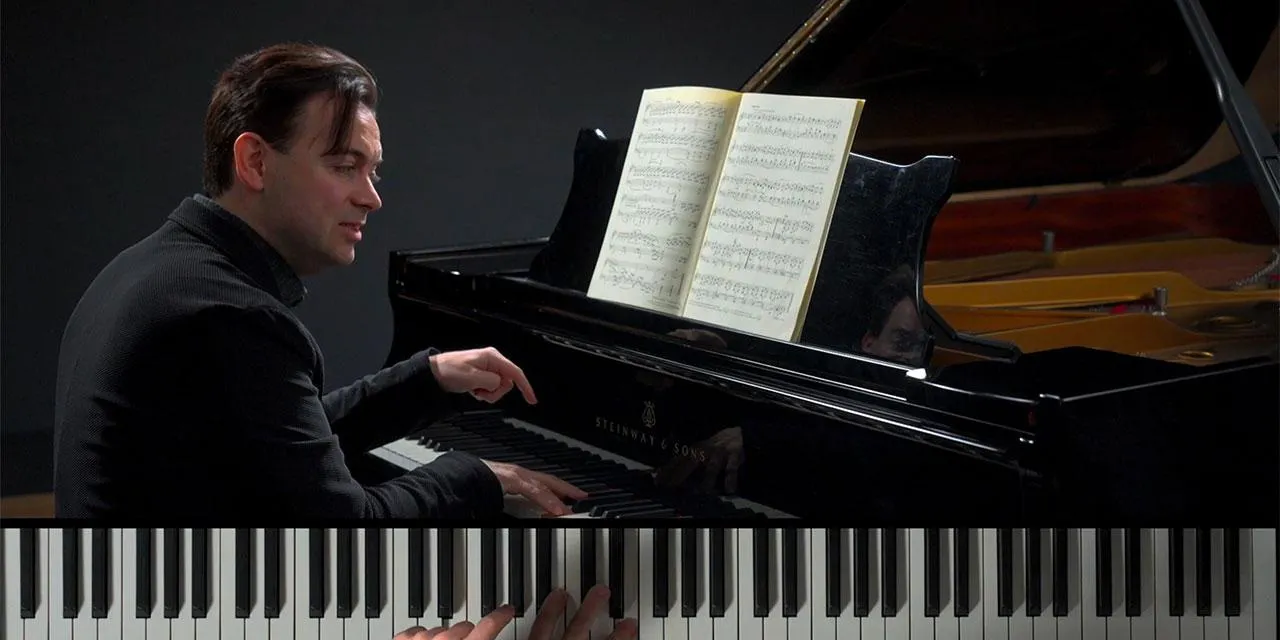
Beethoven's mark for the first movement instructs performers to use one sustained pedal throughout. On a modern instrument, like the Steinway we have here in Amsterdam tonight, sound production is much more robust.
- The piano is not only louder but also more massive than the instruments used in Beethoven's time when this sonata was written (i.e., 1801).
- The range is bigger, and the pedal catches those tones, allowing them to resonate for a much longer time.
The Concern for Pianists
This can be a worrying circumstance for many pianists. Let me show you how it sounds if I simply follow Beethoven's instruction and push down the pedal throughout the piece.
Although I won't play the whole movement, I will demonstrate the beginning:
[Plays the beginning of the movement]
Notice how those harmonies already clash, which can be interesting, but one might wonder, Is it too much?
Authentic Sound
I don't believe this is how Beethoven intended the piece to sound. Having played on a few instruments from Beethoven's time, I think we should respect his remarks from 220 years ago but also adapt them to our modern instruments to capture the essence of what he wanted.
Adapting the Pedal Technique
Half Pedaling
One approach is to change the pedal here and there, or to use half-pedaling.
- Half pedaling means that for certain chords, instead of changing the pedal entirely, you can lift and push down partially, creating a blend that isn't too clean.
For instance, consider this chord:
If I completely lift the pedal, it might sound too crisp.
Now, if I simply leave the pedal down, you would still distinctly hear the initial bass note, which may be too loud. Beethoven's original pianos did not sustain tones as long, allowing harmonies to dissolve more quickly.
Suggested Pedal Usage
What I propose, and this is not a new idea, is to manage the pedal in a way that is not overly explicit.
For example, when you encounter similar harmonies, such as:
- The notes G sharp, C sharp, and E in C sharp minor
- A subsequent change in the bass while the other notes remain the same
You could use the same pedal for these two harmonies, allowing for a smoother transition without needing to change the pedal constantly.
"This approach creates a more authentic sound that resonates more closely with what Beethoven intended."
About the instructor
Les interprétations neuves du répertoire par Dejan Lazić l'ont imposé comme l'un des solistes les plus singuliers et les plus inhabituels de sa génération. Il se produit régulièrement avec les plus grands orchestres du monde, notamment les orchestres symphoniques de Boston et de Chicago, le Budapest Festival Orchestra, le Royal Concertgebouw Orchestra, le London Philharmonic, le Philharmonia Orchestra, le NDR Elbphilharmonie Orchester, ainsi que les orchestres de chambre d'Australie, de Bâle et des Pays-Bas, et il a noué d'étroites collaborations avec des chefs tels que Giovanni Antonini, Iván Fischer, Michael Francis, Andris Nelsons, Ivan Repušić, Thomas Søndergård, Robert Spano, John Storgårds, Krzysztof Urbański et Jan Willem de Vriend. Dejan Lazić a publié de nombreux CD chez Channel Classics et Onyx Classics, ainsi qu'un enregistrement du Triple Concerto de Beethoven pour Sony Classical. Son enregistrement en direct du Concerto pour piano n° 2 de Rachmaninov avec le London Philharmonic Orchestra et Kirill Petrenko a reçu le prix allemand "Echo Klassik". Il jouit également d'un large public en Extrême-Orient et déploie une intense activité de récitaliste et de chambriste, se produisant régulièrement dans de grands festivals internationaux. Les compositions de Dejan Lazić reçoivent une reconnaissance croissante, et il a été engagé comme compositeur par le groupe d'édition Sikorski Music Publishing en 2015. Son arrangement du Concerto pour violon de Brahms en Concerto pour piano "n° 3" a été créé et enregistré avec l'Atlanta Symphony Orchestra et Robert Spano en 2009 et connaît depuis un grand succès continu, aux BBC Proms, au Concertgebouw d'Amsterdam, au Festival de Pâques de Hambourg et au Festival Chopin de Varsovie, sur les deux continents américains et au Japon. Son Concerto pour piano dans le style istrien (Op. 18) a été créé à l'Aspen Music Festival en 2014 et a depuis été joué dans toute l'Europe et aux États-Unis. Parmi ses autres œuvres figurent diverses pièces orchestrales, de chambre et pour piano, des cadences, ainsi que plusieurs arrangements d'œuvres de Mozart, Schubert, R. Strauss, Wagner et Debussy. Dejan Lazić est né à Zagreb, en Croatie, dans une famille de musiciens. Il a grandi à Salzbourg, en Autriche, où il a étudié au Mozarteum (piano, clarinette et composition). Ses premières rencontres avec Zoltán Kocsis et Imre Rohmann au Festival Bartók de Hongrie ont été décisives pour sa carrière artistique, tout comme l'influence considérable de Peter Eötvös. Dejan Lazić vit à Amsterdam. Dans Master Moonlight Sonata by Beethoven, Dejan partage la réflexion qui sous-tend ces interprétations acclamées, te guidant à travers les trois mouvements de l'une des œuvres les plus aimées du répertoire pianistique afin que tu puisses la façonner avec une véritable compréhension plutôt que par imitation. www.dejanlazic.com read more