



La production du son

Lesson time: (14min 3sec)
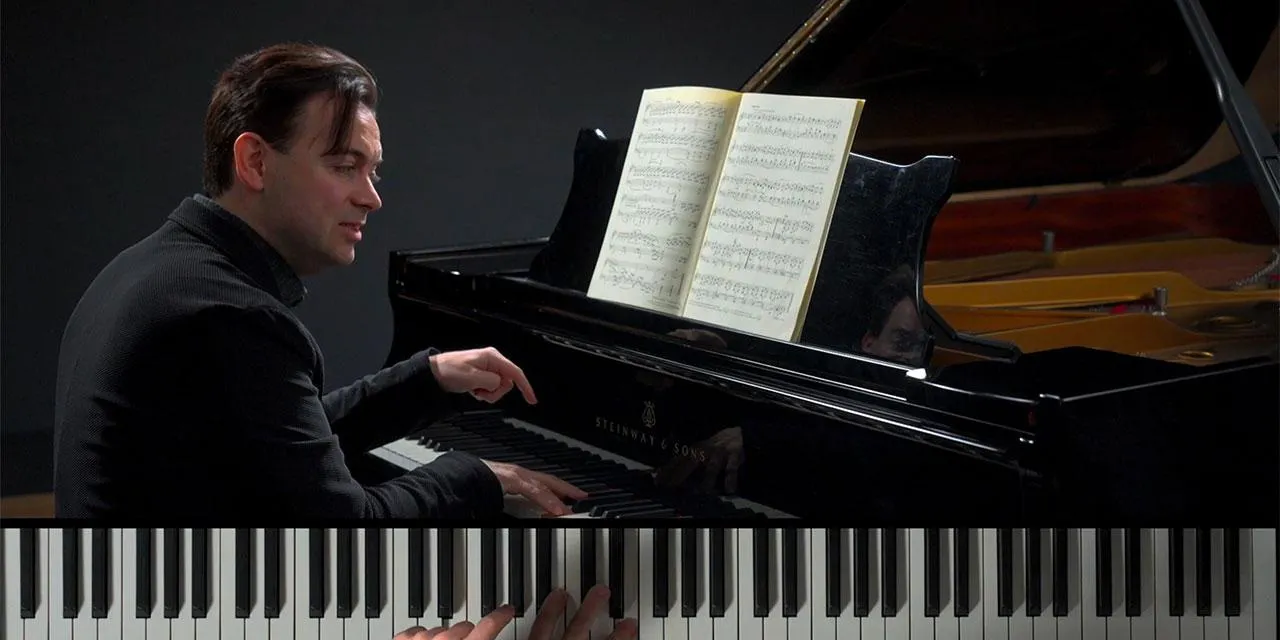
Dejan Lazić montre comment produire le son sempre pianissimo qu'exige le premier mouvement, en gardant le pouce léger, en jouant les triolets de façon régulière et en maîtrisant la pédale.
Course preview
This lesson is part of the course Maîtrise la Sonate au clair de lune de Beethoven : mouvements I, II et III
Watch a preview of the full course below.
Lesson transcript:
Beethoven's Moonlight Sonata: Opus 27, Number 2
Introduction
Hello, and welcome back to this course! Today, we will delve into Beethoven's famous Moonlight Sonata, Opus 27, Number 2.
This sonata is his 14th piano sonata and stands pretty much in the middle of his 32 sonatas, written in 1801.
First Movements and Sound Production
Sempre Pianissimo
Let's first talk about sound production.
- Beethoven's marking right at the beginning is sempre pianissimo, which means this whole movement should be played very, very quietly.
How can we achieve that?
Until bar five, where we introduce the famous motive in the right hand, we encounter:
- Triplets in the right hand
- Long bass notes in the left hand, also in pianissimo.
The piano can sound like an entire orchestra, with a great range from very soft to very loud and many different colors. Today, I would like to address how to achieve this pianissimo throughout the movement and also touch upon the topic of pedalization.
Right Hand Technique
First, let's talk about the right hand.
- It should be played very calmly.
Key Points:
- Pay attention to your thumb.
- Our hand is not ideally constructed for playing the piano, the fifth finger is short, and the thumb is poorly positioned.
When playing black keys with your thumb, you might have to turn your hand inwards.
The Thumb Challenges:
- Since we place our other fingers naturally, the thumb often ends up sounding too loud, so it must be tamed.
Concentrate on making the thumb flexible and avoiding false accents. Focus more on fingers 2 and 4 while keeping the thumb light.
Left Hand Considerations
Now, regarding the left hand:
- The bass notes can be quite loud, especially on a modern Steinway piano, which has a massive and robust sound.
It is crucial to maintain balance so the left hand doesn't overpower the piece. Pay special attention to:
- The thumb in the right hand and octave in the left hand should be played very gently.
Additionally, when playing black keys, remember that while you could theoretically use your second finger, the thumb is needed for the lower octave when the motive appears.
The Challenge of Dynamics
It's vital to recognize that:
- The fifth finger, often the weakest, plays important musical material.
- The strongest finger (the thumb) should be played the softest.
This is what makes the movement particularly difficult. When I learned this sonata as a child, I thought it was relatively easy. However, as I matured and explored the harmonic structure, phrasing, and pacing, I realized how deep this music truly is.
Starting in Bar Five
Let's begin in bar five.
- Be cautious with your left hand, and only emphasize the right hand's fifth finger clearly on the motive.
The last note in this motif, which lasts for three beats, should be sustained.
Image This:
- If you were a horn player or singer, you would sustain the note, but on the piano, the sound declines once the hammer hits the string.
To enhance the G sharp, consider:
- Playing the triplets a bit loudly to emphasize its presence and sustain the tone in the air.
Creativity in Performance
When it comes to sound production, it's a multidimensional aspect, including timing.
- I took a little time between the major triplets in E major, slowing down slightly.
Although this isn't specified in the music, remember that Beethoven's Sonata Quasi Una Fantasia suggests a free improvisation style. Adapt your performance based on how you feel in the moment, making each performance unique.
Phrasing and Structure
As we discuss phrasing, pay attention to Beethoven's notations:
- In bars 7 and 8, the right hand has a slur over two bars, while the left hand only covers one bar.
This means the right hand continues the phrase, creating a more prominent emphasis there.
Concluding Thoughts
Geniuses like Beethoven didn't make decisions lightly; there's intent behind every marking.
We'll explore the following in our next lesson:
- The reasoning behind the structure and markings in his works.
- More on sound production, timing, and phrasing.
I look forward to welcoming you back!
About the instructor
Les interprétations neuves du répertoire par Dejan Lazić l'ont imposé comme l'un des solistes les plus singuliers et les plus inhabituels de sa génération. Il se produit régulièrement avec les plus grands orchestres du monde, notamment les orchestres symphoniques de Boston et de Chicago, le Budapest Festival Orchestra, le Royal Concertgebouw Orchestra, le London Philharmonic, le Philharmonia Orchestra, le NDR Elbphilharmonie Orchester, ainsi que les orchestres de chambre d'Australie, de Bâle et des Pays-Bas, et il a noué d'étroites collaborations avec des chefs tels que Giovanni Antonini, Iván Fischer, Michael Francis, Andris Nelsons, Ivan Repušić, Thomas Søndergård, Robert Spano, John Storgårds, Krzysztof Urbański et Jan Willem de Vriend. Dejan Lazić a publié de nombreux CD chez Channel Classics et Onyx Classics, ainsi qu'un enregistrement du Triple Concerto de Beethoven pour Sony Classical. Son enregistrement en direct du Concerto pour piano n° 2 de Rachmaninov avec le London Philharmonic Orchestra et Kirill Petrenko a reçu le prix allemand "Echo Klassik". Il jouit également d'un large public en Extrême-Orient et déploie une intense activité de récitaliste et de chambriste, se produisant régulièrement dans de grands festivals internationaux. Les compositions de Dejan Lazić reçoivent une reconnaissance croissante, et il a été engagé comme compositeur par le groupe d'édition Sikorski Music Publishing en 2015. Son arrangement du Concerto pour violon de Brahms en Concerto pour piano "n° 3" a été créé et enregistré avec l'Atlanta Symphony Orchestra et Robert Spano en 2009 et connaît depuis un grand succès continu, aux BBC Proms, au Concertgebouw d'Amsterdam, au Festival de Pâques de Hambourg et au Festival Chopin de Varsovie, sur les deux continents américains et au Japon. Son Concerto pour piano dans le style istrien (Op. 18) a été créé à l'Aspen Music Festival en 2014 et a depuis été joué dans toute l'Europe et aux États-Unis. Parmi ses autres œuvres figurent diverses pièces orchestrales, de chambre et pour piano, des cadences, ainsi que plusieurs arrangements d'œuvres de Mozart, Schubert, R. Strauss, Wagner et Debussy. Dejan Lazić est né à Zagreb, en Croatie, dans une famille de musiciens. Il a grandi à Salzbourg, en Autriche, où il a étudié au Mozarteum (piano, clarinette et composition). Ses premières rencontres avec Zoltán Kocsis et Imre Rohmann au Festival Bartók de Hongrie ont été décisives pour sa carrière artistique, tout comme l'influence considérable de Peter Eötvös. Dejan Lazić vit à Amsterdam. Dans Master Moonlight Sonata by Beethoven, Dejan partage la réflexion qui sous-tend ces interprétations acclamées, te guidant à travers les trois mouvements de l'une des œuvres les plus aimées du répertoire pianistique afin que tu puisses la façonner avec une véritable compréhension plutôt que par imitation. www.dejanlazic.com read more