



Nuances et défis techniques

Lesson time: (14min 30sec)
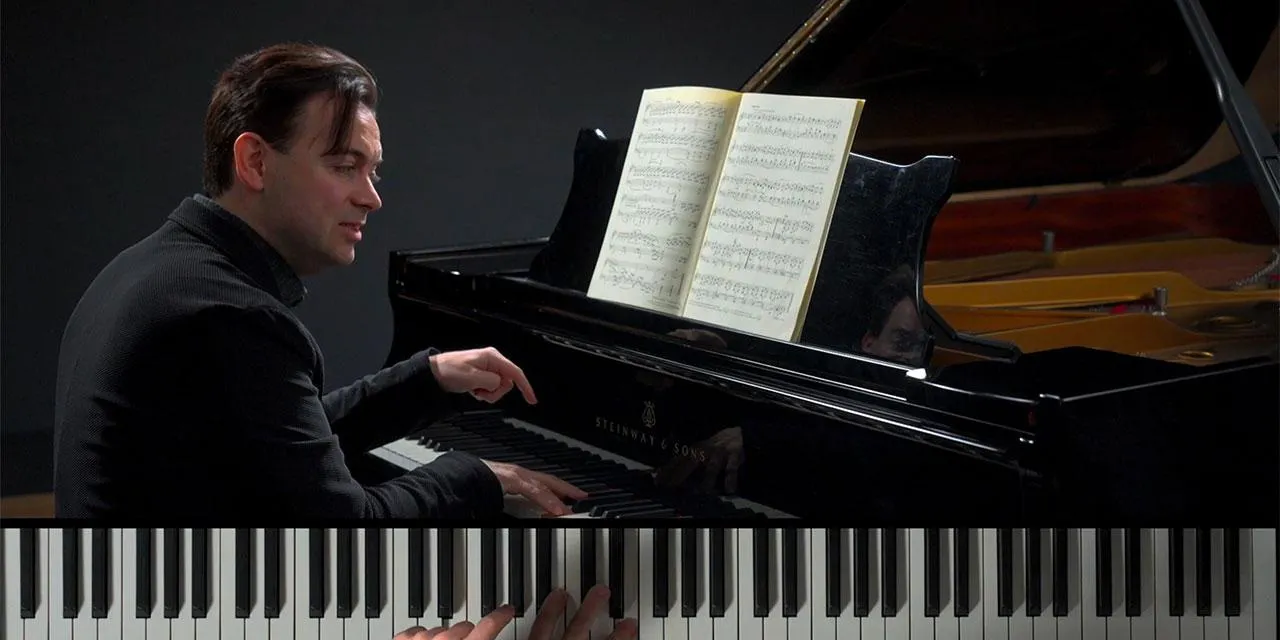
Dejan t'apprend à obtenir un “sempre pianissimo” & legato tout au long de ce mouvement, et à surmonter des défis techniques qui ne sont pas forcément virtuoses.
Course preview
This lesson is part of the course Maîtrise la Sonate au clair de lune de Beethoven : mouvements I, II et III
Watch a preview of the full course below.
Lesson transcript:
Proper Pedalization in Beethoven's First Movement
Introduction
Today, we will delve deeper into the topic of pedal usage in Beethoven's first movement. Beethoven clearly indicates that this piece should be played throughout with the pedal lying down. The term senza sordino means the pedal should not be pushed down, sordino meaning mute. So, senza translates to without mute, which means we play with the pedal down.
The Challenge of Modern Instruments
Using the pedal on a modern instrument, such as a Steinway, can be problematic. Modern pianos tend to sustain the bass, especially in the low register, for too long, resulting in a mushy sound. This can make it difficult to distinguish different harmonies, sounds, and phrases.
In this movement, Beethoven frequently shifts between minor and major keys, specifically from B minor to B major (starting at B15). It's essential to consider how Beethoven might have heard his piano in 1801, 220 years ago. His piano did not sustain notes for as long as modern instruments.
Recommendations for Pedal Usage
Pedal Techniques
- Half Pedal: Experiment with using a half pedal to adapt to modern acoustics.
- Lift the Pedal: Occasionally lift the pedal entirely to create clarity and distinction in the harmonies.
Analyzing Bar Changes
Let's examine a specific segment:
- Beginning from Bar 15, where Beethoven explores minor and major harmonies.
- The Neapolitan chord appears in Bar 21, leading to F-sharp minor, a completely different sound world.
Using one pedal here would result in unclear sounds, which definitely isn't what Beethoven intended. He wanted listeners to be able to "see through the cloud" of harmonies.
Connecting to Other Composers
This exploration may remind us of Debussy and Ravel, who represent French impressionism, a century ahead of Beethoven. Despite Beethoven's genius, he was remarkably forward-thinking with this 1801 piece.
Right Hand Technique
- Remember those triplets with a calm hand.
- Be careful with your thumb and ensure the left hand doesn't overpower the sound.
Further Pedal Applications
Bars One and Two
In Bars 1 and 2, you can leave the pedal down. As the A changes, you might gently create a tremolando effect without fully releasing the pedal. This allows for a smoother sound transition.
Acoustical Considerations
- If you play in a church (which has a lot of acoustics), use less pedal.
- In a drier space, you can afford to use more pedal.
Middle Pedal Technique
A more radical approach involves using your left foot on the sustained middle pedal:
- Press down C-sharps, G-sharps, and F-sharps as these represent the tonic, subdominant, and dominant chords, recurring pedal tones in the bass.
- Press down these notes quietly before starting the piece and then engage the middle pedal.
This allows you to sustain critical harmonic tones while keeping others from sounding, helping to achieve a clearer articulation and helping you get closer to Beethoven's intended sound.
Additional Considerations
In Bar 28, you can fully utilize the right pedal, allowing for vibrato since you have a new harmony after two bars of the dominant chord. Pay attention to crescendo and decrescendo markings in bars 28-31 and obey every minor detail in the score, from sudden pianos to subtle fluctuations in expression.
Conclusion
As you play, think like a conductor, always questioning the significance of each note. Remember:
- Approach every movement with calm hands, avoiding any accents.
- Observe voicing fluctuations as they guide you through the piece.
- Tailor your pedal technique to the specific piano and environment you're in, there are no fixed rules; it's about what makes sense musically.
In your journey to connect with Beethoven's spirit, focus on enjoying the process. As long as it fits with the score and feels convincing, you will be well on your way to capturing the essence of this magnificent work. Enjoy!
About the instructor
Les interprétations neuves du répertoire par Dejan Lazić l'ont imposé comme l'un des solistes les plus singuliers et les plus inhabituels de sa génération. Il se produit régulièrement avec les plus grands orchestres du monde, notamment les orchestres symphoniques de Boston et de Chicago, le Budapest Festival Orchestra, le Royal Concertgebouw Orchestra, le London Philharmonic, le Philharmonia Orchestra, le NDR Elbphilharmonie Orchester, ainsi que les orchestres de chambre d'Australie, de Bâle et des Pays-Bas, et il a noué d'étroites collaborations avec des chefs tels que Giovanni Antonini, Iván Fischer, Michael Francis, Andris Nelsons, Ivan Repušić, Thomas Søndergård, Robert Spano, John Storgårds, Krzysztof Urbański et Jan Willem de Vriend. Dejan Lazić a publié de nombreux CD chez Channel Classics et Onyx Classics, ainsi qu'un enregistrement du Triple Concerto de Beethoven pour Sony Classical. Son enregistrement en direct du Concerto pour piano n° 2 de Rachmaninov avec le London Philharmonic Orchestra et Kirill Petrenko a reçu le prix allemand "Echo Klassik". Il jouit également d'un large public en Extrême-Orient et déploie une intense activité de récitaliste et de chambriste, se produisant régulièrement dans de grands festivals internationaux. Les compositions de Dejan Lazić reçoivent une reconnaissance croissante, et il a été engagé comme compositeur par le groupe d'édition Sikorski Music Publishing en 2015. Son arrangement du Concerto pour violon de Brahms en Concerto pour piano "n° 3" a été créé et enregistré avec l'Atlanta Symphony Orchestra et Robert Spano en 2009 et connaît depuis un grand succès continu, aux BBC Proms, au Concertgebouw d'Amsterdam, au Festival de Pâques de Hambourg et au Festival Chopin de Varsovie, sur les deux continents américains et au Japon. Son Concerto pour piano dans le style istrien (Op. 18) a été créé à l'Aspen Music Festival en 2014 et a depuis été joué dans toute l'Europe et aux États-Unis. Parmi ses autres œuvres figurent diverses pièces orchestrales, de chambre et pour piano, des cadences, ainsi que plusieurs arrangements d'œuvres de Mozart, Schubert, R. Strauss, Wagner et Debussy. Dejan Lazić est né à Zagreb, en Croatie, dans une famille de musiciens. Il a grandi à Salzbourg, en Autriche, où il a étudié au Mozarteum (piano, clarinette et composition). Ses premières rencontres avec Zoltán Kocsis et Imre Rohmann au Festival Bartók de Hongrie ont été décisives pour sa carrière artistique, tout comme l'influence considérable de Peter Eötvös. Dejan Lazić vit à Amsterdam. Dans Master Moonlight Sonata by Beethoven, Dejan partage la réflexion qui sous-tend ces interprétations acclamées, te guidant à travers les trois mouvements de l'une des œuvres les plus aimées du répertoire pianistique afin que tu puisses la façonner avec une véritable compréhension plutôt que par imitation. www.dejanlazic.com read more