



Articulation et modulation enharmonique entre Ré bémol et Do dièse

Lesson time: (3min 21sec)
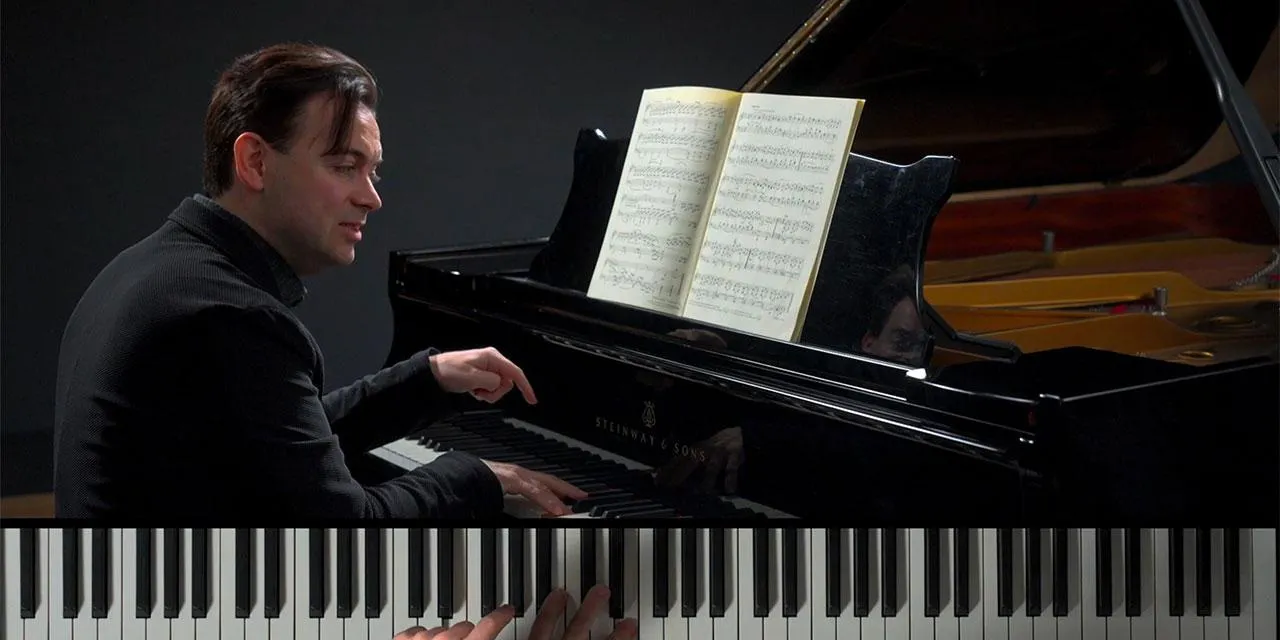
Ici, Dejan donne quelques pistes sur les défis d'articulation de ce Deuxième Mouvement, en particulier les indications legato vs staccato et “sf” vs “fp”.
Course preview
This lesson is part of the course Maîtrise la Sonate au clair de lune de Beethoven : mouvements I, II et III
Watch a preview of the full course below.
Lesson transcript:
Music Lesson: Articulation in Piano
Hi everyone. Welcome back!
Introduction to Articulation
Today, we are going to talk about articulation. It is very important because, as clear as the word might sound, it doesn't always come out of pianists' or musicians' hands. Very often, there are different additions to different phrases.
Importance of Urtext
Always keep in mind that urtext, especially with Viennese classics like Haydn, Mozart, and Beethoven, is of utmost importance.
Step One: Get a URtext Edition
- Please get a URtext edition.
- There, you will only see markings made by the composer himself.
Articulation in the Second Movement
Analyzing the Slurs
Now, let's look into the articulation of the second movement.
- Bars One and Two: These are slurred.
- Two Bars After That: Also slurred.
- In-Between: No slurs whatsoever, but very pointy dots.
This means it is really in German, "AB Gazette." So the idea is to bounce off.
Creating Contrast
This creates a beautiful contrast between:
- Legato: Slurred legato
- Short and Pointy: Very short, pointy legato
In this case, your left hand should be legato and shorter, while your right hand has the following pattern:
- Two Notes Slurred
- Two Notes Detached
- Alternatively: Four together or none
Achieving Clarity
This is really difficult to achieve. If you just play somewhere in the middle, it might sound unclear.
Practicing Techniques
Recommended Practice Methods
- Practice not only the right hand and left hand separately but also the voices. Remember, this piece is in four voices.
- Consider practicing hands together as well.
You essentially have two brains in this sense. You should sound like a string quartet or a group of four musicians.
Important Tips
- Go bar by bar and really explore what Beethoven had in mind.
Conclusion
Enjoy!
About the instructor
Les interprétations neuves du répertoire par Dejan Lazić l'ont imposé comme l'un des solistes les plus singuliers et les plus inhabituels de sa génération. Il se produit régulièrement avec les plus grands orchestres du monde, notamment les orchestres symphoniques de Boston et de Chicago, le Budapest Festival Orchestra, le Royal Concertgebouw Orchestra, le London Philharmonic, le Philharmonia Orchestra, le NDR Elbphilharmonie Orchester, ainsi que les orchestres de chambre d'Australie, de Bâle et des Pays-Bas, et il a noué d'étroites collaborations avec des chefs tels que Giovanni Antonini, Iván Fischer, Michael Francis, Andris Nelsons, Ivan Repušić, Thomas Søndergård, Robert Spano, John Storgårds, Krzysztof Urbański et Jan Willem de Vriend. Dejan Lazić a publié de nombreux CD chez Channel Classics et Onyx Classics, ainsi qu'un enregistrement du Triple Concerto de Beethoven pour Sony Classical. Son enregistrement en direct du Concerto pour piano n° 2 de Rachmaninov avec le London Philharmonic Orchestra et Kirill Petrenko a reçu le prix allemand "Echo Klassik". Il jouit également d'un large public en Extrême-Orient et déploie une intense activité de récitaliste et de chambriste, se produisant régulièrement dans de grands festivals internationaux. Les compositions de Dejan Lazić reçoivent une reconnaissance croissante, et il a été engagé comme compositeur par le groupe d'édition Sikorski Music Publishing en 2015. Son arrangement du Concerto pour violon de Brahms en Concerto pour piano "n° 3" a été créé et enregistré avec l'Atlanta Symphony Orchestra et Robert Spano en 2009 et connaît depuis un grand succès continu, aux BBC Proms, au Concertgebouw d'Amsterdam, au Festival de Pâques de Hambourg et au Festival Chopin de Varsovie, sur les deux continents américains et au Japon. Son Concerto pour piano dans le style istrien (Op. 18) a été créé à l'Aspen Music Festival en 2014 et a depuis été joué dans toute l'Europe et aux États-Unis. Parmi ses autres œuvres figurent diverses pièces orchestrales, de chambre et pour piano, des cadences, ainsi que plusieurs arrangements d'œuvres de Mozart, Schubert, R. Strauss, Wagner et Debussy. Dejan Lazić est né à Zagreb, en Croatie, dans une famille de musiciens. Il a grandi à Salzbourg, en Autriche, où il a étudié au Mozarteum (piano, clarinette et composition). Ses premières rencontres avec Zoltán Kocsis et Imre Rohmann au Festival Bartók de Hongrie ont été décisives pour sa carrière artistique, tout comme l'influence considérable de Peter Eötvös. Dejan Lazić vit à Amsterdam. Dans Master Moonlight Sonata by Beethoven, Dejan partage la réflexion qui sous-tend ces interprétations acclamées, te guidant à travers les trois mouvements de l'une des œuvres les plus aimées du répertoire pianistique afin que tu puisses la façonner avec une véritable compréhension plutôt que par imitation. www.dejanlazic.com read more