



Basse d'Alberti (accompagnement)

Lesson time: (10min 30sec)
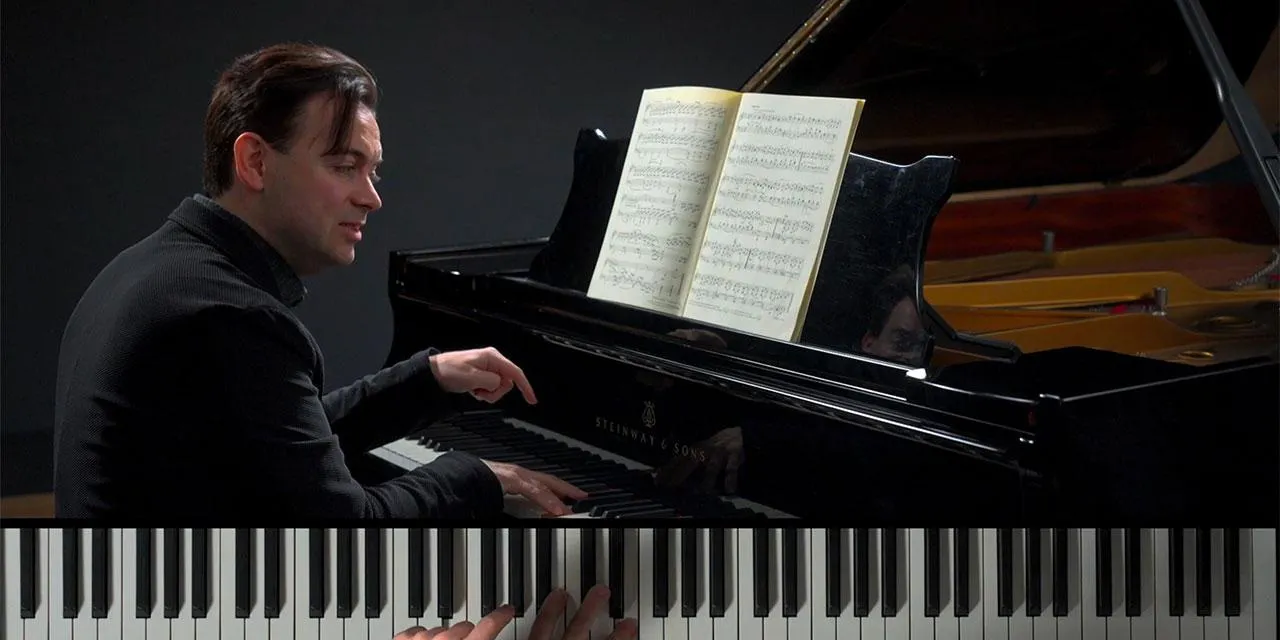
Dejan Lazic explique les figures d'accompagnement de la basse d'Alberti dans le troisième mouvement de Moonlight Sonata, comment les équilibrer face à la mélodie et comment les travailler.
Course preview
This lesson is part of the course Maîtrise la Sonate au clair de lune de Beethoven : mouvements I, II et III
Watch a preview of the full course below.
Lesson transcript:
Beethoven's Moonlight Sonata: Third Movement
Hi everyone, we are back with Beethoven and the Moonlight Sonata, third movement, the most virtuosic one.
Contrasts in the Sonata
We were talking about the great contrasts Beethoven included when composing this sonata:
- First Movement: Very intimate, soft, and slow.
- Second Movement: Cheerful and dance-like, described as a "flower between the two Abbesses," as Lis called it, in D flat major.
- Third Movement: Back to C sharp minor with incredible broken chords passages.
Rhapsodic Movement
This movement doesn't start with a clear theme or subject. Instead, it begins with broken chords, similar to how we started the first movement. Later, we discover that there is indeed a motivic subject, a theme worthy of singing.
Theme Introduction
The thematic material appears a bit later, in Bar 21, after we encounter a fermata. Do you remember the pedal note: G sharp fermata?
Fermata Timing
- Importance of Timing: No one really knows how long this fermata should be.
- Repetition: Since you are likely repeating this first section multiple times, you can experiment with timing.
- Consider making it dramatically longer the first time and a bit shorter another time.
- Beethoven's Improvisation: Beethoven was a great improviser. Performers noted that he often played the same piece differently in repeats.
Transitioning from Second Movement
After the second movement, which ends in B flat major, we transition immediately to C sharp minor, setting up the "engine" for the third movement.
Fingering Recommendations
For fingering, I recommend:
- Not the usual: Octave 1:5.
- Consider 1-4 for certain sections since the fourth finger is positioned between the black keys and doesn't project as well.
Accentuation and Dynamics
- Use piano sforzando and prepare for novelty.
- In Bar 19, we see a crescendo for the first time with the same figure (broken chords), but it's done with slurs, meaning it should be played legato and more expressively.
Alberti Bass
We encounter the Alberti bass, a familiar accompaniment figure used extensively by the Italian composer Alberti, a singer and harpsichordist.
- This figure appears frequently in Beethoven's writing and is a mix of humor and irony.
- It's essential to play it with minimal pedal to ensure clarity since it belongs more to the 18th century than to a 19th-century piece.
Variations of Alberti Bass
- The figure appears in various forms:
- In the left hand during the middle section,
- In the right hand from Bar 75.
Practicing Tips
Pay attention to the thumb:
- We discussed the importance of the thumb's flexibility earlier.
- For G sharp minor, your thumb should be very flexible:
- In the left hand, use G sharp 5-3-1 for the first inversion.
- Then, try 4 to 1 to maintain a natural hand position.
Additional Considerations
- Avoid practicing too fast, focusing instead on maintaining proper technique to avoid strain.
- Ensure that you take care of your thumbs throughout the practice.
See you next time!
About the instructor
Les interprétations neuves du répertoire par Dejan Lazić l'ont imposé comme l'un des solistes les plus singuliers et les plus inhabituels de sa génération. Il se produit régulièrement avec les plus grands orchestres du monde, notamment les orchestres symphoniques de Boston et de Chicago, le Budapest Festival Orchestra, le Royal Concertgebouw Orchestra, le London Philharmonic, le Philharmonia Orchestra, le NDR Elbphilharmonie Orchester, ainsi que les orchestres de chambre d'Australie, de Bâle et des Pays-Bas, et il a noué d'étroites collaborations avec des chefs tels que Giovanni Antonini, Iván Fischer, Michael Francis, Andris Nelsons, Ivan Repušić, Thomas Søndergård, Robert Spano, John Storgårds, Krzysztof Urbański et Jan Willem de Vriend. Dejan Lazić a publié de nombreux CD chez Channel Classics et Onyx Classics, ainsi qu'un enregistrement du Triple Concerto de Beethoven pour Sony Classical. Son enregistrement en direct du Concerto pour piano n° 2 de Rachmaninov avec le London Philharmonic Orchestra et Kirill Petrenko a reçu le prix allemand "Echo Klassik". Il jouit également d'un large public en Extrême-Orient et déploie une intense activité de récitaliste et de chambriste, se produisant régulièrement dans de grands festivals internationaux. Les compositions de Dejan Lazić reçoivent une reconnaissance croissante, et il a été engagé comme compositeur par le groupe d'édition Sikorski Music Publishing en 2015. Son arrangement du Concerto pour violon de Brahms en Concerto pour piano "n° 3" a été créé et enregistré avec l'Atlanta Symphony Orchestra et Robert Spano en 2009 et connaît depuis un grand succès continu, aux BBC Proms, au Concertgebouw d'Amsterdam, au Festival de Pâques de Hambourg et au Festival Chopin de Varsovie, sur les deux continents américains et au Japon. Son Concerto pour piano dans le style istrien (Op. 18) a été créé à l'Aspen Music Festival en 2014 et a depuis été joué dans toute l'Europe et aux États-Unis. Parmi ses autres œuvres figurent diverses pièces orchestrales, de chambre et pour piano, des cadences, ainsi que plusieurs arrangements d'œuvres de Mozart, Schubert, R. Strauss, Wagner et Debussy. Dejan Lazić est né à Zagreb, en Croatie, dans une famille de musiciens. Il a grandi à Salzbourg, en Autriche, où il a étudié au Mozarteum (piano, clarinette et composition). Ses premières rencontres avec Zoltán Kocsis et Imre Rohmann au Festival Bartók de Hongrie ont été décisives pour sa carrière artistique, tout comme l'influence considérable de Peter Eötvös. Dejan Lazić vit à Amsterdam. Dans Master Moonlight Sonata by Beethoven, Dejan partage la réflexion qui sous-tend ces interprétations acclamées, te guidant à travers les trois mouvements de l'une des œuvres les plus aimées du répertoire pianistique afin que tu puisses la façonner avec une véritable compréhension plutôt que par imitation. www.dejanlazic.com read more