



True Colours (analyse)
Lesson time: (11min 21sec)
Juliet Russell décortique True Colours, le classique de Cyndi Lauper également apprécié dans la version d'Eva Cassidy, ainsi que les passages plus délicats où tu appliqueras les outils vocaux avancés des leçons précédentes.
Course preview
This lesson is part of the course Les compétences essentielles pour les chanteurs
Watch a preview of the full course below.
Lesson transcript:
Welcome to Your Second Challenge: True Colors
Hello, lovely singers, and welcome to your second challenge!
Song Background
So this next song is True Colors, originally recorded by Cyndi Lauper and featuring a beautiful version by Eva Cassidy. I encourage you to listen to various renditions on Spotify and YouTube and see which versions appeal to you.
Note on Versions
- The Eva Cassidy version is a bit more challenging, as it offers a unique interpretation of the original song.
- We'll be focusing on a hybrid of both versions, primarily sticking to the Cyndi Lauper rendition, which I find a little easier.
Getting Familiar with the Song
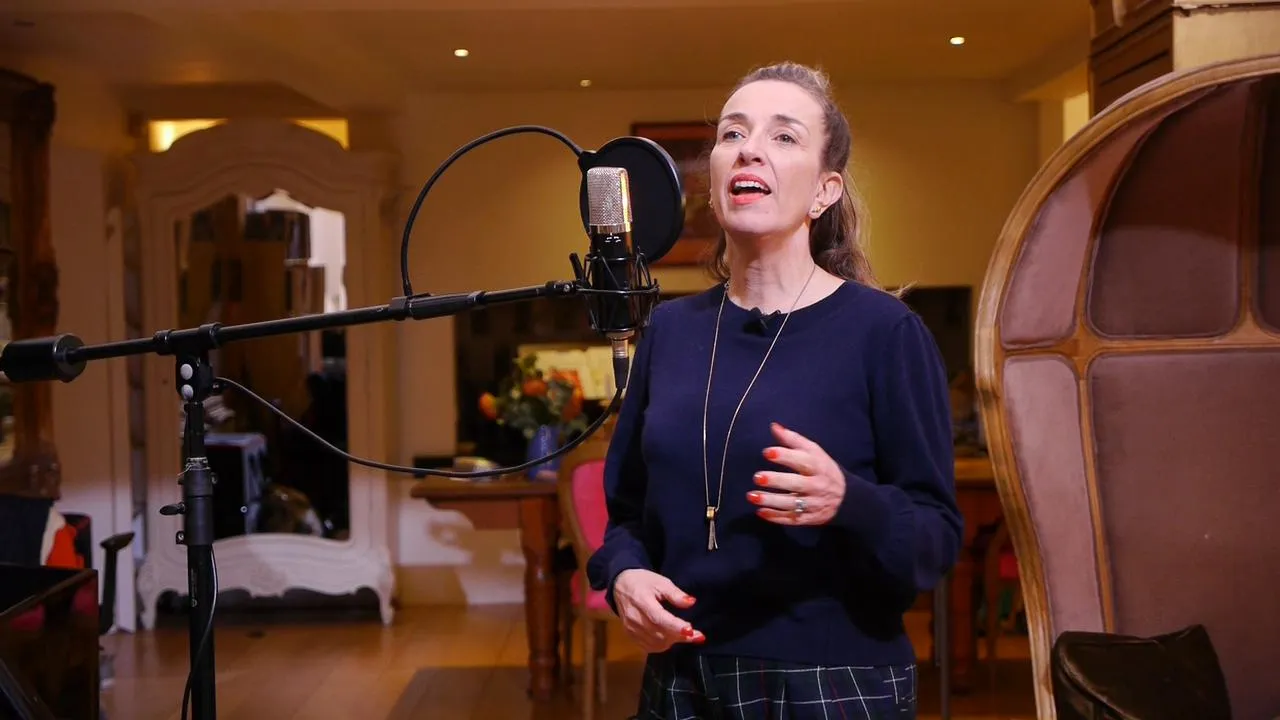
We are joined by Cara, who will sing through it for us. To familiarize yourself, I recommend checking out as many versions as you can.
- If you want to download the backing track, I've provided a link. It's a Rock School backing track that aligns more with the Eva Cassidy version. However, you can still sing the Cyndi Lauper version over it, and we'll cover the differences in timing as we progress.
Difficulty Level
True Colors is a beautiful song and is more challenging to sing than Make You Feel My Love. It features a larger vocal range and includes three distinct sections, unlike the two sections in Make You Feel My Love.
Let's Walk Through the Song
We'll walk through the song, identifying any challenging parts and covering some basics to look out for.
Starting From the Top
The song starts after three beats. Here are the first lines:
- You with the sad eyes.
- Don't be discouraged
- Though I realize it's hard to take courage
Great!
Cara, could you demonstrate the first verse for us?
-
- You with the sad eyes.
- Don't be discouraged.
- Though I realize it's hard to take courage.
-
First Impressions
That sounded really nice!
- How does that feel to sing?
- Cara: "Very easy! It rolls off the tongue."
For most female voices, those first three lines should feel quite easy, closely resembling our natural speech.
Increasing Dynamics
As we build through the song, the dynamics will increase, especially at the beginning of the chorus.
Next section:
In a world full of people, you can feel the percussion of the phrases increase.
- Phrase: "In a world FULL of people."
- You get a rest there:
-
- In a world full of people, you can lose sight of it all.
- In the darkness inside you, it can make you feel so small.
-
Consonants and Phrasing
There's more space between the phrasing and the consonants. It's essential to energize those consonants.
Cara, could you demonstrate starting from "in a world" after four?
- In a world full of people, you can lose sight of it all.
- In the darkness inside you, makes you feel so small.
Moving to the Chorus
Shall we go straight to the chorus? Here it is:
-
- But I see your true colors shining through.
-
Lovely! Cara does such a beautiful riff on that line.
- Feel free to add any individual styling once you're used to the song.
- Just remember not to slide up to that first note; you want to really hit it clearly.
Repeating the Key Lines
Let's try that again:
-
- But I see your true colors shining through.
- And I see your true colors, and that's why I love you.
-
Important Melody Variations
- Note: The second time Cara did slide, but once you've established a melody, slight variations are fine.
- Focus on nailing that first jump in the melody.
Melody Differences:
- First chorus: "Don't be afraid to let them show."
- Second chorus: "Don't be afraid to let them show."
If you're comfortable doing the lower melody, it's totally fine to maintain that both times.
Dynamic Approaches
Several approaches for the chorus are possible:
- Sing it lightly: "But I see your true colors shining through."
- Add energy: "But I see your true colors."
Timing and Instrumentation
As the song builds, especially in the Eva Cassidy version, instrumentation increases as Cara adjusts her dynamics accordingly.
Transitioning to the Chorus
Take note of the timing transitions from the end of the first verse into the chorus:
- "In the darkness inside you, can make you feel so small..."
-
- But I see your true colors shining through.
-
Key Differences in Interpretation
Eva Cassidy sings the melody differently:
- Eva: "True colors"
- Cyndi: "True colors shining through"
Both interpretations are valid.
Demonstrating the Chorus
Now, Cara will sing through the first chorus for us. Notice how this particular chorus builds at the beginning and then comes back down, giving it a different arc compared to most songs.
- But I see your true colors shining through.
- I see your true colors and that's why I love you.
- So don't be afraid to let them show.
- Your true colors, your true colors are beautiful...
Conclusion and Recap
To recap, here are some critical points to remember while singing True Colors:
- Building dynamics: Start softly and gradually add volume.
- Phrasing: Keep space for breaths as required.
- Melody: Nail the first jump in the chorus and notice the variations in the lyrics.
Remember, this song offers room for interpretation, so feel free to explore different dynamics and styles! Enjoy practicing!
About the instructor
Juliet Russell est chanteuse, compositrice, coach vocale et cheffe de chœur. Elle a à cœur d'aider les individus et les communautés à développer leur voix et leur créativité. Coach vocale sur The Voice et The Voice Kids d'ITV et sur le Michael McIntyre’s Big Show de la BBC, Juliet a également travaillé avec des artistes lauréats de Grammy, Brit, MTV Europe et MOBO Awards. Elle a collaboré et joué avec des artistes novateurs comme Damon Albarn, Imogen Heap, Paloma Faith, alt-J, Yoko Ono, Seal et Ringo Starr. En 2015, avec le soutien de l'Arts Council of England, elle a mené en tournée son album Earth Meets Sky, réunissant musiciens locaux et chœurs communautaires pour créer dix concerts uniques à travers le Royaume-Uni. On lui commande régulièrement de nouvelles pièces chorales et des arrangements vocaux, et elle s'est produite à l'échelle nationale et internationale. Attachée au développement des artistes, Juliet accompagne et coache des artistes émergents, en travaillant avec des sociétés de management, des maisons de disques et d'édition ainsi qu'avec des artistes indépendants. Elle possède un studio vocal en plein cœur de la vibrante Brick Lane à Londres. Juliet a été directrice artistique fondatrice de Sense of Sound et directrice créative de Sing Up Greenwich et de Sing Late au V&A. Elle dirige le Portobello Live Choir, un chœur communautaire de l'ouest de Londres, et le chœur professionnel Assemble, et elle est formatrice pour le programme Singing for Lung Health de la British Lung Foundation. read more