



Rythme

Lesson time: (4min 18sec)
Comment obtenir un bon rythme ? Juliet nous initie aux signatures rythmiques avec des façons ludiques de comprendre les temps d'une chanson.
Course preview
This lesson is part of the course Les compétences essentielles pour les chanteurs
Watch a preview of the full course below.
Lesson transcript:
Exploring Rhythm in Music
In this lesson, we're going to explore rhythm.
Embodying Rhythm
For me, personally, I find a really great way of exploring rhythm is to start embodying it, just moving along to music. This might be while you're listening to a song on the radio or while you're doing something else.
- Keeping that inner pulse in the body is really useful.
Basics of Rhythm and Tempo
To explain some of the very basics of rhythm and tempo:
- Most pop songs (this is a generalization) are in a four-four rhythm. This means there are four beats to a bar.
Counting in Four-Four
Let's count it out together:
- 1, 2, 3, 4
- 1, 2, 3, 4
Join me:
- 1, 2, 3, start to move.
- 1, 2, 3. Walk around the room if you want to.
- 1, 2, 3, 4.
For some people, you might want to use your feet:
- 1, 2, 3, 4
- and
- 1, 2, 3, 4.
Whatever feels good, you can walk around to that rhythm, just practicing it.
Understanding Tempo
Rhythm can speed up or slow down, and that is the tempo of the song.
- So when someone talks about the tempo, it's basically how fast or slow it is.
- Ballads tend to be slower than dance music.
For example, consider a classic disco tune like "Car Wash":
"You might not ever get rich, but let me tell you, it's better than digging a ditch."
You can hear that it's got more tempo and pace. In contrast, some of the songs we're working on in the course are more ballad-like, which means they tend to be slower with longer phrases.
The Four Beats in a Bar
Now, often as a singer, we refer to the four beats in a bar, which are known as crotchets.
- These four beats are counted as:
- 1 and 2 and 3 and 4.
When singing, sometimes we focus on the offbeat, which occurs on:
- and 1 and 2 and 3 and 4 and.
Coordinating Rhythm
To start embodying that, I would say do a stamp and then a click or a clap, whatever you're comfortable with:
- 1 and 2 and 3 and 4 and
- 1 and 2 and 3 and 4.
This might be difficult to coordinate if you're not used to it.
Physicalizing Rhythm
Another way of doing it is to walk around:
- Just do a 1 and 2 and 3 and 4.
You can use whatever space you have and just learn to physicalize and embody that rhythm.
Time Signatures
There's another thing called time signatures.
- The four-four time we talked about consists of four crotchet beats in a bar, which is what we started with:
- 1, 2, 3, 4.
You can also have three crotchets in a bar, which is called waltz time:
- 1, 2, 3
- 1, 2, 3.
For example, the song "Natural Woman" has groups of three:
"Looking out on the morning rain, I used to feel so uninspired."
Emphasizing the Offbeat
Another thing that happens when we sing pop or soul music is we often think about the rhythm being on the 2 and the 4. For one of the songs we're going to work on, "I Need a Dollar," this is true:
"I need a dollar, a dollar, a dollar is what I need."
Join in:
- 1, 2, 3, 4
- 1, 2, 3, 4.
Click or clap as you join in:
"I need a dollar, a dollar, a dollar is what I need."
Finding Your Rhythm
Just play around with where you feel the pulse of something. This is a great way to get your ears and body attuned to rhythm.
A good way to explore it is to simply dance.
- Nod your head,
- Tap your foot,
- Whatever feels natural.
About the instructor
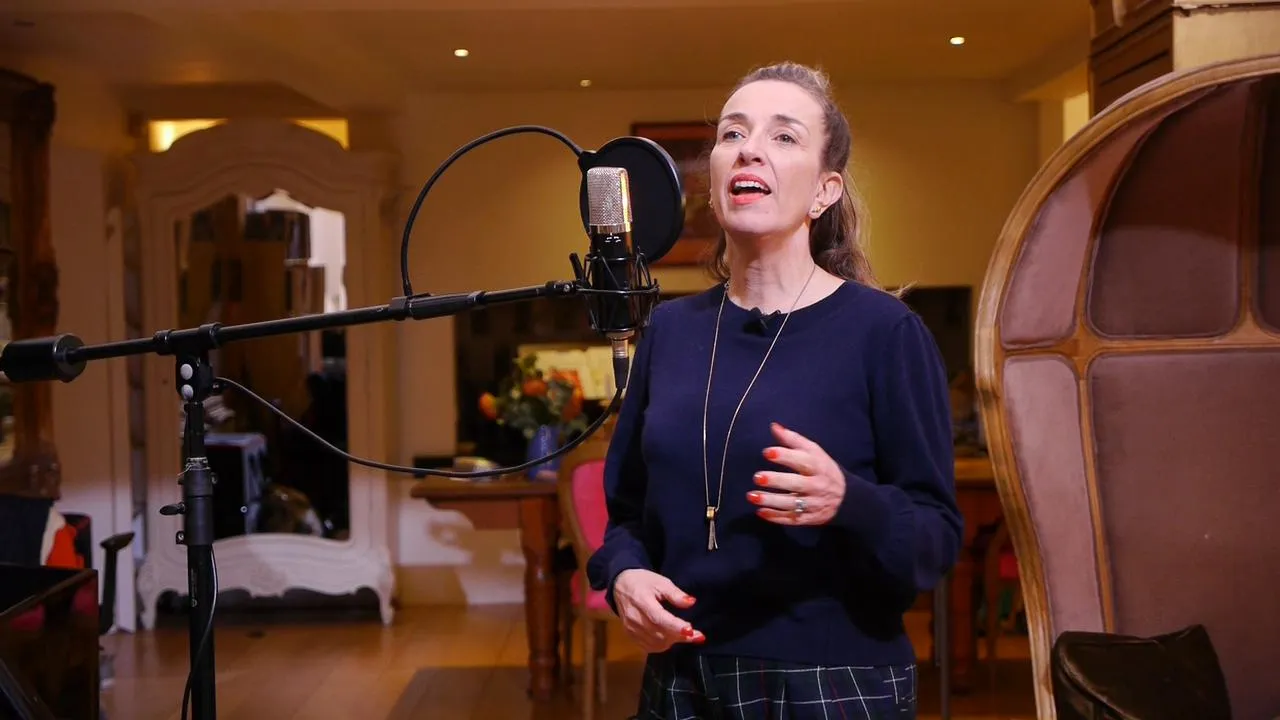
Juliet Russell est chanteuse, compositrice, coach vocale et cheffe de chœur. Elle a à cœur d'aider les individus et les communautés à développer leur voix et leur créativité. Coach vocale sur The Voice et The Voice Kids d'ITV et sur le Michael McIntyre’s Big Show de la BBC, Juliet a également travaillé avec des artistes lauréats de Grammy, Brit, MTV Europe et MOBO Awards. Elle a collaboré et joué avec des artistes novateurs comme Damon Albarn, Imogen Heap, Paloma Faith, alt-J, Yoko Ono, Seal et Ringo Starr. En 2015, avec le soutien de l'Arts Council of England, elle a mené en tournée son album Earth Meets Sky, réunissant musiciens locaux et chœurs communautaires pour créer dix concerts uniques à travers le Royaume-Uni. On lui commande régulièrement de nouvelles pièces chorales et des arrangements vocaux, et elle s'est produite à l'échelle nationale et internationale. Attachée au développement des artistes, Juliet accompagne et coache des artistes émergents, en travaillant avec des sociétés de management, des maisons de disques et d'édition ainsi qu'avec des artistes indépendants. Elle possède un studio vocal en plein cœur de la vibrante Brick Lane à Londres. Juliet a été directrice artistique fondatrice de Sense of Sound et directrice créative de Sing Up Greenwich et de Sing Late au V&A. Elle dirige le Portobello Live Choir, un chœur communautaire de l'ouest de Londres, et le chœur professionnel Assemble, et elle est formatrice pour le programme Singing for Lung Health de la British Lung Foundation. read more