



Zungenstoß-Übung #1
Lesson time: (4min 36sec)
John O'Neill stellt den Zungenstoß vor, das Pendant des Saxofonisten zum Bogen des Geigers, mit dem Töne präzise angestoßen und die Phrasierung geformt werden — und eine der am schwersten zu meisternden Fertigkeiten.
Course preview
This lesson is part of the course The Saxophone Method Vol. 1: Grundlagentechniken
Watch a preview of the full course below.
Lesson transcript:
Mastering Tonguing for Saxophone Players
Tonguing is one of the most important skills to master for every saxophone player. The tongue is like the saxophone player's equivalent of the violinist's bow. It enables you to:
- Start notes precisely
- Repeat notes quickly and efficiently
- Create subtle variations of phrasing
Unfortunately, it's also one of the most difficult skills to acquire. Part of the reason for that is that you can't see what I'm doing, and I can't see what you're doing. We're both kind of working with our eyes shut. However, over the years that I've been teaching, I have devised an effective way of teaching people to tongue.
The Ventriloquist Exercise
My first teacher, Don Rendell, used to tell me that tonguing was like ventriloquism, and he was absolutely right. When I first started teaching, I would go into all kinds of complicated descriptions of what the tongue was doing. As the years went by, I came back to Don's idea of tonguing being like ventriloquism.
Here's the exercise:
-
Stand in front of a mirror.
-
Take a note, let's say the B that we've been playing already.
-
Sing that note as if you were a ventriloquist:
- Attempt to do this without moving your lips, teeth, or jaw.
"Do, do, do, do, do."
Using the mirror, observe how much movement there is. It may be impossible to have no movement, but try to keep it to an absolute minimum.
Notable Points During the Exercise:
- The "do" sound is produced not by the tip of your tongue, but just behind the tip.
- The tongue moves as little as possible.
- The tongue moves as gently as possible, so it's not like this: "do, do, do," but more like: "do, do, do."
I'm moving my hand across to remind myself to maintain the line. Earlier, when we were playing long notes, I talked about the importance of drawing a line. Keep that in mind as you do the ventriloquist exercise:
"Do, do, do, do."
Final Thoughts
Although you hear distinct notes, I want you to think of this as one breath because it is one breath. It's almost like thinking of it as one continuous sound.
Don't confuse trying to keep the action of the tongue gentle with playing or singing more quietly. This is a common misunderstanding. The gentleness of the tongue's action is completely distinct from the volume of the sound, whether you're singing or playing.
About the instructor
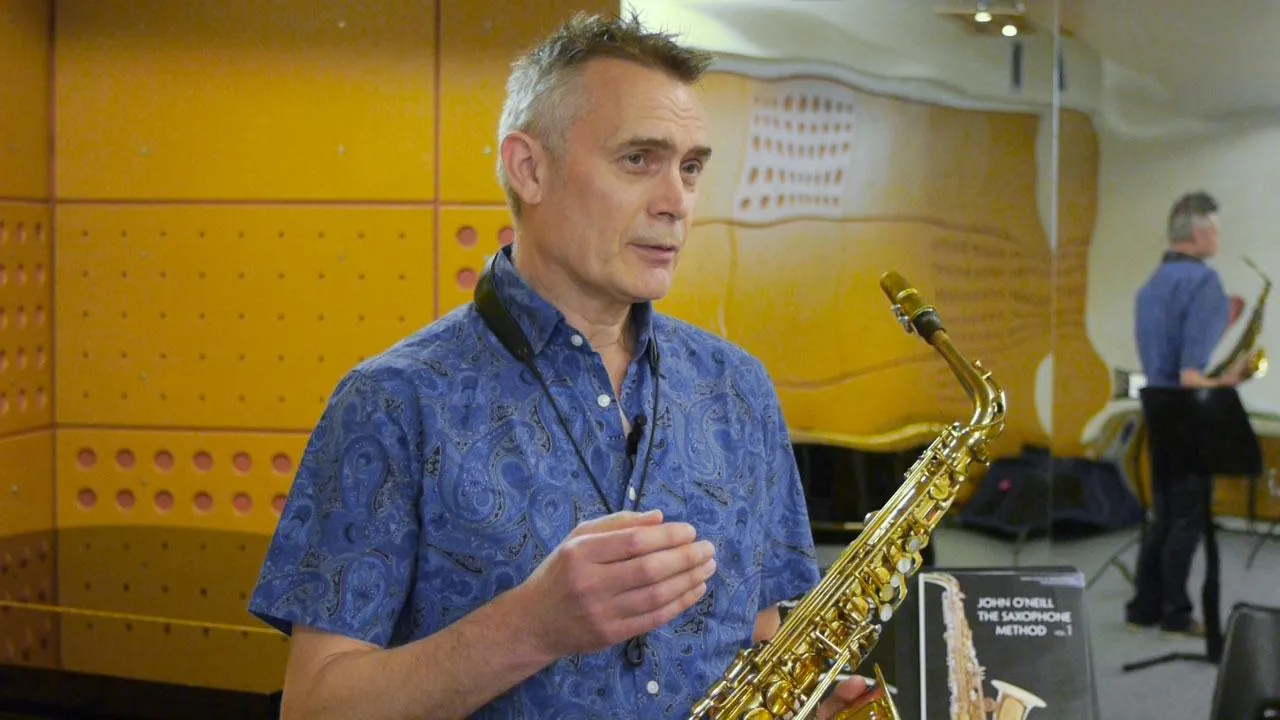
John O'Neill ist der Saxofonist hinter The Jazz Method for Saxophone, der bei Schott erschienenen Reihe, die einer ganzen Generation von Musikern weltweit das Improvisieren beigebracht hat. Erstmals 1991 veröffentlicht, zählt sie neben seinen begleitenden Methoden für Klarinette und Flöte bis heute zu den meistverkauften Jazz-Lehrwerken, die je geschrieben wurden.Zum Saxofon kam er mit zwanzig Jahren, während er am Trinity College in Oxford Französisch und Deutsch studierte, nachdem er John Coltrane gehört hatte. Anschließend studierte er beim großen britischen Tenoristen Don Rendell und lernte Improvisation bei Lee Konitz, Warne Marsh und Peter Ind, den direkten Erben des legendären Lehrers Lennie Tristano. Seit 1979 professioneller Musiker, ist er auf Jazz und Bossa Nova spezialisiert und hat in Londons führenden Clubs gespielt, darunter im Ronnie Scott's, und komponiert zugleich Musik für Film, Fernsehen, Theater und Tanz.Als ausgebildeter Lehrer mit jahrzehntelanger Erfahrung hat John Saxofon, Klarinette und Flöte privat und an Schulen unterrichtet, im Jazz-Studiengang des Trinity College of Music in London sowie bei Sommerkursen in Spanien und der Tschechischen Republik. Von seinem Zuhause im Norden Londons aus tritt er nach wie vor auf und unterrichtet. read more