



Atemübung Nr. 2
Lesson time: (4min 34sec)
John O'Neills zweite Atemübung für Saxofon, im Stehen vor einem Spiegel mit den Händen auf dem Bauch, um den Atem zu spüren und Verspannungen zu vermeiden.
Course preview
This lesson is part of the course The Saxophone Method Vol. 1: Grundlagentechniken
Watch a preview of the full course below.
Lesson transcript:
Standing Exercise for Breath Control
So the next exercise involves you standing up in that nice relaxed posture, preferably in front of a mirror so you can actually see what's going on.
Mirror Setup
- If the mirror can be a nice big tall mirror where you can see the whole of the upper half of your body, even better.
Hand Placement
- Place your hands on your stomach, just below your solar plexus.
- Try to do the same thing that you did when you were lying on your back.
Common Breathing Faults
Now, here is where often the problems start. A common fault that I see with beginners is a tendency, when they breathe in, to do it like so.
"That's what I call the anxiety breath."
This breath just doesn't work for playing the saxophone or for any wind instrument for that matter.
Shoulder Awareness
Remember when you were lying on your back, your shoulders didn't go up, did they? When you took the in-breath, the shoulders just stayed exactly where they were.
- Use the mirror: carefully watch your shoulders to see if there's any tendency to lift up.
I think that tendency to lift comes from the misconception that you need large quantities of air to blow the instrument.
"Remember, you don't need to take a lot of air into your body. You certainly do not need to fill your lungs."
Lung Capacity Analogy
Think of your lungs like a petrol tank.
- We're going to operate with our tank somewhere between a quarter and half full but we're never going to fill up.
- We're never going to try to fill to the maximum; that isn't going to help us at all.
Breathing Technique
So, I'm going to take a breath again through my mouth, and it should feel like:
- Almost like a silent breath, like a sip of air rather than a gulp of air.
- I should feel my hands being pushed out very slightly.
Then, you're going to breathe out while making that same whispered "R" sound.
Muscle Engagement
In the course of making that sound, I can feel my core muscles pushing against my hands.
- My hands gradually, gradually, gradually move in towards my center.
- These core muscles are squeezing all the time, but they're squeezing quite gently at first.
By the end of your breath (I'm going to call it a note for the moment), it should feel like those muscles can't pull in anymore.
An Imagery Tool
Imagine you're wringing out a sponge.
- You pick up a sponge that's full of water to achieve a steady trickle.
- You'll squeeze very gently at first, and then harder and harder until you can't squeeze any harder.
The same principle applies here: I'm squeezing gently at first and then gradually harder to sustain the sound at the same level.
Maintaining Sound Quality
- Don't let the sound fade away.
- Keep it strong while keeping the throat nice and relaxed.
The throat muscles are really important when you play the saxophone.
"So we don't want this kind of sound."
Maintain a relaxed open throat for a sound that's strong enough to be heard right across the other side of the room.
- Even though it's a whispered sound, it should be a strong whispered sound.
About the instructor
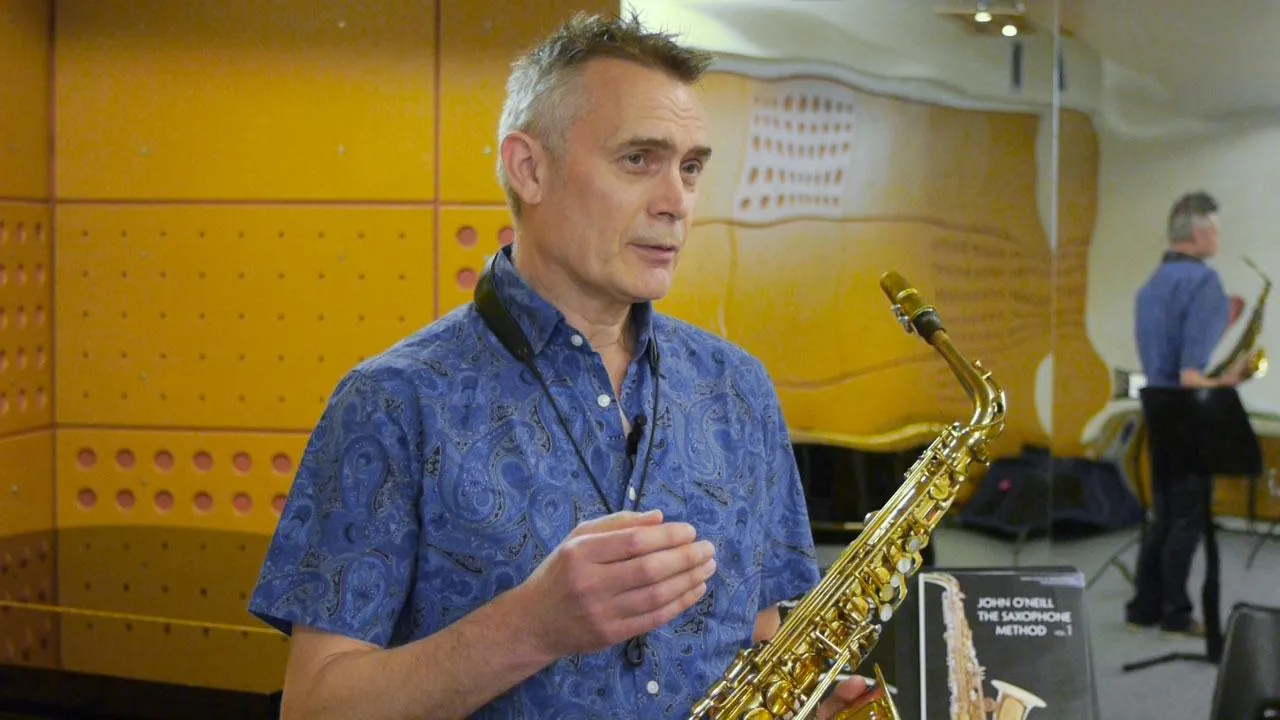
John O'Neill ist der Saxofonist hinter The Jazz Method for Saxophone, der bei Schott erschienenen Reihe, die einer ganzen Generation von Musikern weltweit das Improvisieren beigebracht hat. Erstmals 1991 veröffentlicht, zählt sie neben seinen begleitenden Methoden für Klarinette und Flöte bis heute zu den meistverkauften Jazz-Lehrwerken, die je geschrieben wurden.Zum Saxofon kam er mit zwanzig Jahren, während er am Trinity College in Oxford Französisch und Deutsch studierte, nachdem er John Coltrane gehört hatte. Anschließend studierte er beim großen britischen Tenoristen Don Rendell und lernte Improvisation bei Lee Konitz, Warne Marsh und Peter Ind, den direkten Erben des legendären Lehrers Lennie Tristano. Seit 1979 professioneller Musiker, ist er auf Jazz und Bossa Nova spezialisiert und hat in Londons führenden Clubs gespielt, darunter im Ronnie Scott's, und komponiert zugleich Musik für Film, Fernsehen, Theater und Tanz.Als ausgebildeter Lehrer mit jahrzehntelanger Erfahrung hat John Saxofon, Klarinette und Flöte privat und an Schulen unterrichtet, im Jazz-Studiengang des Trinity College of Music in London sowie bei Sommerkursen in Spanien und der Tschechischen Republik. Von seinem Zuhause im Norden Londons aus tritt er nach wie vor auf und unterrichtet. read more