



Atemübung Nr. 3
Lesson time: (2min 29sec)
Eine dritte Atemübung: Mit den Handflächen auf dem unteren Rücken zeigt John O'Neill, wie man spürt, dass sich der Atem in den Rücken ausdehnt, für einen gleichmäßigeren Saxofonklang.
Course preview
This lesson is part of the course The Saxophone Method Vol. 1: Grundlagentechniken
Watch a preview of the full course below.
Lesson transcript:
Breathing Exercise for Saxophone
So in this next exercise, we're doing the same thing again, but this time I'm positioning my hands so the palms of my hands are on my back like so.
Breathing Technique
-
Breathe In:
- Again, I should feel that my hands are being pushed out.
- This is a little bit more difficult to feel for some people.
-
Feel the Breath:
- You should feel that you're breathing into your hands.
Reflection on Learning
When I first started playing the saxophone, I was always down at the library seeing if I could find any books that would help me understand better what was going on.
A Memorable Book
I remember finding a book called "The Foundations of Singing" by Franklin Kelsey.
- Background:
- This was a book written in the 1920s.
- Franklin Kelsey recommended that when you sing, you imagine that you're breathing in through two holes in the back of your waistcoat.
Of course, that was an age when all gentlemen wore waistcoats, but that image really stuck in my mind.
Visualization Technique
So, you imagine you've got two holes just here, and you're actually taking the breath in through those two holes.
And actually, that really works for me. I can really feel that it's as if I was breathing in through my back. Let me demonstrate that for you just one more time.
-
Breath In:
- Taking the breath in again through the mouth, feeling the hands pushed out.
-
Sound Production:
- Then making your loud, whispered R sound.
Encouragement
And don't be discouraged if when you start doing this, you can't hold your sound for as long as I can. Don't forget, I've been doing this for over 40 years, so I've got pretty good breath control. But you'll get there. Just keep at it. Stay with the exercises.
About the instructor
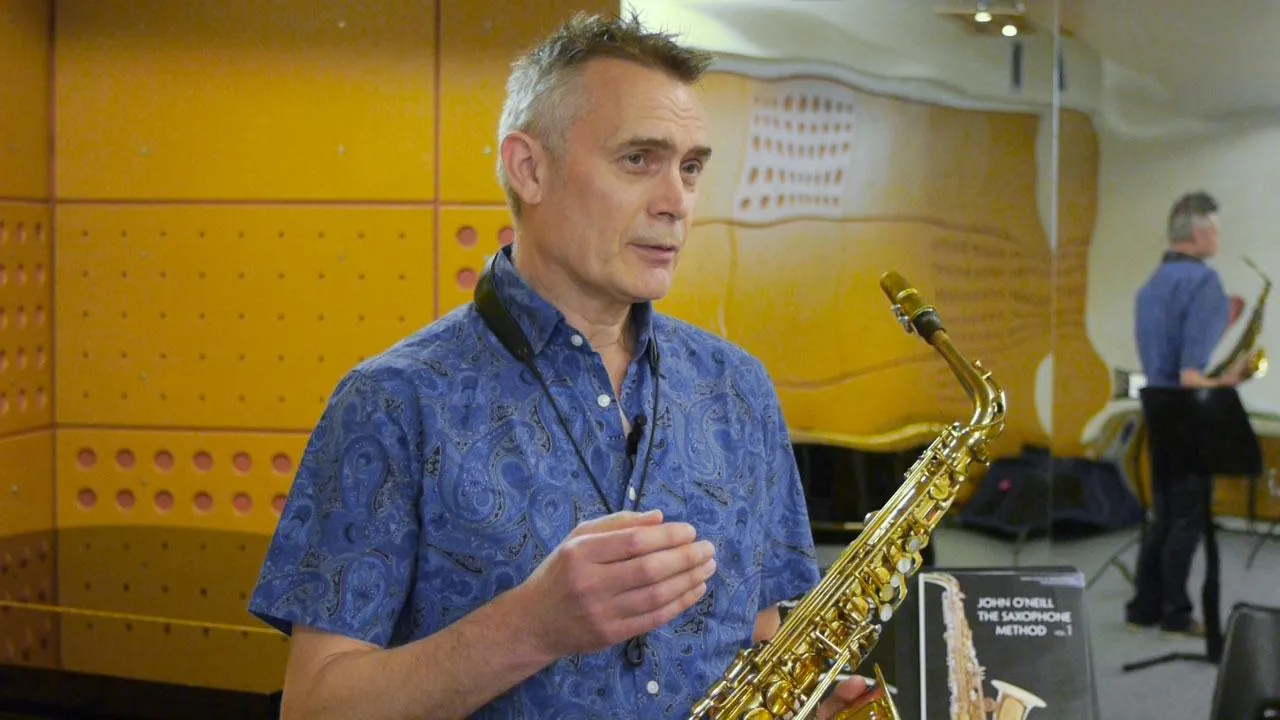
John O'Neill ist der Saxofonist hinter The Jazz Method for Saxophone, der bei Schott erschienenen Reihe, die einer ganzen Generation von Musikern weltweit das Improvisieren beigebracht hat. Erstmals 1991 veröffentlicht, zählt sie neben seinen begleitenden Methoden für Klarinette und Flöte bis heute zu den meistverkauften Jazz-Lehrwerken, die je geschrieben wurden.Zum Saxofon kam er mit zwanzig Jahren, während er am Trinity College in Oxford Französisch und Deutsch studierte, nachdem er John Coltrane gehört hatte. Anschließend studierte er beim großen britischen Tenoristen Don Rendell und lernte Improvisation bei Lee Konitz, Warne Marsh und Peter Ind, den direkten Erben des legendären Lehrers Lennie Tristano. Seit 1979 professioneller Musiker, ist er auf Jazz und Bossa Nova spezialisiert und hat in Londons führenden Clubs gespielt, darunter im Ronnie Scott's, und komponiert zugleich Musik für Film, Fernsehen, Theater und Tanz.Als ausgebildeter Lehrer mit jahrzehntelanger Erfahrung hat John Saxofon, Klarinette und Flöte privat und an Schulen unterrichtet, im Jazz-Studiengang des Trinity College of Music in London sowie bei Sommerkursen in Spanien und der Tschechischen Republik. Von seinem Zuhause im Norden Londons aus tritt er nach wie vor auf und unterrichtet. read more