



Verminderte Akkorde
Mit
Chris HaighDer verminderte Akkord besteht aus drei kleinen Terzen, eine über der anderen
Das steckt im Kurs
28 Lektionen (1h 46m) · 1 gratis
01. Verminderte Akkorde
Du bist hier6:10
02. Aufgabe: vermindert
0:17
03. Übermäßige Akkorde
3:48
04. Aufgabe: übermäßige Akkorde
0:19
05. Minor 7b5/7b9
2:24
06. Aufgabe m7b5/7b9
1:15
07. Slash- und sus-Akkorde
6:18
08. Aufgabe: Slash- und Sus-Akkorde
0:18
09. Substitutionen und 'outside' spielen
7:21
10. Aufgabe: Outside spielen
0:29
Transkript der Lektion
Understanding the Diminished Chord
In this chapter, we're going to look at the diminished chord.
What is a Diminished Chord?
The diminished chord is made up of three minor thirds, one on top of the other. The symbol for a diminished chord is either dim or a little circle.
The Peculiarity of Diminished Chords
The diminished chord is peculiar in that instead of there being 12 diminished chords, there are only really three. This is because for any diminished chord, any of the notes can count as the root.
For example:
- B flat diminished has all the same notes as:
- G diminished
- D flat diminished
- E diminished
So, G diminished is the same as:
- B flat diminished
- D flat diminished
- E diminished
Similarly:
-
A flat diminished is the same as:
- B flat diminished
- D diminished
- F diminished
-
A diminished is the same as:
- C diminished
- E flat diminished
- G flat diminished
Good News for Practice
This is very good news because it means that you only need to practice three sets of scales and arpeggios, not 12.
Practicing Diminished Arpeggios
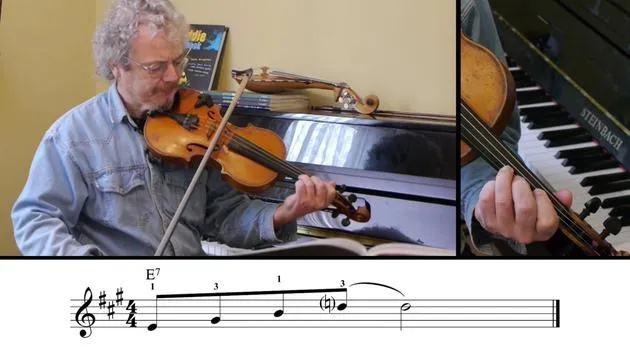
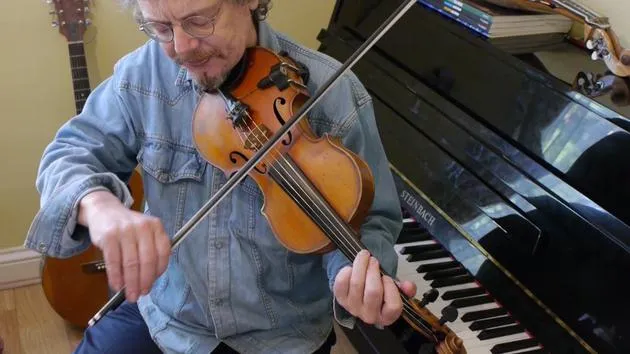
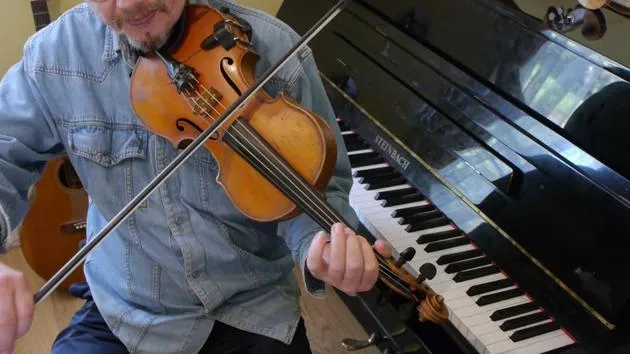
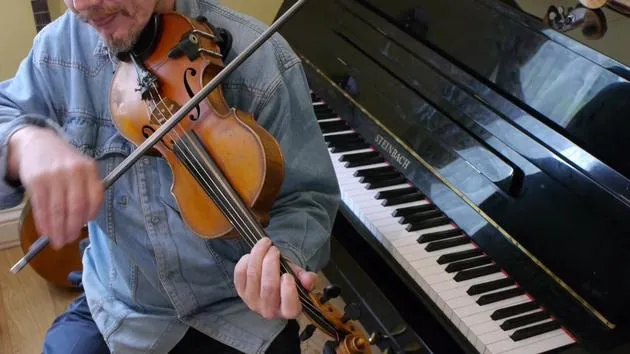
Here is the G diminished arpeggio in first position.
Note: You will see no logic in the fingering of these arpeggios, so you just have to practice them until your fingers know where to go.
Do the same with the A flat diminished and A diminished arpeggios.
Soloing with Diminished Scales
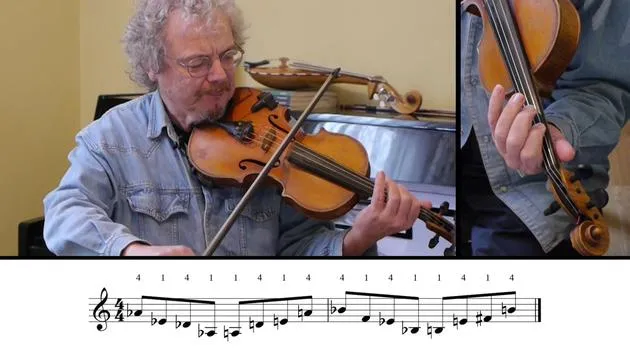
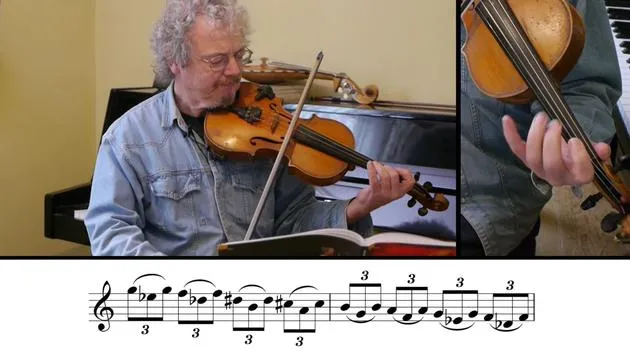
If you're soloing using a diminished scale, a pattern which is very useful is this one:
You can create a riff by combining triplets and arpeggio notes.
The G Diminished Scale
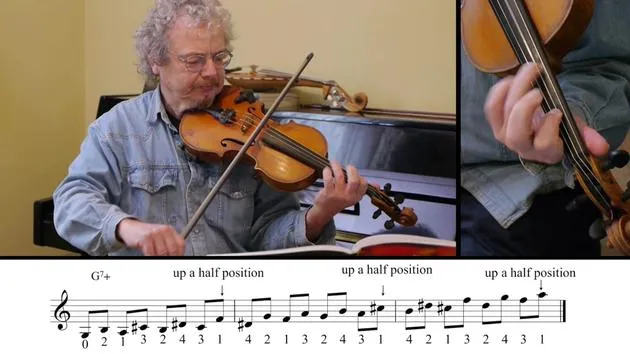
The scale of G diminished consists of the arpeggio notes, plus, for each note, a leading note a semitone below.
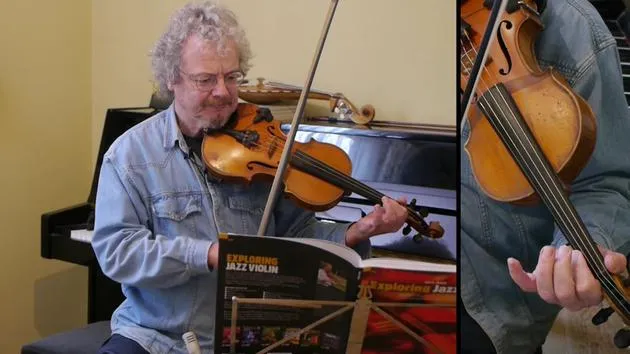
If you look at your fingers as you play a diminished scale, you may see a pattern emerge. The finger pattern you use on the G string is repeated on the D string, but a half position lower, and the same again on the next string.
Open strings complicate this pattern, but if you start on the G string in a higher position, you can use the same fingering four times as you ascend the scale.
Common Use of Diminished Chords
The most common use of diminished chords is as a passing chord between a I and a II minor 7. It works very well in this way because the diminished chord has a strong tendency to want to move and resolve up a semitone.
A diminished chord will often appear in this turnaround sequence.
Ignoring the Diminished Chord
In this context, where the diminished chord is only half a bar long, you can virtually ignore it.
For example: Here is a G major pentatonic phrase, which sounds fine over the A flat diminished.
Paying Attention to Diminished Chords
Here, on the other hand, we pay proper attention to the chord. It's pretty rare, but not impossible to find an extended section of diminished chord.
The bridge to the standard September Song, for example, goes something like this. The song is in the key of C, but there's no way you'd get away with bluffing your way through this as if it was a diatonic sequence.
Here's an example of what you could play.
Finally, here's an extended G diminished sequence, a bit more up tempo.
28 Lektionen
1 Std. 46 Min. strukturierte Videolektionen
Erweiterte Videofunktionen
Verlangsamen, Passagen loopen, mitlesen
Handy, Tablet & Desktop
Üben, wo du willst
100 % Zufriedenheitsgarantie
30 Tage Geld-zurück-Garantie
Lern deinen Guru kennen
Lern deinen Guru kennen
Chris Haigh ist seit 25 Jahren professioneller Fiddle-Spieler mit Erfahrung in vielen verschiedenen Genres. Er hat auf über 75 Alben gespielt und dabei mit Künstlern wie Alison Moyet, Bob Geldof, All About Eve, Michael Ball, David Soul, Oumou Sangare, The Quireboys, Riverdance, Morcheeba, James Galway und Steps zusammengearbeitet.
Er hat Swing-Jazz mit The Kimbara Brothers, Diz Disley, Le Jazz, The Hot Club of London und den Quecumbar Allstars gespielt und leitet die siebenköpfige sowjetische Swing-Band The Kremlinaires.
Chris gibt Unterricht und Workshops zur Jazzgeigen-Technik und hat Jazzgeige an den Universitäten Middlesex, Brunel und Newcastle sowie am Truro College unterrichtet. Zu seinen Veröffentlichungen zählen neun Fiddle-Bücher, darunter The Fiddle Handbook.
Außerdem betreibt er Fiddling Around (fiddlingaround.co.uk), vermutlich die umfassendste und meistbesuchte Quelle für Fiddle-Wissen im Netz.







