



Die Violine verstärken
Mit
Chris HaighChris Haigh geht die Möglichkeiten durch, die Jazz-Violine zu verstärken, von Standard- und Ansteckmikrofonen wie dem DPA 4099 bis hin zu Tonabnehmern und Verstärkern.
Das steckt im Kurs
28 Lektionen (1h 46m) · 1 gratis
01. Verminderte Akkorde
6:10
02. Aufgabe: vermindert
0:17
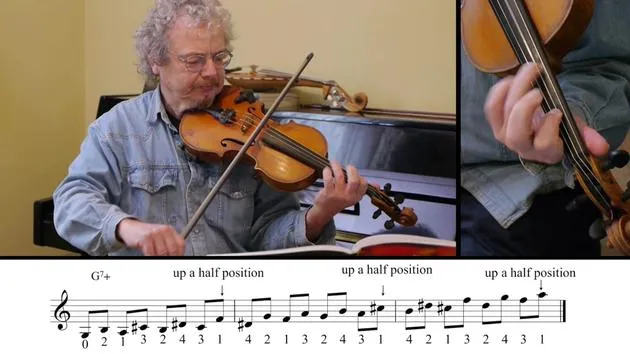
03. Übermäßige Akkorde
3:48
04. Aufgabe: übermäßige Akkorde
0:19
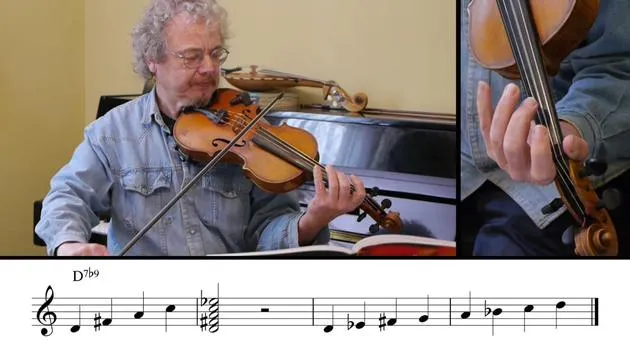
05. Minor 7b5/7b9
2:24
06. Aufgabe m7b5/7b9
1:15
07. Slash- und sus-Akkorde
6:18
08. Aufgabe: Slash- und Sus-Akkorde
0:18
09. Substitutionen und 'outside' spielen
7:21
10. Aufgabe: Outside spielen
0:29
Transkript der Lektion
Amplification of the Violin in Jazz
Now we need to say a few words about amplification of the violin because, in a jazz situation, there are some instances where:
- If you were just playing with a guitarist, you might be able to get away with playing unamplified.
However, mostly in a band, especially if the band has drums, you're going to need amplification. Achieving a good amplified sound isn't the simplest or most straightforward thing, so let's look at the possibilities.
Using a Normal Microphone
First of all, playing straight into a normal microphone is something that might be provided by the PA company or the band you're playing with. In this case:
- You'll get a mic on the end of a stand.
- You stand in front of it and play.
In a good situation, such as a quiet stage with an acoustic band (maybe a double bass and a couple of guitars), this may work. For someone like Stefan Grappelli in his later years, this was his method. He would just sit down with a microphone in front of him and play away.
Limitations of Normal Microphones
However, in anything above a quiet ideal situation, this is not a good idea because:
- A standard microphone will feed back, which means it will pick up extraneous noise, particularly from drums or electric guitars.
- Your mic will not be loud enough to pick up what you want it to hear, which is only your fiddle.
Thus, this is often not a good solution.
Close-up Microphones
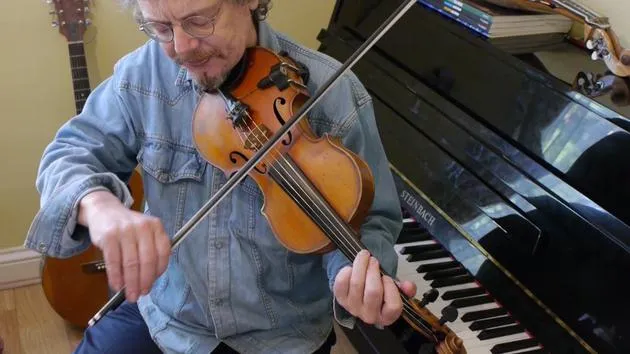
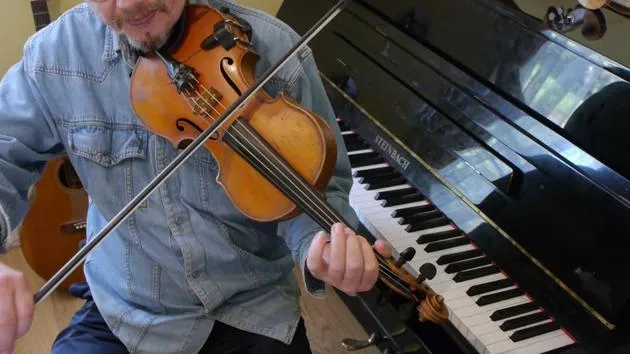
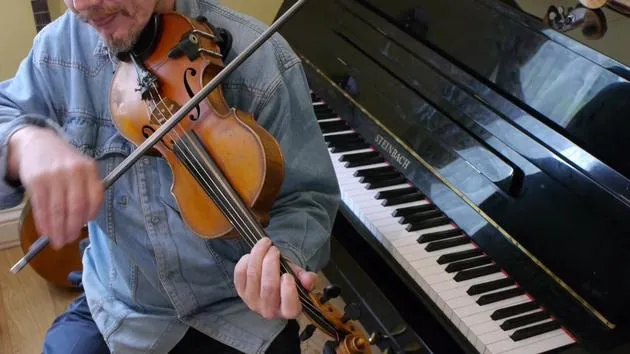
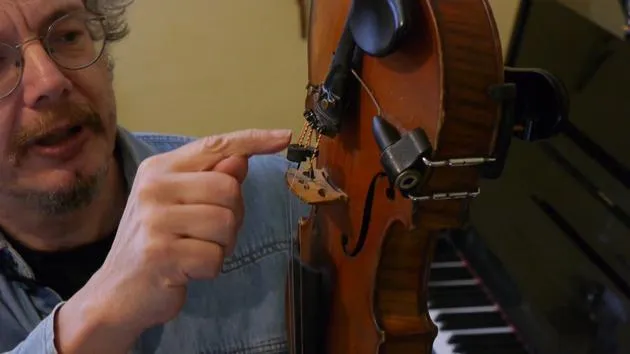
A second idea is to use a close-up mic. For example, I have a DPA 4099, which is designed specifically for the violin. It clips on very easily onto the body of the violin.
- This little condenser mic gets close to the strings.
- It will pick up a lot of the sound coming directly into it while minimizing sound from further away.
While this option can be expensive, it provides a very clean acoustic sound, which is much better than playing into a normal microphone. I use this all the time for my recordings.
Pickups
Another solution involves using a pickup, which amplifies the sound of the violin through electricity. There are many different kinds of pickups, with the most common brands being Fishman and Barkis Berry. These pickups can:
- Stick onto the bridge,
- Clip onto the bridge, or
- Sometimes be slotted into a little groove in the bridge.
My Experience with Pickups
What I use is a Bags Pickup, which is built into the bridge. To have one of these, you have to get it fitted since it is not something you can do yourself.
- It stays on the violin all the time.
- There is a little lead that runs around here, ending with a carpenter jack attached to the violin. You plug your lead into that, and then it goes to an amplifier.
Choosing a Pickup
How do you make a decision about which kind of pickup to use? Consider:
- Are you going to leave this pickup on all the time? Some are easy to remove, while others are permanent.
- For example, with the Bags, this is a permanent fixture. With pickups like Fishman, you can remove them and put them back on easily.
But there's a challenge: If the positioning of the removable pickups is ever so slightly different, the sound will vary. One of the reasons I like the Bags pickup is that it delivers very consistent sound because it's there all the time.
Debunking Myths
Some people claim that sticking a pickup onto the bridge or any part of the violin mutes the sound. Personally, I don't believe this. I think the violin sounds as loud as it would otherwise. With other pickups I've used, such as Fishman and Barkis Berry, I've never found that they altered or diminished the sound.
Cost Considerations
Another aspect to consider is the cost:
- The cheapest pickups you can get are probably around £50-£60.
- The fitted Bags is around £300.
- There are even more expensive systems available.
Your decision will depend on how often you're using it and whether you're using it professionally.
Alternative: Electric Violins
The DPA mic is quite expensive, but it offers absolute clarity of sound in good situations, making it a solid option.
Another option is the electric violin. I don't have one to show you because I've never used one, but I've tried them. In my opinion, electric violins look great and impress people. However, in many situations, they simply are not as good as an acoustic violin.
- MIDI violins were produced by a company called Zeta in the 80s and 90s, and you may still find MIDI violins available, but I think MIDI technology has progressed to the point where it's not really necessary today.
Advantages of Electric Violins
The advantages of an electric violin include:
- No feedback, as the sound doesn't resonate within a hollow body.
- You can play quietly without disturbing others. If you want to practice, you can do so without making much noise. Alternatively, you can plug in earphones and hear yourself with an electric sound.
Final Considerations
After deciding how you're going to amplify your instrument, the final decision involves what you'll plug into. If you're playing with a PA, the best practice is usually to go into a DI box. Your jack plugs into this box, and an XLR cable will come out from it into the mixing desk.
- If you have your own amplifier, keep in mind there are no amplifiers specifically designed for the violin.
- Most violins will use something designed for a guitarist.
The Right Amplifier
Electric guitar amps are often not suitable because they tend to have excessive treble. You'll find that plugging into one of those results in too much treble and not enough bass for the violin.
Fortunately, there's an amp called AER, a German brand that many in the hot club jazz scene use.
- This is an A60 watt amp.
- It's light, portable, quite powerful, and provides a very clean sound.
This is what I would definitely recommend, even though it's not cheap. This is an expensive amp, but it will last you a long time and provide you with a very high quality of sound.
28 Lektionen
1 Std. 46 Min. strukturierte Videolektionen
Erweiterte Videofunktionen
Verlangsamen, Passagen loopen, mitlesen
Handy, Tablet & Desktop
Üben, wo du willst
100 % Zufriedenheitsgarantie
30 Tage Geld-zurück-Garantie
Lern deinen Guru kennen
Lern deinen Guru kennen
Chris Haigh ist seit 25 Jahren professioneller Fiddle-Spieler mit Erfahrung in vielen verschiedenen Genres. Er hat auf über 75 Alben gespielt und dabei mit Künstlern wie Alison Moyet, Bob Geldof, All About Eve, Michael Ball, David Soul, Oumou Sangare, The Quireboys, Riverdance, Morcheeba, James Galway und Steps zusammengearbeitet.
Er hat Swing-Jazz mit The Kimbara Brothers, Diz Disley, Le Jazz, The Hot Club of London und den Quecumbar Allstars gespielt und leitet die siebenköpfige sowjetische Swing-Band The Kremlinaires.
Chris gibt Unterricht und Workshops zur Jazzgeigen-Technik und hat Jazzgeige an den Universitäten Middlesex, Brunel und Newcastle sowie am Truro College unterrichtet. Zu seinen Veröffentlichungen zählen neun Fiddle-Bücher, darunter The Fiddle Handbook.
Außerdem betreibt er Fiddling Around (fiddlingaround.co.uk), vermutlich die umfassendste und meistbesuchte Quelle für Fiddle-Wissen im Netz.







