



Übermäßige Akkorde
Mit
Chris HaighDer übermäßige Akkord klingt eher exotisch und ist, wie der verminderte, symmetrisch. Aber statt eines Stapels kleiner Terzen ist der übermäßige ein Stapel großer Terzen
Das steckt im Kurs
28 Lektionen (1h 46m) · 1 gratis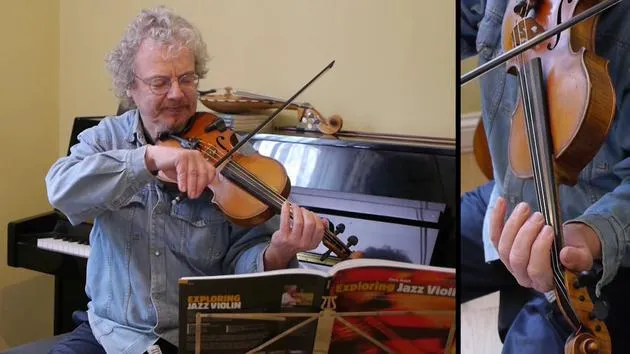
01. Verminderte Akkorde
6:10
02. Aufgabe: vermindert
0:17
03. Übermäßige Akkorde
Du bist hier3:48
04. Aufgabe: übermäßige Akkorde
0:19
05. Minor 7b5/7b9
2:24
06. Aufgabe m7b5/7b9
1:15
07. Slash- und sus-Akkorde
6:18
08. Aufgabe: Slash- und Sus-Akkorde
0:18
09. Substitutionen und 'outside' spielen
7:21
10. Aufgabe: Outside spielen
0:29
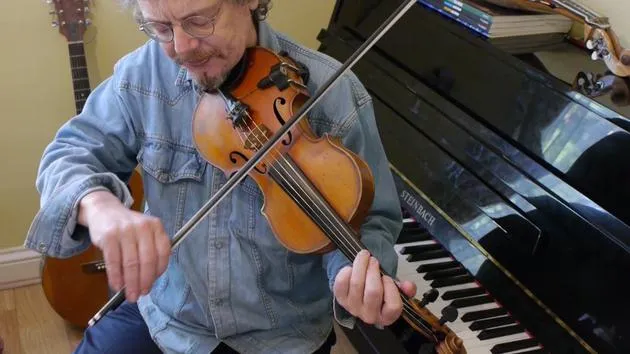
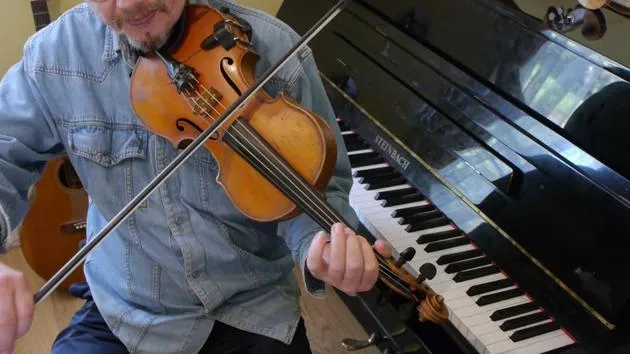
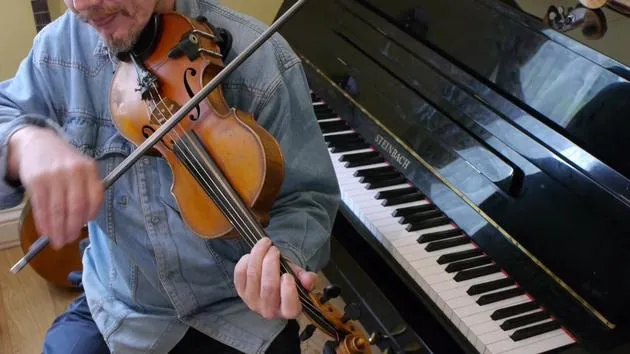
Transkript der Lektion
Understanding the Augmented Chord
In this chapter, we're going to look at the augmented chord.
Nature of the Augmented Chord
The augmented chord sounds rather exotic. Unlike the diminished chord, it's symmetrical. But instead of a pile of minor thirds, this is a pile of major thirds.
Notation
- G Augmented can be written as:
- G Aug
- G
- G7
- G7, 5
I have to apologize for the absolute mess of chord names, but no one accepts responsibility for the way this has been organized.
Scales and Patterns
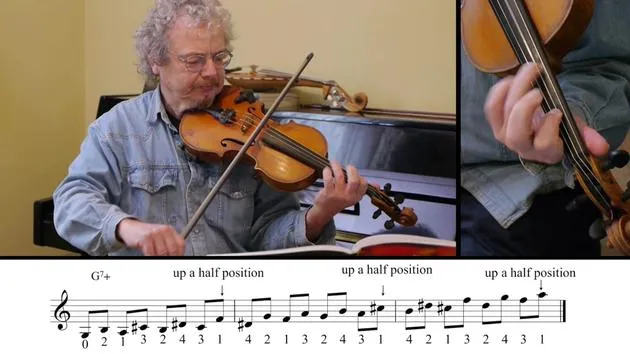
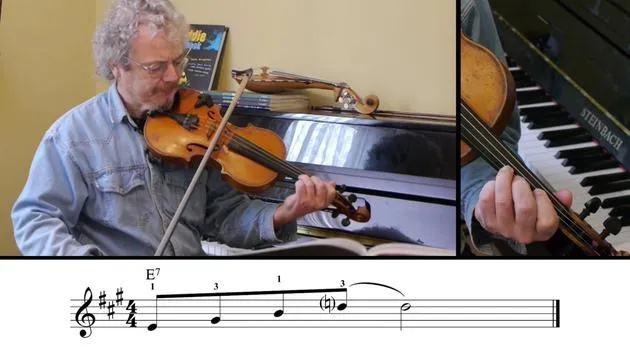
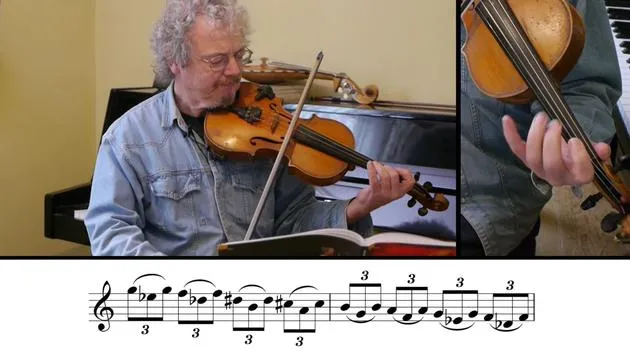
The scale that best fits the augmented chord is the whole tone scale. You can see from the arpeggio that it is a G7 with the fifth sharpened.
Learning Scales
From the point of view of learning scales, the augmented is even better than the diminished because there are only two to learn.
-
The G whole tone scale also works for:
- A
- B
- C sharp
- D sharp
- F natural
-
The AB whole tone scale works for all the others.
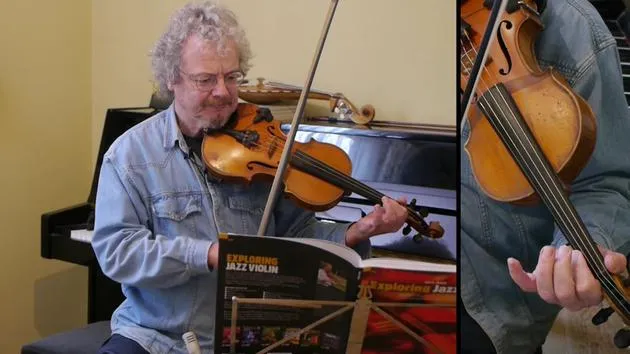
Like the diminished scale, the whole tone scale can use the same fingering on each string, but instead of moving down half a step as you go to the next string, you move up half a step.
Whole Tone Scale Movement
So here is the whole tone scale:
- Up half a position.
- Up half a position.
- Up half a position.
You can do the same thing with scale patterns. Over an augmented chord, you can play a phrase and then transpose it up or down a tone as many times as you like.
Popularity of Descending Patterns
For some reason, descending scales and patterns seem to be more useful and popular than ascending ones.
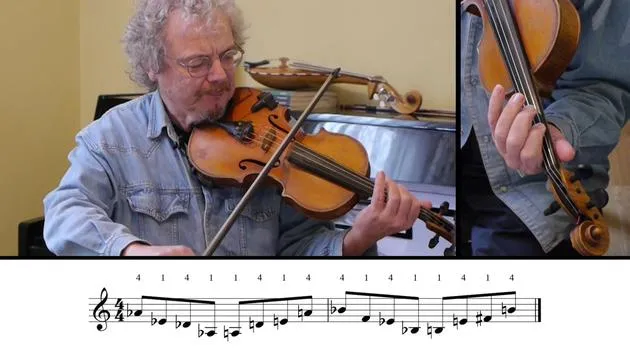
Here's a pattern:
Because it stays in first position, there's no logic to the fingering, so you have to just memorize it.
Use of Augmented Chords
Common Occurrence
Augmented chords are not very common. They usually occur as an alternative to the seventh chord, punctuating the end of a line, a section, or a sequence.
Example
Here's an extended G augmented chord sequence.
28 Lektionen
1 Std. 46 Min. strukturierte Videolektionen
Erweiterte Videofunktionen
Verlangsamen, Passagen loopen, mitlesen
Handy, Tablet & Desktop
Üben, wo du willst
100 % Zufriedenheitsgarantie
30 Tage Geld-zurück-Garantie
Lern deinen Guru kennen
Lern deinen Guru kennen
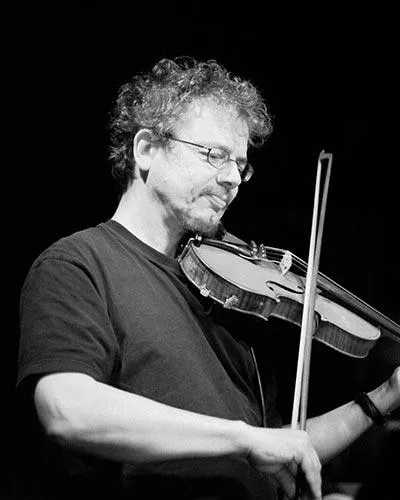
Chris Haigh ist seit 25 Jahren professioneller Fiddle-Spieler mit Erfahrung in vielen verschiedenen Genres. Er hat auf über 75 Alben gespielt und dabei mit Künstlern wie Alison Moyet, Bob Geldof, All About Eve, Michael Ball, David Soul, Oumou Sangare, The Quireboys, Riverdance, Morcheeba, James Galway und Steps zusammengearbeitet.
Er hat Swing-Jazz mit The Kimbara Brothers, Diz Disley, Le Jazz, The Hot Club of London und den Quecumbar Allstars gespielt und leitet die siebenköpfige sowjetische Swing-Band The Kremlinaires.
Chris gibt Unterricht und Workshops zur Jazzgeigen-Technik und hat Jazzgeige an den Universitäten Middlesex, Brunel und Newcastle sowie am Truro College unterrichtet. Zu seinen Veröffentlichungen zählen neun Fiddle-Bücher, darunter The Fiddle Handbook.
Außerdem betreibt er Fiddling Around (fiddlingaround.co.uk), vermutlich die umfassendste und meistbesuchte Quelle für Fiddle-Wissen im Netz.







