



Akkord-Grundlagen
Mit
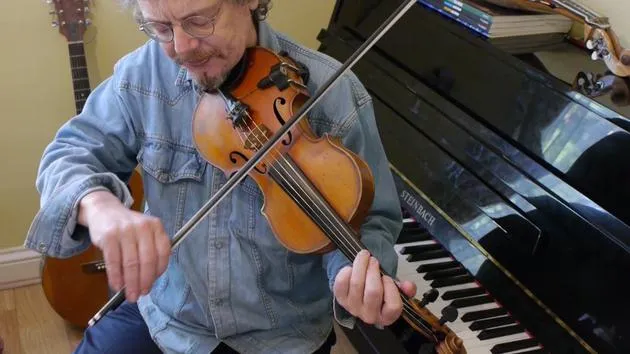
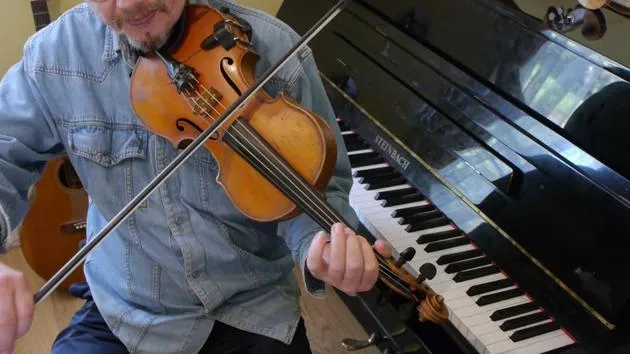
Chris HaighChris Haigh erklärt Jazz-Akkorde von Grund auf für Geiger – wie ein Dreiklang aus Grundton, Terz und Quinte aufgebaut wird.
Das steckt im Kurs
28 Lektionen (1h 46m) · 1 gratis
01. Verminderte Akkorde
6:10
02. Aufgabe: vermindert
0:17
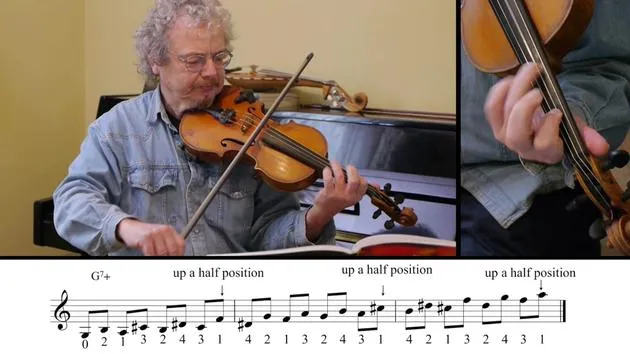
03. Übermäßige Akkorde
3:48
04. Aufgabe: übermäßige Akkorde
0:19
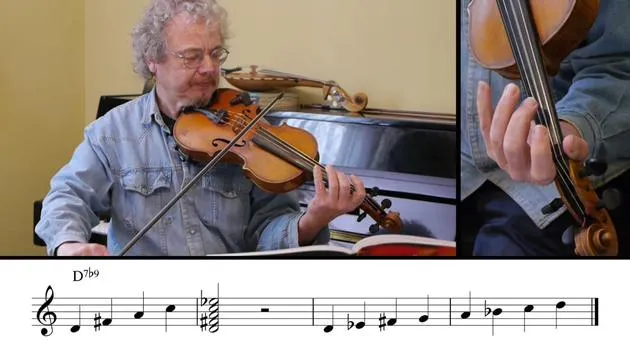
05. Minor 7b5/7b9
2:24
06. Aufgabe m7b5/7b9
1:15
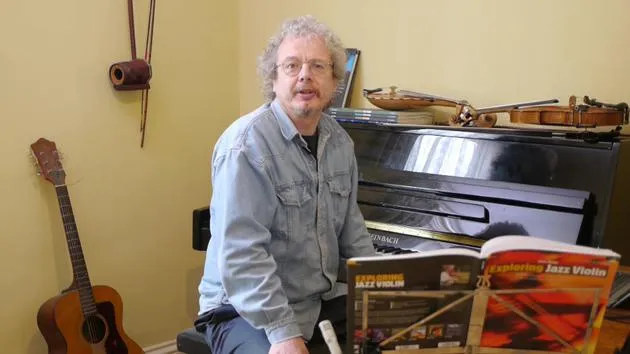
07. Slash- und sus-Akkorde
6:18
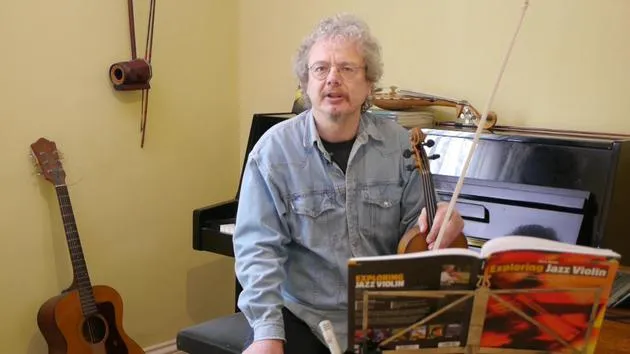
08. Aufgabe: Slash- und Sus-Akkorde
0:18
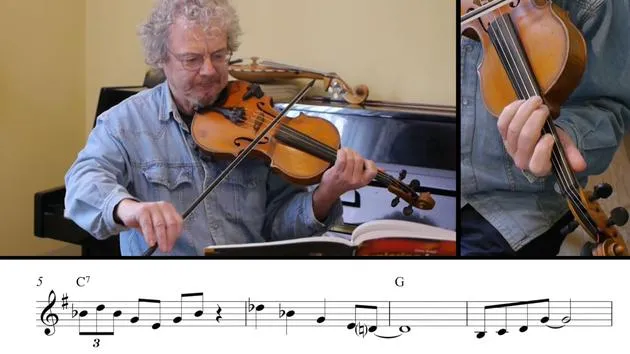
09. Substitutionen und 'outside' spielen
7:21
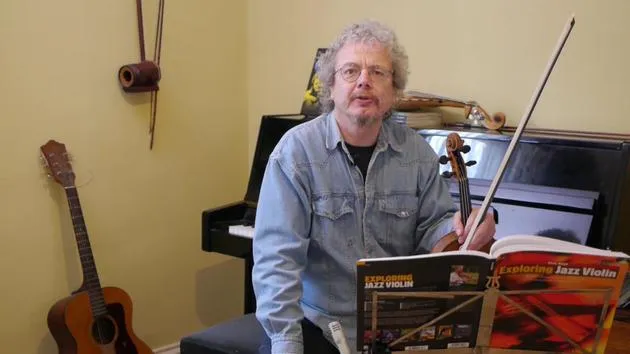
10. Aufgabe: Outside spielen
0:29
Transkript der Lektion
Understanding Jazz Chords for Violinists
Chords can pose a significant challenge for most jazz violinists, especially since we primarily play a single line instrument and often start with classical or folk music, neither of which requires a strong understanding of chords. In this series of videos, I'll guide you through the basics of chord sequences and how to handle them.
Introduction to Chords
In this lesson, I'm going to explain chords from first principles. At its simplest, a chord is made up of three notes known as a triad. These are:
- Root
- Third
- Fifth
For example, the C major chord consists of the notes from the C major scale:
- C (the root)
- E (the third)
- G (the fifth)
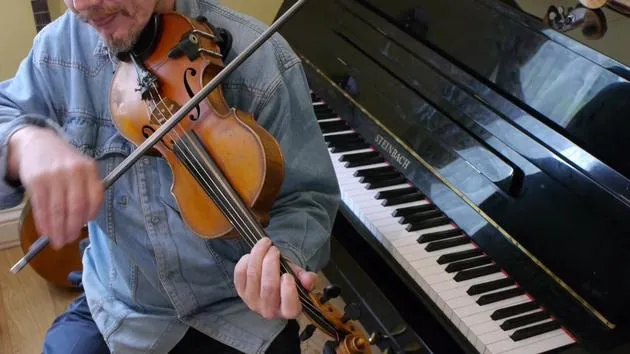
Demonstration on Piano
Let me demonstrate that for you on the piano:
- C (the root)
- E (the third)
- G (the fifth)
Why 1, 3, and 5?
You might wonder:
- Why use 1, 3, and 5?
- Why not use 1, 2, and 4, or 2, 4, and 6?
We miss out alternate notes to create harmony. Notes a third apart will harmonize together, whereas notes that are not separated will not. That's why we start off with 1, 3, and 5.
- In terms of semitones, 1 and 3 notes are four semitones apart.
- This interval is called a major third, which is four semitones or two tones.
- The distance from 3 to 5 gives us:
- One semitone (1 to 2)
- Two semitones (2 to 3)
- Three semitones (3 to 4)
- This total is a tone and a half or three semitones, also reflecting a minor third.
Major and Minor Chords
As a general rule:
- A major third with a minor third on top of it makes a major chord.
- A minor third with a major third on top makes a minor chord.
The Perfect Fifth
The fifth note is called a perfect fifth, the distance between the root and the fifth.
- So far, we've looked at three-note chords, which are either major or minor.
- Most jazz chords, however, include at least four notes: 1, 3, 5, and a 7.
Four-Note Chords and the C Major Scale
The seventh note can either be a major or minor third above the fifth, altering the sound of the chord. Returning to C:
- C chord: 1, 3, 5
- A minor third above creates C7.
- A major third above the fifth creates C major 7.
Let's explore the four-note chords of each degree of the C major scale.
Chords Based on the C Major Scale
-
C Major 7
- First degree of the scale.
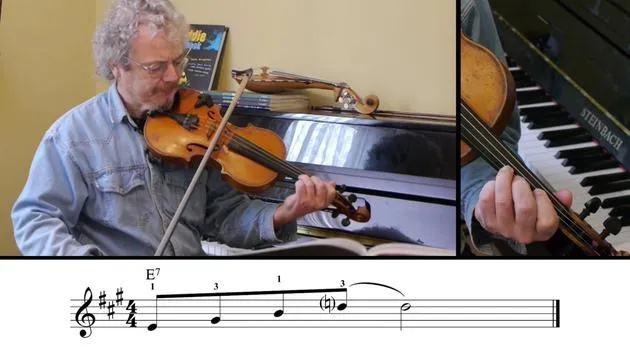
- Notes: C (1), E (3), G (5), B (7)
- Can be referred to as C Maj 7, C capital M7, or C Triangle 7.
-
D Minor 7
- Second degree (D).
- Third: Minor third above root
- Chord: D minor 7.
-
E Minor 7
- Third degree (E).
- Chord: E minor 7.
-
F Major 7
- Fourth degree (F).
- Chord: F major 7.
-
G7 (Dominant)
- Fifth degree (G).
- Chord: G7, a major chord with a flattened seventh.
-
A Minor 7
- Sixth degree (A).
- Chord: A minor 7.
-
B Minor 7 Flat Fifth
- Seventh degree (B).
- First part: Minor third (B to D)
- Second part: Minor third (D to F)
- Chord: B minor 7 flat fifth or B half diminished.
Summary of Diatonic Chords
To summarize, the chords based on each degree of the C major scale are:
- C Major 7
- D Minor 7
- E Minor 7
- F Major 7
- G7
- A Minor 7
- B Minor 7 flat fifth
Using the key of C makes it easier to demonstrate on a keyboard since it has no sharps or flats.
Chords in Other Keys
You can apply the same principles to work out the chords for any key or scale. The chords built from a specific scale are known as the diatonic chords for that scale.
This is crucial for you as a beginning improviser because:
- All chords come from a single major scale, meaning you can use all notes of the scale over any of the chords.
- Be advised that any non-diatonic chords may clash with the scale notes, proceed with caution.
Assignment
As a good exercise, ensure you understand this lesson by using another key, such as G major, and work out the chords based on each degree of the scale.
28 Lektionen
1 Std. 46 Min. strukturierte Videolektionen
Erweiterte Videofunktionen
Verlangsamen, Passagen loopen, mitlesen
Handy, Tablet & Desktop
Üben, wo du willst
100 % Zufriedenheitsgarantie
30 Tage Geld-zurück-Garantie
Lern deinen Guru kennen
Lern deinen Guru kennen
Chris Haigh ist seit 25 Jahren professioneller Fiddle-Spieler mit Erfahrung in vielen verschiedenen Genres. Er hat auf über 75 Alben gespielt und dabei mit Künstlern wie Alison Moyet, Bob Geldof, All About Eve, Michael Ball, David Soul, Oumou Sangare, The Quireboys, Riverdance, Morcheeba, James Galway und Steps zusammengearbeitet.
Er hat Swing-Jazz mit The Kimbara Brothers, Diz Disley, Le Jazz, The Hot Club of London und den Quecumbar Allstars gespielt und leitet die siebenköpfige sowjetische Swing-Band The Kremlinaires.
Chris gibt Unterricht und Workshops zur Jazzgeigen-Technik und hat Jazzgeige an den Universitäten Middlesex, Brunel und Newcastle sowie am Truro College unterrichtet. Zu seinen Veröffentlichungen zählen neun Fiddle-Bücher, darunter The Fiddle Handbook.
Außerdem betreibt er Fiddling Around (fiddlingaround.co.uk), vermutlich die umfassendste und meistbesuchte Quelle für Fiddle-Wissen im Netz.







