



Letzte Tipps und Tricks
Mit
Chris HaighChris Haigh schließt den Kurs mit praktischen Tipps ab, wie du dir erreichbare Ziele setzt und Jazz-Violine lernst, übst und aufführst.
Das steckt im Kurs
28 Lektionen (1h 46m) · 1 gratis
01. Verminderte Akkorde
6:10
02. Aufgabe: vermindert
0:17
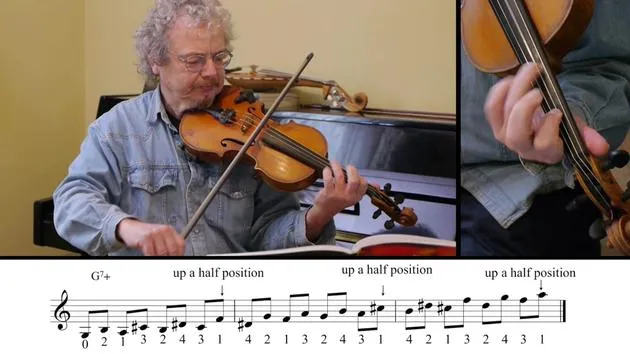
03. Übermäßige Akkorde
3:48
04. Aufgabe: übermäßige Akkorde
0:19
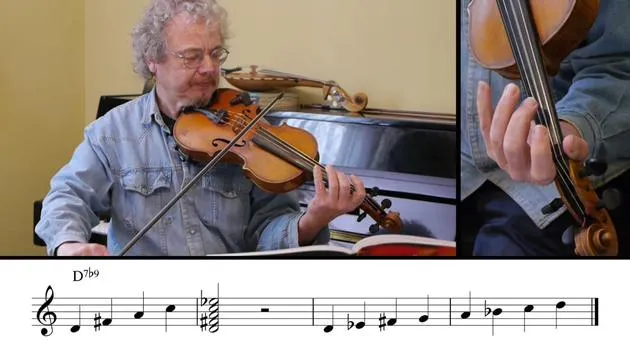
05. Minor 7b5/7b9
2:24
06. Aufgabe m7b5/7b9
1:15
07. Slash- und sus-Akkorde
6:18
08. Aufgabe: Slash- und Sus-Akkorde
0:18
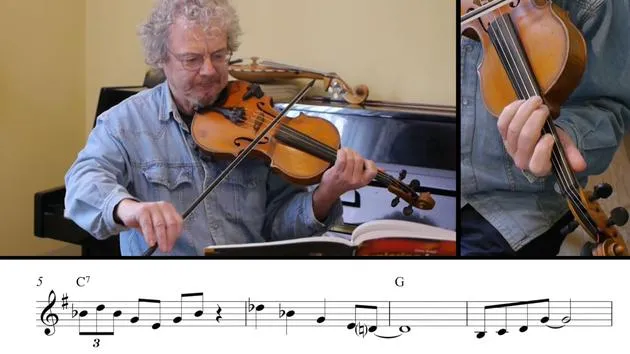
09. Substitutionen und 'outside' spielen
7:21
10. Aufgabe: Outside spielen
0:29
Transkript der Lektion
Final Thoughts on Learning Jazz Violin
Okay, so very well done for getting through the course. I'll just round up a few final thoughts on learning:
Individual Achievable Goals
First of all, I mentioned before, it's very useful and important to give yourself individual, achievable goals for each task that you're looking at.
- Decide for each thing that you're learning:
- How long is this going to take me to absolutely master it?
You might play it and think you've learned it within a few minutes, but until you can do that without thinking, you haven't really learned it.
Consider Timeframes:
- Is this going to take:
- 10 minutes?
- 10 days?
- 10 years?
Remember that some things do take 10 years. No one said the jazz violin was going to be easy.
Practicing One Thing at a Time
Secondly, when you're practicing, practice one thing at a time.
- Don't jump straight in with a piece and start soloing on it, thinking about everything and nothing at once.
- What you need to do when practicing soloing is to think about:
- Phrasing
- Positions
- Scales
- Chords
Hopefully, when you get up and perform, you can forget everything and hope that it's all in that part of your brain where you don't have to think about it, but you actually know it.
Conscious vs. Unconscious Learning
This idea of getting things from the conscious to the unconscious part of the brain is one of the most difficult things to achieve.
- When I learn a new riff, especially a difficult one, I start by learning it in one key.
- To get that riff so familiar that it comes out without me even thinking about it, in any key and in any tune, sometimes takes years of practice.
Often, I will over-practice something or overplay it, so I learn something new.
- For the next few months, every time I play any tune, I might use this technique over and over again.
While it may be annoying, getting something totally integrated into your playing is important.
Building Your Repertoire
It's essential to get yourself a good repertoire of standards and to listen to lots of different versions of those standards.
- I recommend you get yourself a folder and put in the sheet music as you collect it.
- Before too long, you'll have a folder full enough to go out and do a gig or a rehearsal, knowing you have 20, 30, 40, or 50 numbers that other people will know.
Practice with Chords
When you practice, always try to practice with chords.
- This is apart from maybe the first time you are actually learning a melody when the melody itself is useful.
- As soon as you want to start soloing on something, you've got to have backing chords.
You can use the backing chords from this course or from software like:
- Band-in-a-Box
- iReal Pro
Playing with Other Musicians
Even though you might start off working entirely on your own or with your laptop, your aim should always be to play with other musicians.
- As soon as you can, look out for other people who are at a similar or slightly higher standard than you and try to get out and practice with them.
- Hopefully, you may be able to form a band and start doing gigs.
Resources for Further Learning
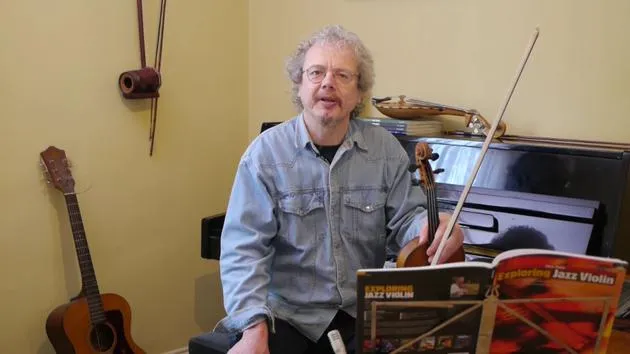
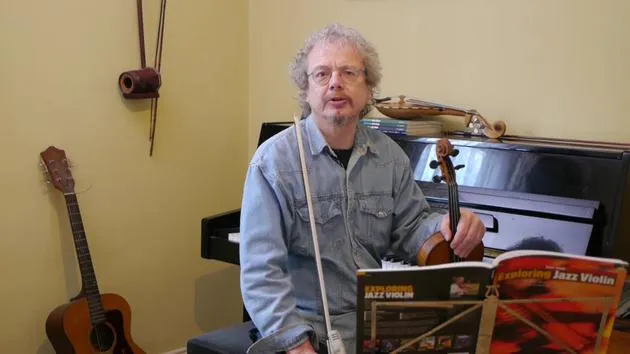
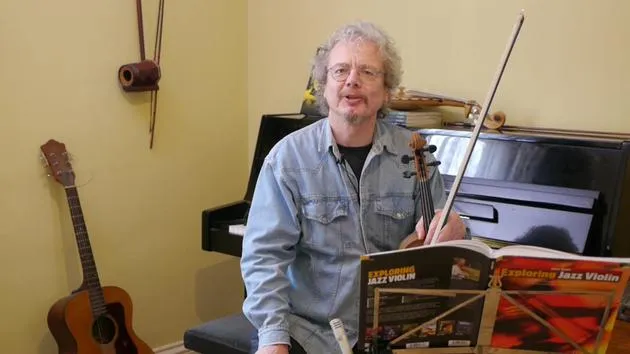
All of the content in this course comes from the book Exploring Jazz Violin, which goes into greater detail than we've covered in these videos and covers a broader scope.
I recommend that you get a copy, published by Schott. Additionally, Schott will soon be publishing another book of mine, Beginning Jazz Violin, which goes through the earlier chapters in more detail for slower or earlier learners.
You can also take a look at my website, fiddlingaround.co.uk, where you'll find:
- Ideas about learning and teaching jazz violin
- Information about the history of jazz violin
- Details about the players we've mentioned
- Information about various other fiddle styles from around the world
Getting in Touch
Finally, I'd be very happy to hear from you!
- You can ask me specific questions or send videos of your playing.
- I can send you back comments or videos that demonstrate the kind of direction you might want to take your playing in.
I hope it's been as much fun for you as it has been for me. You have plenty to work on for months, if not years, and I hope to see you playing on stage one day!
28 Lektionen
1 Std. 46 Min. strukturierte Videolektionen
Erweiterte Videofunktionen
Verlangsamen, Passagen loopen, mitlesen
Handy, Tablet & Desktop
Üben, wo du willst
100 % Zufriedenheitsgarantie
30 Tage Geld-zurück-Garantie
Lern deinen Guru kennen
Lern deinen Guru kennen
Chris Haigh ist seit 25 Jahren professioneller Fiddle-Spieler mit Erfahrung in vielen verschiedenen Genres. Er hat auf über 75 Alben gespielt und dabei mit Künstlern wie Alison Moyet, Bob Geldof, All About Eve, Michael Ball, David Soul, Oumou Sangare, The Quireboys, Riverdance, Morcheeba, James Galway und Steps zusammengearbeitet.
Er hat Swing-Jazz mit The Kimbara Brothers, Diz Disley, Le Jazz, The Hot Club of London und den Quecumbar Allstars gespielt und leitet die siebenköpfige sowjetische Swing-Band The Kremlinaires.
Chris gibt Unterricht und Workshops zur Jazzgeigen-Technik und hat Jazzgeige an den Universitäten Middlesex, Brunel und Newcastle sowie am Truro College unterrichtet. Zu seinen Veröffentlichungen zählen neun Fiddle-Bücher, darunter The Fiddle Handbook.
Außerdem betreibt er Fiddling Around (fiddlingaround.co.uk), vermutlich die umfassendste und meistbesuchte Quelle für Fiddle-Wissen im Netz.







