



Songstruktur und Arrangement-Ansicht

Mit
John WatsonWie du deine aufgenommenen Clips in der Arrangement-Ansicht von Ableton zu einem drei- bis vierminütigen Song anordnest und die Pegel für eine klare Struktur automatisierst.
Das steckt im Kurs
14 Lektionen (1h 39m) · 2 gratis
01. Erste Schritte und Geräte-Setup
11:07
02. Ideen mit MIDI entwickeln - Einführung in MIDI
Gratis-Lektion6:12
03. Eine einfache Rhythmus-Guide-Spur aufnehmen
7:41
04. Audio aufnehmen: Einrichtung und Pegel
6:21
05. Audio aufnehmen
6:25
06. Ein externes Instrument verwenden
3:27
07. Die Basslinie erstellen
11:05
08. Eine weitere Rhythmusspur hinzufügen
2:50
09. Premixing & Session View
9:59
10. Songstruktur und Arrangement-Ansicht
Du bist hier8:47
11. Mischen: EQ und Kompression
7:37
12. Räumliche Effekte
4:40
13. Modulationseffekte
5:26
14. BONUS: Eine Basslinie mit dem Doepfer Dark Energy II erstellen
Gratis-Lektion7:26
Transkript der Lektion
Music Lesson: Creating a Cohesive Arrangement
Moving to Record or Range View
So, the next stage is to actually move over into what we call Record or Range View.
-
Double Click the Stop Button
This ensures that none of these clips are able to play. -
Start Recording
- Go up to the first scene and click Record.
- Start triggering the scenes.
- Get rid of the metronome as it's not needed right now.
Live Recording and Adjustments
In Section 2:
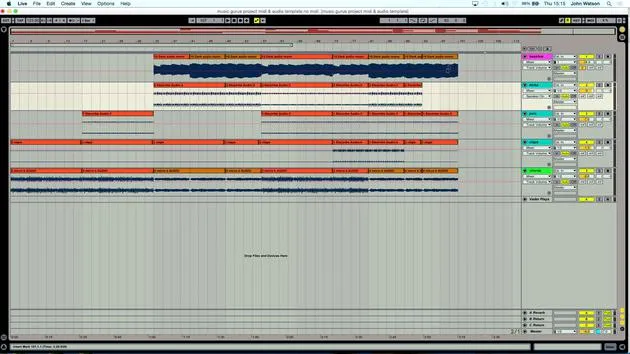
- As you can see, by launching these scenes, if I press Tab on my keyboard, you can see that it's actually recording these scenes as I'm generating them into this arrangement.
- A lot of the work is done for you.
Structure Review
My structure is now here, and I'm fairly happy with it. However, there are a few adjustments I'd like to make:
-
Trim the Ending
The ending feels like it goes on for a little bit. I'd like to trim this back a touch. -
Adjust the Bass
With the bass, I'm just going to pull out its original length. I recorded just half the bass and then repeated that half. I actually just want the full thing. -
Linking Sections
These two sections don't necessarily link particularly well, so I think I will drop a little section of the audio here and maybe drop the first kick as well.
Volume Fades for Smooth Transitions
To help with introducing elements rather than having them come in at full volume one at a time, I'll do little volume fades:
- I've put the claps back in.
- When the percussion comes in, let's add a little volume fade.
Creating a Volume Fade
-
Select the Track
Click in the track where the little red line represents the volume automation. -
Adjust Volume
- Click before it and pull the volume down.
- This creates a nice little fade-in for the percussion layer over time.
-
Fade at the End
I'll do the same at the end of the track, pulling down the percussion and likely the bass too.
Working with Clips
One way to create fades is to:
- Grab a clip, right-click, and select Show Fades.
- Pull in a little fade.
Joining Sections Smoothly
To connect different sections, especially during a key change or verse-chorus structure:
-
Manipulate the Audio
Cut some of the audio just before the new section comes in. -
Reverse Audio for Effects
For instance, in the section we jump back to, I will double-click it and then reverse the audio. This creates a nice little drum fill with the drums going backwards for a moment.
Final Steps
I think I'm pretty happy now in terms of the structure. The next thing to do is to start adding effects, mixing it, and making it sound more cohesive as one piece.
14 Lektionen
1 Std. 39 Min. strukturierte Videolektionen
Erweiterte Videofunktionen
Verlangsamen, Passagen loopen, mitlesen
Handy, Tablet & Desktop
Üben, wo du willst
100 % Zufriedenheitsgarantie
30 Tage Geld-zurück-Garantie
Lern deinen Guru kennen
Lern deinen Guru kennen
Nach einem Praktikum bei Dave Allen, dem Produzenten von Depeche Mode und The Cure, ließ sich John dazu inspirieren, in London Music Technology zu studieren. Seine Musikkarriere nahm nach einem erfolgreichen Vertrag bei CookShop Records Fahrt auf, wo er 9 Singles und 2007 ein Album veröffentlichte, das begeisterte Kritiken von Q, Uncut und Lowdown Magazine sowie Airplay bei XFM und Radio One erhielt.
John begann seine Ausbildung zum Tontechniker 2005 im Bonafide-Studio, wo er sein Können verfeinerte, und gründete noch im selben Jahr Jackdaw Recordings. Er hat mit vielen erfolgreichen Künstlern zusammengearbeitet und begann 2007, für den Pop-Musiker Patrick Wolf zu spielen, mit Auftritten in führenden Häusern in Großbritannien und international – darunter The Astoria und das Shepherds Bush Empire.
Von seinem Londoner Studio aus schreibt John heute Musik, mit zwei weiteren Veröffentlichungen bei CookShop, macht Tontechnik für namhafte Künstler und gestaltet Sounddesign für TV-Spots, Film, Theater und Unternehmensvideos.
Genau diese seltene Mischung aus Songwriter, Produzent und aktivem Studiotechniker bringt John in seinen Unterricht ein. In Creative Composition & Production in Ableton Live und Creative Sampling & Production in Ableton Live zeigt er dir, wie er aus rohen Ideen fertige, veröffentlichungsreife Tracks macht – das Schreiben, das Sampling, das Sounddesign und das praktische technische Know-how hinter einer professionellen Platte.







