



Adaptive project tempo
With
Aamir YaqubAamir Yaqub shows how to use Logic's Smart Tempo and Adapt Project Tempo so the grid follows your playing when you record freely without a click.
What's in the course
14 lessons (1h 22m) · 1 free
01. Welcome to Recording audio
0:58
02. Intro to recording audio
4:47
03. Using the metronome
5:00
04. Making your first recording
Free lesson5:32
05. Comping
13:03
06. Editing audio
9:41
07. Managing project files
3:46
08. Recording an instrument track
2:06
09. How to use Flex Time
10:58
10. How to use Flex Pitch
11:12
11. Converting pitch to MIDI data
3:11
12. Smart Tempo
3:04
13. Varispeed parameters and uses
4:08
14. Adaptive project tempo
You are here5:00
Lesson transcript
Working with Smart Tempo in Logic
So, a really handy feature that we have when we're working with Smart Tempo is actually different from the example shown before, which involved pre-recorded audio.
Free Recording Without a Click
What if I was just sitting here playing guitar and thought, "I want to put the idea in, but I don't want to record with a click?" I want my grid and my tempo to conform to what I'm playing.
Logic uses Smart Tempo to help you when you're free recording, meaning you're recording without a click. Here's how to do it:
-
Adapt Project Tempo
- Go to the LCD and select Adapt Project Tempo.
- Once you've done that, you'll see a notification appear, but it won't do anything yet.
-
Disable the Metronome
- Right-click on the metronome and ensure it's not clicking while recording.
-
Start Recording
- Now you can press Record. This will start to adapt to and follow the tempo you are playing.
Demonstration
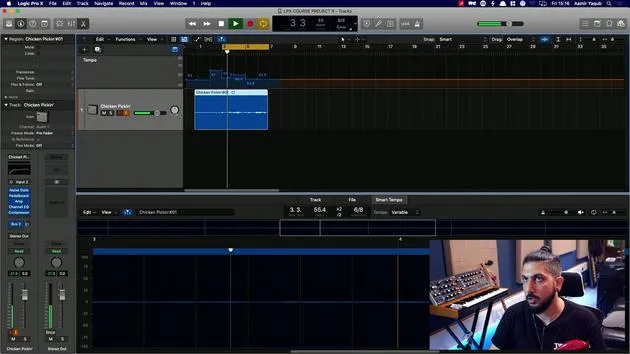
You can see that I've got my record going on. If I just start strumming, Logic will now detect the tempo, and as you can see, it's moving the tempo around.
Smart Tempo Editor
Next, you'll get a prompt that says "Click Show to open the Smart Tempo editor." Here you can:
- Preview the audio file.
- Shift the downbeat if needed.
- Adjust the detected tempo.
Now, let's look at the editor.
-
Identify the Downbeat
-
The first beat you've played should be set as the downbeat.
-
Let's zoom into the waveform to see what's going on.
-
If I look closely, I can identify that the first hit there is actually the downbeat. The downbeat just means the first beat of the bar.
-
-
Adjust the Downbeat Marker
- Move the marker to signify that as being the downbeat.
Tempo Changes
When I adjust that marker, you'll notice that the tempo has changed in my global tempo track. It didn't just jump from 78.5 to 38.8, so you might need to adjust the next downbeat marker as well.
- Move the marker back to accurately represent the start of the bar.
- As I progress, I adjust it accordingly to reflect where the music actually starts.
This consistency allows my tempo map to change constantly because I'm not stuck in a rigid tempo.
Adding Drums
Next, if I wanted to go in and program some drums or even use something like Drummer, I can do that easily:
- Add a Drummer Track
- Go to add a drummer track, select the songwriter option, and pick a drummer.
- Let's choose Mason and see what he brings to the mix.
You can see there that the drummer adapts to the tempo changes. This is signified in the global tempo track and allows for dynamic adjustments.
Final Thoughts
You might find that sometimes the tempo feels a little too fast or too slow, especially with a range jump from 80 to 120.
Always make sure your markers are in the right place, and everything should work out just fine.
14 lessons
1h 22m of structured video lessons
Advanced video features
Slow down, loop a passage, follow along
Mobile, tablet & desktop
Practise wherever you are
100% satisfaction guarantee
30-day money-back guarantee
Meet your guru
Meet your guru
Aamir Yaqub is a music producer and engineer based in London. He has worked with some of the biggest names in music, including Alicia Keys, David Guetta, Rihanna, Sia and will.i.am, as well as developing independent artists.
Across his courses he teaches his complete Logic Pro workflow - from the interface and recording through beat-making, synthesis and MIDI effects to mixing and finishing a track.







