



Advanced Arpeggio Work - Using Sevenths & Inversions
With
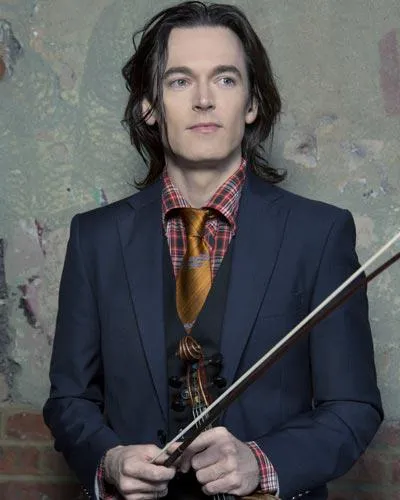
Zach BrockStack sevenths onto your arpeggios and invert them, the way a pianist or guitarist reworks chord voicings, to deepen your understanding of harmony on the violin.
What's in the course
24 lessons (2h 32m) · 1 free
Lesson transcript
Stacking Triads and Seventh Chords: A G Major Lesson
After you've played your triads, I want you to stack something one more third above that. Remember, this is all completely diatonic, so the only thing that you have to remember is the key signature.
Key Signature: G Major
- We're playing in the key of G major.
- Everything is a natural note except for F sharp.
As I start to stack these things above a triad, a third above this, diatonically, it's not F natural; it's F sharp. This is the sound of an A major seven arpeggio.
Exercise: Adding a Third
So, I want you to do the same thing that you did with your triads, but add one more third above that.
- This can really be helpful.
- I spent a lot of my early years writing exercises out for myself.
Don't think that you should be able to achieve 100% accuracy in this type of stuff. Just like I'm doing it right now:
- If it's difficult for you, it's definitely worth getting some manuscript paper.
- Put the key signature there and write the stuff out for yourself.
- Then play it.
Once you do that, and maybe write it out in a few different keys, you'll start to get it.
Note: If you go that route, just make sure not to tie yourself to the page.
I urge you to get the flavor and the technical side, the accuracy together, and then put the stuff down and do it just on your instruments.
Seventh Chords of G Major
Here are the seventh chords of G major:
- First mode
- Second mode
- Third mode
- Fourth mode
- Fifth mode
Ah, that sounds a little bit different now. Dominant.
And here's that weird seventh mode that I said we were going to talk about. So, what is that?
- It's not fully diminished.
- Fully diminished is where everything is stacked in minor thirds.
But this isn't quite that. Here's how it's stacked:
- Minor third
- Minor third
- Major third
This is referred to as the half diminished. You could also call it a Locrian seventh chord, but it's usually referred to as a half diminished or a minor 7 flat 5.
Practice Strategies
I would urge you to do these things just like you did with all of the triads:
- In different directions: up, up, down, down, up, down, down, up.
You're going to start to hear some really interesting things happen. That's just one pattern that I picked, so start playing around with seventh chords.
Inversions of Arpeggios
As string players, we tend to not think about inversions of arpeggios, so we play everything in root position or however the concerto on the page has us playing it.
The first thing that I would like you to do is:
- Take a basic G major arpeggio from the one.
- Now, play from the third of the scale, or the second note of the arpeggio, which is B, and play B to B.
So the first time we went:
- Then I want you to go like this.
- And finally, I want you to go like this.
Inversions
Inversions can be practiced with every type of arpeggio and every chord that you do.
Tip: If you can get to a piano or if you want to write this out so that you can actually see what's going on, do that.
- Go slow,
- Be accurate,
- And have fun!
24 lessons
2h 32m of structured video lessons
Advanced video features
Slow down, loop a passage, follow along
Mobile, tablet & desktop
Practise wherever you are
100% satisfaction guarantee
30-day money-back guarantee
Meet your guru
Meet your guru
Heralded as "the pre-eminent improvising violinist of his generation," Zach Brock is a violinist and composer whose music draws on the traditions of jazz, classical, world and popular music.
Zach received his first Grammy Award in 2017 for his work on Snarky Puppy's album Culcha Vulcha. His acclaim as a bandleader has grown through appearances at venues such as Carnegie Hall and festivals like "Tudo e Jazz" in Brazil, while his reputation as a sideman has spread through his work with legendary bassist Stanley Clarke, contemporary instrumental super-group Snarky Puppy, and jazz masters Phil Markowitz and Dave Liebman.
Zach has made ten recordings as a leader or co-leader and is the first violinist to record for the venerable Dutch jazz label Criss Cross. He has also represented the U.S. Department of State as a Musical Ambassador in the Solomon Islands, performed as a featured soloist for two Sundance Festival feature film scores, and is currently an Artist In Residence at Temple University in Philadelphia.
In his course you will learn to improvise on the violin straight from the source: how Zach approaches melody, rhythm and harmony, and how to start finding your own voice the way he has alongside Snarky Puppy and beyond.







