



Augmented chords
With
Chris HaighThe augmented chord sounds rather exotic and, like the diminished, it is symmetrical. But instead of a pile of minor thirds, the augmented is a pile of major thirds
What's in the course
28 lessons (1h 46m) · 1 free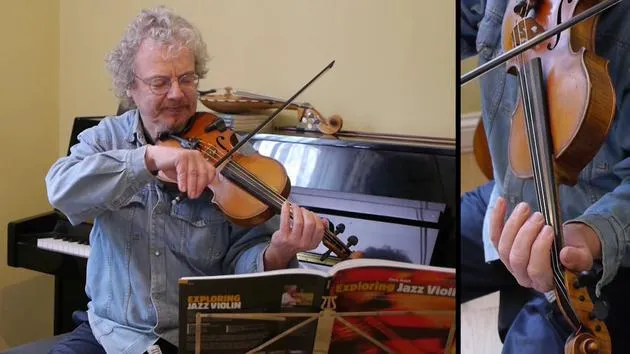
01. Diminished chords
6:10
02. Assignment: diminished
0:17
03. Augmented chords
You are here3:48
04. Assignment: augmented chords
0:19
05. Minor 7b5/7b9
2:24
06. Assignment m7b5/7b9
1:15
07. Slash and sus chords
6:18
08. Assignment: slash and sus chords
0:18
09. Substitutions and playing outside
7:21
10. Assignment: playing outside
0:29
Lesson transcript
Understanding the Augmented Chord
In this chapter, we're going to look at the augmented chord.
Nature of the Augmented Chord
The augmented chord sounds rather exotic. Unlike the diminished chord, it's symmetrical. But instead of a pile of minor thirds, this is a pile of major thirds.
Notation
- G Augmented can be written as:
- G Aug
- G
- G7
- G7, 5
I have to apologize for the absolute mess of chord names, but no one accepts responsibility for the way this has been organized.
Scales and Patterns
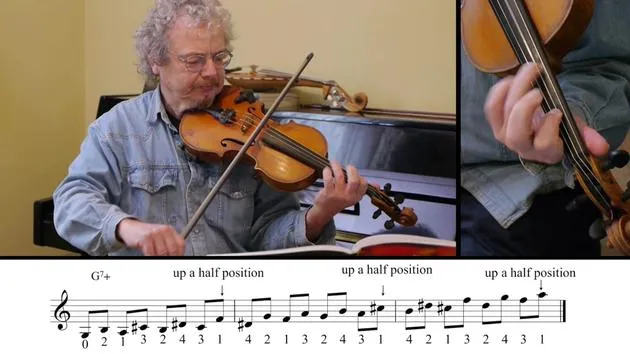
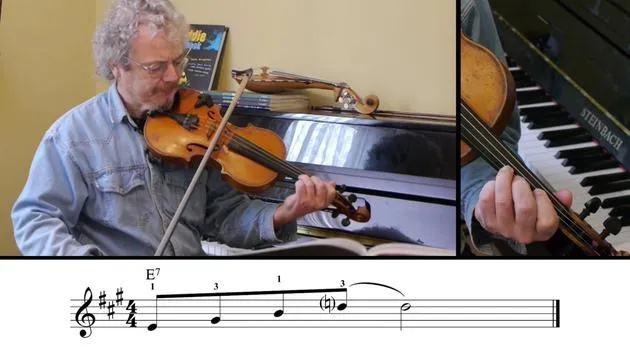
The scale that best fits the augmented chord is the whole tone scale. You can see from the arpeggio that it is a G7 with the fifth sharpened.
Learning Scales
From the point of view of learning scales, the augmented is even better than the diminished because there are only two to learn.
-
The G whole tone scale also works for:
- A
- B
- C sharp
- D sharp
- F natural
-
The AB whole tone scale works for all the others.
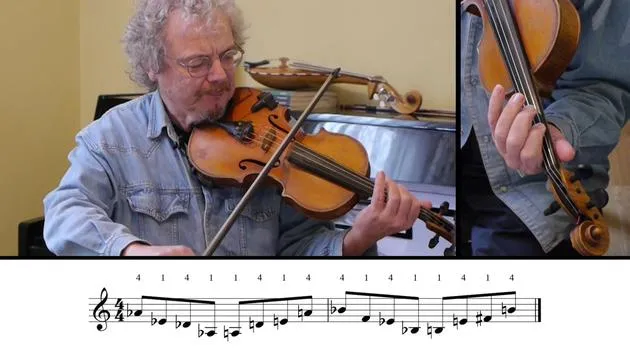
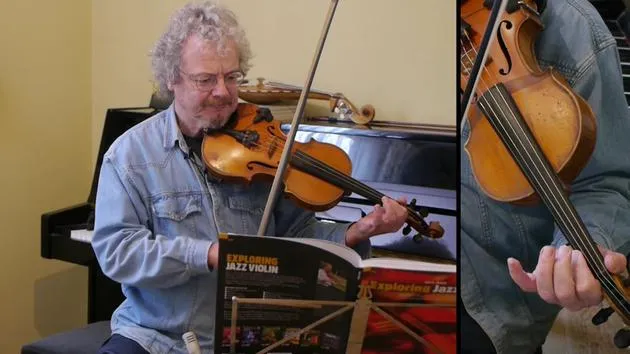
Like the diminished scale, the whole tone scale can use the same fingering on each string, but instead of moving down half a step as you go to the next string, you move up half a step.
Whole Tone Scale Movement
So here is the whole tone scale:
- Up half a position.
- Up half a position.
- Up half a position.
You can do the same thing with scale patterns. Over an augmented chord, you can play a phrase and then transpose it up or down a tone as many times as you like.
Popularity of Descending Patterns
For some reason, descending scales and patterns seem to be more useful and popular than ascending ones.
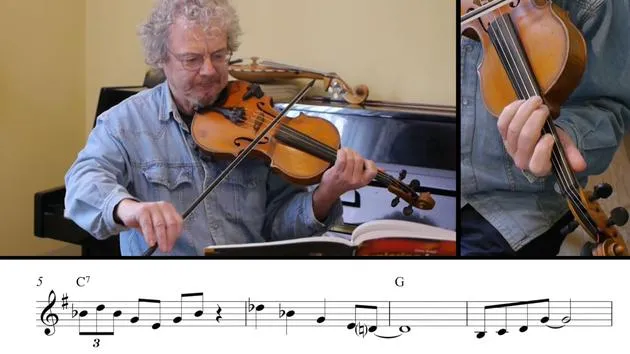
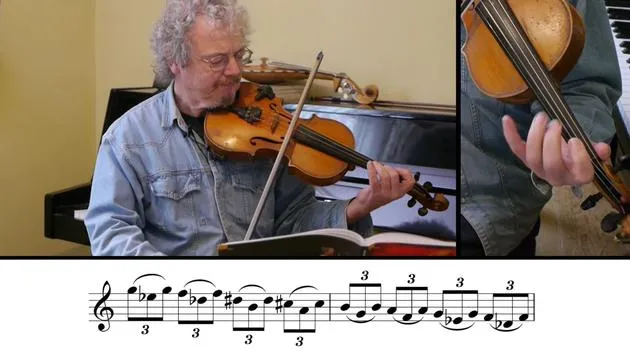
Here's a pattern:
Because it stays in first position, there's no logic to the fingering, so you have to just memorize it.
Use of Augmented Chords
Common Occurrence
Augmented chords are not very common. They usually occur as an alternative to the seventh chord, punctuating the end of a line, a section, or a sequence.
Example
Here's an extended G augmented chord sequence.
28 lessons
1h 46m of structured video lessons
Advanced video features
Slow down, loop a passage, follow along
Mobile, tablet & desktop
Practise wherever you are
100% satisfaction guarantee
30-day money-back guarantee
Meet your guru
Meet your guru
Chris Haigh has been a professional fiddle player for 25 years, with experience covering many different genres. He has played on over 75 albums, working with artists including Alison Moyet, Bob Geldof, All About Eve, Michael Ball, David Soul, Oumou Sangare, The Quireboys, Riverdance, Morcheeba, James Galway and Steps.
He has played swing jazz with The Kimbara Brothers, Diz Disley, Le Jazz, The Hot Club of London, and the Quecumbar Allstars, and leads a 7-piece Soviet swing band, The Kremlinaires.
Chris gives lessons and workshops on jazz violin technique and has taught jazz violin at Middlesex, Brunel and Newcastle universities and Truro College. His writing credits include nine fiddle books, among them The Fiddle Handbook.
He also runs Fiddling Around (fiddlingaround.co.uk), probably the most comprehensive and widely visited source of fiddle information on the web.







