



Chord basics
With
Chris HaighChris Haigh explains jazz chords from first principles for violinists - how a triad is built from the root, third and fifth.
What's in the course
28 lessons (1h 46m) · 1 free
01. Diminished chords
6:10
02. Assignment: diminished
0:17
03. Augmented chords
3:48
04. Assignment: augmented chords
0:19
05. Minor 7b5/7b9
2:24
06. Assignment m7b5/7b9
1:15
07. Slash and sus chords
6:18
08. Assignment: slash and sus chords
0:18
09. Substitutions and playing outside
7:21
10. Assignment: playing outside
0:29
Lesson transcript
Understanding Jazz Chords for Violinists
Chords can pose a significant challenge for most jazz violinists, especially since we primarily play a single line instrument and often start with classical or folk music, neither of which requires a strong understanding of chords. In this series of videos, I'll guide you through the basics of chord sequences and how to handle them.
Introduction to Chords
In this lesson, I'm going to explain chords from first principles. At its simplest, a chord is made up of three notes known as a triad. These are:
- Root
- Third
- Fifth
For example, the C major chord consists of the notes from the C major scale:
- C (the root)
- E (the third)
- G (the fifth)
Demonstration on Piano
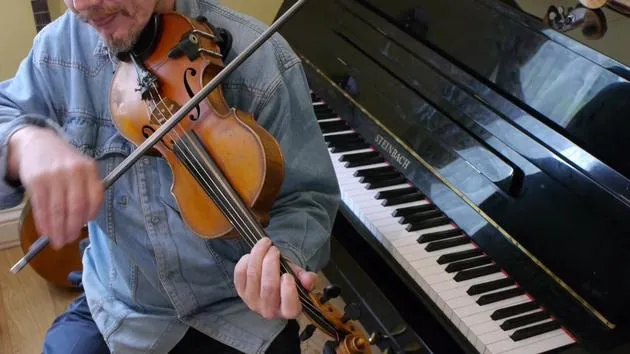
Let me demonstrate that for you on the piano:
- C (the root)
- E (the third)
- G (the fifth)
Why 1, 3, and 5?
You might wonder:
- Why use 1, 3, and 5?
- Why not use 1, 2, and 4, or 2, 4, and 6?
We miss out alternate notes to create harmony. Notes a third apart will harmonize together, whereas notes that are not separated will not. That's why we start off with 1, 3, and 5.
- In terms of semitones, 1 and 3 notes are four semitones apart.
- This interval is called a major third, which is four semitones or two tones.
- The distance from 3 to 5 gives us:
- One semitone (1 to 2)
- Two semitones (2 to 3)
- Three semitones (3 to 4)
- This total is a tone and a half or three semitones, also reflecting a minor third.
Major and Minor Chords
As a general rule:
- A major third with a minor third on top of it makes a major chord.
- A minor third with a major third on top makes a minor chord.
The Perfect Fifth
The fifth note is called a perfect fifth, the distance between the root and the fifth.
- So far, we've looked at three-note chords, which are either major or minor.
- Most jazz chords, however, include at least four notes: 1, 3, 5, and a 7.
Four-Note Chords and the C Major Scale
The seventh note can either be a major or minor third above the fifth, altering the sound of the chord. Returning to C:
- C chord: 1, 3, 5
- A minor third above creates C7.
- A major third above the fifth creates C major 7.
Let's explore the four-note chords of each degree of the C major scale.
Chords Based on the C Major Scale
-
C Major 7
- First degree of the scale.
- Notes: C (1), E (3), G (5), B (7)
- Can be referred to as C Maj 7, C capital M7, or C Triangle 7.
-
D Minor 7
- Second degree (D).
- Third: Minor third above root
- Chord: D minor 7.
-
E Minor 7
- Third degree (E).
- Chord: E minor 7.
-
F Major 7
- Fourth degree (F).
- Chord: F major 7.
-
G7 (Dominant)
- Fifth degree (G).
- Chord: G7, a major chord with a flattened seventh.
-
A Minor 7
- Sixth degree (A).
- Chord: A minor 7.
-
B Minor 7 Flat Fifth
- Seventh degree (B).
- First part: Minor third (B to D)
- Second part: Minor third (D to F)
- Chord: B minor 7 flat fifth or B half diminished.
Summary of Diatonic Chords
To summarize, the chords based on each degree of the C major scale are:
- C Major 7
- D Minor 7
- E Minor 7
- F Major 7
- G7
- A Minor 7
- B Minor 7 flat fifth
Using the key of C makes it easier to demonstrate on a keyboard since it has no sharps or flats.
Chords in Other Keys
You can apply the same principles to work out the chords for any key or scale. The chords built from a specific scale are known as the diatonic chords for that scale.
This is crucial for you as a beginning improviser because:
- All chords come from a single major scale, meaning you can use all notes of the scale over any of the chords.
- Be advised that any non-diatonic chords may clash with the scale notes, proceed with caution.
Assignment
As a good exercise, ensure you understand this lesson by using another key, such as G major, and work out the chords based on each degree of the scale.
28 lessons
1h 46m of structured video lessons
Advanced video features
Slow down, loop a passage, follow along
Mobile, tablet & desktop
Practise wherever you are
100% satisfaction guarantee
30-day money-back guarantee
Meet your guru
Meet your guru
Chris Haigh has been a professional fiddle player for 25 years, with experience covering many different genres. He has played on over 75 albums, working with artists including Alison Moyet, Bob Geldof, All About Eve, Michael Ball, David Soul, Oumou Sangare, The Quireboys, Riverdance, Morcheeba, James Galway and Steps.
He has played swing jazz with The Kimbara Brothers, Diz Disley, Le Jazz, The Hot Club of London, and the Quecumbar Allstars, and leads a 7-piece Soviet swing band, The Kremlinaires.
Chris gives lessons and workshops on jazz violin technique and has taught jazz violin at Middlesex, Brunel and Newcastle universities and Truro College. His writing credits include nine fiddle books, among them The Fiddle Handbook.
He also runs Fiddling Around (fiddlingaround.co.uk), probably the most comprehensive and widely visited source of fiddle information on the web.







