



Rhythm

With
Juliet RussellHow do you get good rhythm? Juliet introduces us to time signatures with some fun ways to understand beats in a song.
What's in the course
23 lessons (1h 55m) · 1 free
Lesson transcript
Exploring Rhythm in Music
In this lesson, we're going to explore rhythm.
Embodying Rhythm
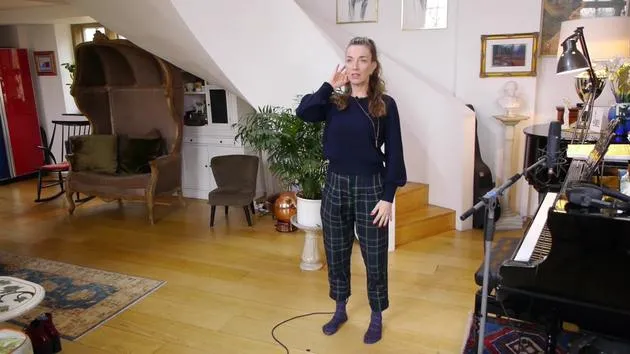
For me, personally, I find a really great way of exploring rhythm is to start embodying it, just moving along to music. This might be while you're listening to a song on the radio or while you're doing something else.
- Keeping that inner pulse in the body is really useful.
Basics of Rhythm and Tempo
To explain some of the very basics of rhythm and tempo:
- Most pop songs (this is a generalization) are in a four-four rhythm. This means there are four beats to a bar.
Counting in Four-Four
Let's count it out together:
- 1, 2, 3, 4
- 1, 2, 3, 4
Join me:
- 1, 2, 3, start to move.
- 1, 2, 3. Walk around the room if you want to.
- 1, 2, 3, 4.
For some people, you might want to use your feet:
- 1, 2, 3, 4
- and
- 1, 2, 3, 4.
Whatever feels good, you can walk around to that rhythm, just practicing it.
Understanding Tempo
Rhythm can speed up or slow down, and that is the tempo of the song.
- So when someone talks about the tempo, it's basically how fast or slow it is.
- Ballads tend to be slower than dance music.
For example, consider a classic disco tune like "Car Wash":
"You might not ever get rich, but let me tell you, it's better than digging a ditch."
You can hear that it's got more tempo and pace. In contrast, some of the songs we're working on in the course are more ballad-like, which means they tend to be slower with longer phrases.
The Four Beats in a Bar
Now, often as a singer, we refer to the four beats in a bar, which are known as crotchets.
- These four beats are counted as:
- 1 and 2 and 3 and 4.
When singing, sometimes we focus on the offbeat, which occurs on:
- and 1 and 2 and 3 and 4 and.
Coordinating Rhythm
To start embodying that, I would say do a stamp and then a click or a clap, whatever you're comfortable with:
- 1 and 2 and 3 and 4 and
- 1 and 2 and 3 and 4.
This might be difficult to coordinate if you're not used to it.
Physicalizing Rhythm
Another way of doing it is to walk around:
- Just do a 1 and 2 and 3 and 4.
You can use whatever space you have and just learn to physicalize and embody that rhythm.
Time Signatures
There's another thing called time signatures.
- The four-four time we talked about consists of four crotchet beats in a bar, which is what we started with:
- 1, 2, 3, 4.
You can also have three crotchets in a bar, which is called waltz time:
- 1, 2, 3
- 1, 2, 3.
For example, the song "Natural Woman" has groups of three:
"Looking out on the morning rain, I used to feel so uninspired."
Emphasizing the Offbeat
Another thing that happens when we sing pop or soul music is we often think about the rhythm being on the 2 and the 4. For one of the songs we're going to work on, "I Need a Dollar," this is true:
"I need a dollar, a dollar, a dollar is what I need."
Join in:
- 1, 2, 3, 4
- 1, 2, 3, 4.
Click or clap as you join in:
"I need a dollar, a dollar, a dollar is what I need."
Finding Your Rhythm
Just play around with where you feel the pulse of something. This is a great way to get your ears and body attuned to rhythm.
A good way to explore it is to simply dance.
- Nod your head,
- Tap your foot,
- Whatever feels natural.
23 lessons
1h 55m of structured video lessons
Advanced video features
Slow down, loop a passage, follow along
Mobile, tablet & desktop
Practise wherever you are
100% satisfaction guarantee
30-day money-back guarantee
Meet your guru
Meet your guru
Juliet Russell is a singer, composer, vocal coach and choir director. She is passionate about supporting individuals and communities to develop their voices and creativity.
A vocal coach on ITV’s The Voice, The Voice Kids and BBC’s Michael McIntyre’s Big Show, Juliet has also worked with Grammy, Brit, MTV Europe and MOBO award winning artists. She has collaborated and performed with innovative artists including Damon Albarn, Imogen Heap, Paloma Faith, alt-J, Yoko Ono, Seal and Ringo Starr.
In 2015, supported by the Arts Council of England, she toured her Earth Meets Sky album, with local musicians and community choirs to create ten unique performances throughout the UK. She is regularly commissioned to create new choral pieces and vocal arrangements and has performed nationally and internationally.
Committed to artist development, Juliet mentors and coaches emerging artists, working with management, record and publishing companies as well as independent artists. She has a vocal studio in the heart of London’s vibrant Brick Lane.
Juliet was a founding artistic director of Sense of Sound and creative director of Sing Up Greenwich and Sing Late at the V&A. She leads the Portobello Live Choir, a community choir in West London, Assemble professional choir and is a trainer for the British Lung Foundation’s Singing for Lung Health programme.







