



Solear - Arpegios y encierros cromáticos

Con
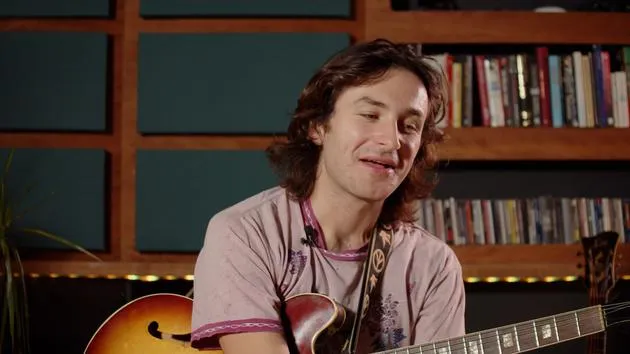
Rob Luft
Qué incluye el curso
28 lecciones (2h 7m) · 1 gratis
01. ¿Por qué estudiar a Django Reinhardt?
3:45
02. Acordes y armonía - Sección A
11:06
03. Acordes y armonía - Sección B
2:21
04. Técnicas de mano derecha - Europea vs. Americana
5:04
05. Cómo crear el feel de swing
1:51
06. Recorrido por la melodía
9:10
07. Solear - Arpegios y encierros cromáticos
Estás aquí10:40
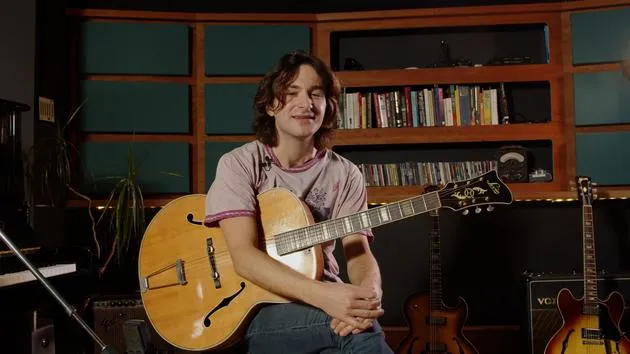
08. Improvisación - La escala bebop de menor armónica
8:27
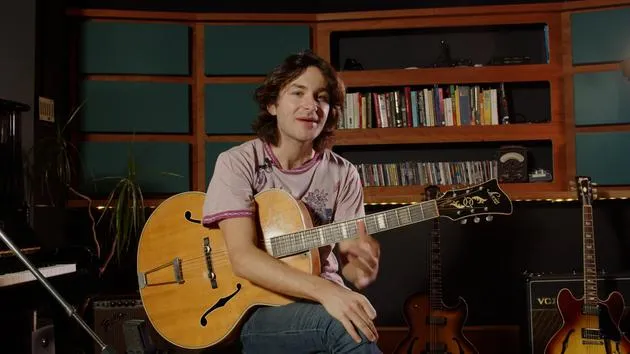
09. Solear - Uso de las pentatónicas
9:45
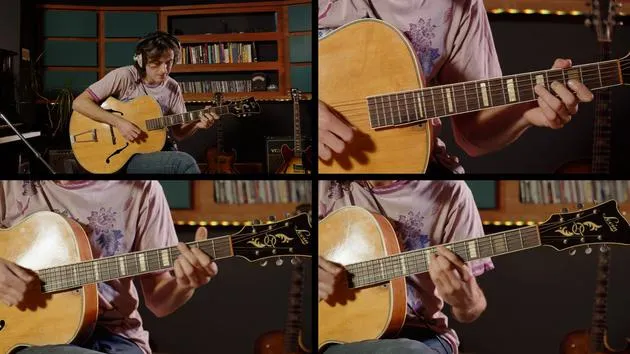
10. Clouds - Interpretación (pantalla dividida con acompañamiento)
3:48
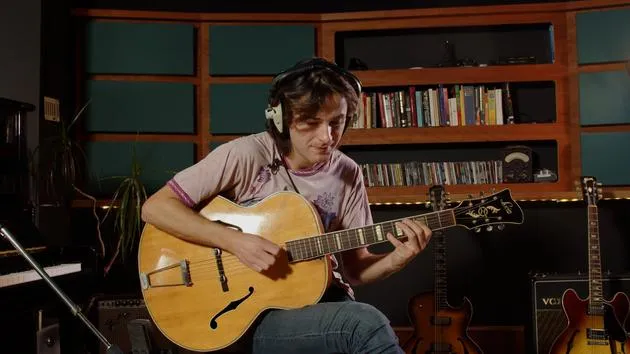
11. Clouds - Interpretación
3:49
12. Clouds - Interpretación (versión simplificada)
2:40
01. ¿Por qué estudiar a Joe Pass?
2:23
02. Introducción al juego en solitario y la armonía paralela
4:00
03. Líneas disminuidas y "terceras sicilianas"
5:19
04. Tocar a tempo con voicings pianísticos
5:22
05. Cómo tocar la segunda mitad
5:06
06. Hybrid picking frente a fingerstyle
5:57
07. November in Norway - Interpretación
2:29
08. November in Norway - Interpretación (simplificada)
1:27
Transcripción de la lección
Improvising in the Style of Django Reinhardt
In this lesson, we're going to explore how to improvise in the style of Django Reinhardt over a chord sequence. Django was famous for a variety of techniques and melodic ideas that he employed throughout his career.
Key Techniques
1. Fast Vibrato
- Django was renowned for his very fast vibrato on the melody notes.
- For example, if he was playing an A on the 10th fret of the B string, he wouldn't just play it plainly.
- He might use this fast vibrato in the left hand, which can be heard throughout his recordings, particularly if you preface it with the F major scale.
Try This:
- Play the F major scale from octave A to A and hear how Django would finish it.
- This fast vibrato adds sustain to long notes, anchoring the sound in Django's style.
2. Arpeggiated Playing Style
- Django often played in a very arpeggiated style.
- For instance, over a D flat seventh or a D flat ninth, he would play beautiful arpeggios starting on the third.
Example:
- Articulate the 3, 5, 7, 9, and then descend using the 6th to the 5th. This works nicely over D flat 7 and can be mirrored on C7 to resolve nicely to F major.
3. Use of Chromaticism
- Another hallmark of Django's playing is light chromaticism between chord tones.
- To get from the third to the fifth of F major, Django might play it using the flat third (the bluesy A flat):
Sample Phrase:
- "F - A - A flat"
- This sound is bluesy and chromatic while still outlining an F major sound.
4. Enclosures of Chord Tones
- Django often used enclosures of chord tones.
- For example, surrounding the notes of the chord F, A, and C with additional melody notes.
Example Phrase:
- This can be very ergonomic on the guitar and allows for fluid phrasing. When played correctly, it easily flows off the fingers.
Applying Techniques to Chord Progressions
Example Chord Sequence:
- Start with D flat seventh.
- Transition to C7, then resolve to F major.
Minor Chord Sequences
Shifting to the relative minor, the chord sequence often moves to D minor, using 2, 5 transitions like E half diminished to A7, then resolving to D minor.
- Musicians like Django used alternating arpeggios between dominant and tonic chords, cycling between seventh and D minor for a cohesive sound.
Breakdown of the Technique:
- Start with an A7 flat ninth arpeggio (starting on A C sharp).
- Move to a D minor arpeggio (starting on F).
- Repeat with octaves, resolving to the D minor's third.
Chord Sequence:
This creates a wonderfully flowing sequence.
Playing Variations
- If you want to play slower, you can simply elongate the phrases.
- For a faster tempo, consider using triplets.
These techniques allow for a rich tapestry of sound, drawing on Django's influences while ensuring your improvisation retains that characteristic swing and flair.
Final Thought
Through these techniques, you can embody the spirit of Django Reinhardt and enrich your improvisational vocabulary. Happy playing!
28 lecciones
2h 7m de lecciones en vídeo estructuradas
Funciones de vídeo avanzadas
Ralentiza, repite un pasaje, sigue la partitura
Móvil, tablet y ordenador
Practica donde quieras
Garantía de satisfacción 100%
30 días de garantía de devolución
Conoce a tu gurú
Conoce a tu gurú
Rob Luft es un músico galardonado de Londres, ampliamente descrito como uno de los guitarristas de jazz contemporáneo jóvenes más destacados y talentosos del Reino Unido. Elogiado por The Times como llamado 'a lograr grandes cosas en el futuro', Rob ganó el Kenny Wheeler Jazz Prize de 2016 en asociación con Edition Records, y obtuvo el 2.º premio en el Montreux Jazz Guitar Competition de 2016. Su álbum de debut, 'Riser', se publicó en julio de 2017 y fue objeto de un amplio reconocimiento de la crítica en los medios de jazz europeos. John Fordham escribió en The Guardian que es un 'debut muy sofisticado, aunque, dados los logros de alma vieja de Luft desde su temprana adolescencia, deberíamos haberlo visto venir'.
'¡Tan joven y con tanto talento!' - Jamie Cullum, BBC Radio 2 (UK)
'...un talento extraordinario!' - Julian Joseph, BBC Radio 3 (UK)
'El virtuosismo de los tres [guitarristas Al di Meola, John McLaughlin y Paco de Lucia] recuerda al londinense de 23 años Rob Luft, celebrado como un nuevo "Wunderkind"' - Spiegel Online (D)
En Play Authentic Jazz Guitar, Rob abre el lenguaje armónico, el fraseo y los instintos improvisadores que hay detrás de ese sonido de 'alma vieja', mostrándote cómo piensa realmente el mástil para que puedas empezar a encontrar tu propia voz en el jazz.







