



Líneas disminuidas y "terceras sicilianas"

Con
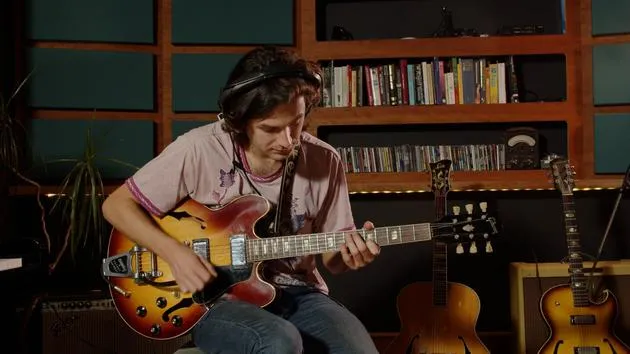
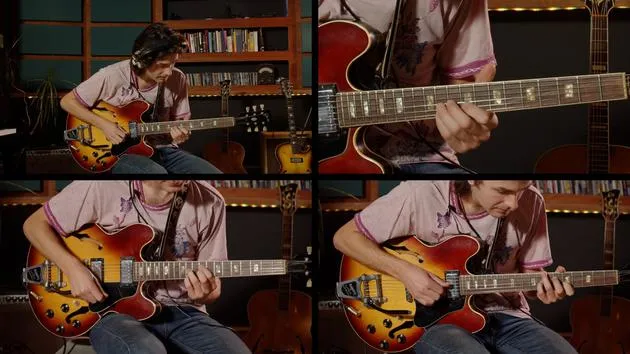
Rob LuftRob Luft trabaja la sonoridad del 13b9, la escala disminuida y las “terceras sicilianas” diatónicas al estilo de Joe Pass que puedes usar en líneas de guitarra jazz a solo.

Qué incluye el curso
28 lecciones (2h 7m) · 1 gratis
01. ¿Por qué estudiar a Django Reinhardt?
3:45
02. Acordes y armonía - Sección A
11:06
03. Acordes y armonía - Sección B
2:21

04. Técnicas de mano derecha - Europea vs. Americana
5:04
05. Cómo crear el feel de swing
1:51
06. Recorrido por la melodía
9:10

07. Solear - Arpegios y encierros cromáticos
Lección gratis10:40
08. Improvisación - La escala bebop de menor armónica
8:27
09. Solear - Uso de las pentatónicas
9:45
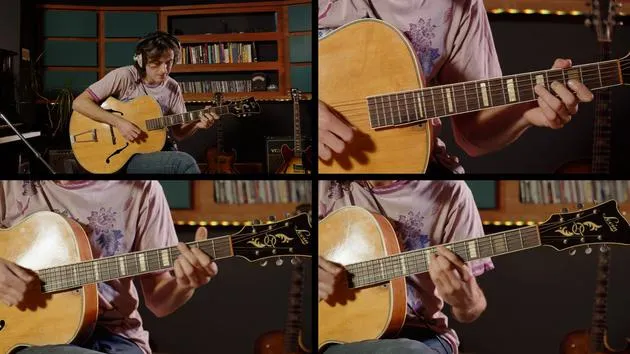
10. Clouds - Interpretación (pantalla dividida con acompañamiento)
3:48
11. Clouds - Interpretación
3:49
12. Clouds - Interpretación (versión simplificada)
2:40
01. ¿Por qué estudiar a Joe Pass?
2:23
02. Introducción al juego en solitario y la armonía paralela
4:00
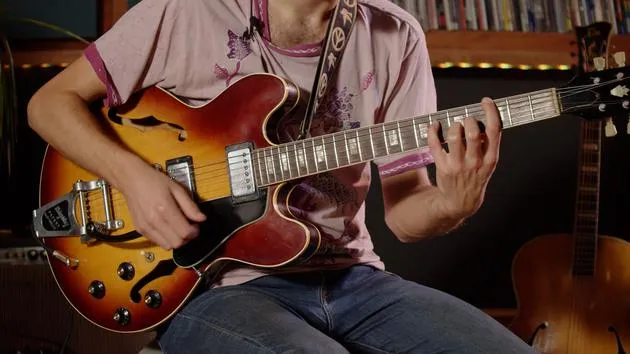
03. Líneas disminuidas y "terceras sicilianas"
Estás aquí5:19
04. Tocar a tempo con voicings pianísticos
5:22
05. Cómo tocar la segunda mitad
5:06

06. Hybrid picking frente a fingerstyle
5:57
07. November in Norway - Interpretación
2:29
08. November in Norway - Interpretación (simplificada)
1:27

Transcripción de la lección
Understanding the 13b9 Sound
Today, we're exploring the 13b9 sound, which refers to an E major triad with a G in the bass. This sound is very nice and quite typical of the legendary guitarist Joe Pass.
The Diminished Scale
I've opted for a version of this chord that incorporates elements of the diminished scale. This scale is an incredibly complex, eight-note scale, known as an octatonic scale, which is formed as follows:
- It is a symmetrical scale.
- It consists of:
- Half step (semitone)
- Whole step (tone)
You repeat this pattern:
- Half step, whole step, half step, whole step, half step, whole step, half step, whole step.
Incorporating Diminished Ideas
In bar four of this piece, Joe might introduce a little diminished idea or a personal melody. This resolves nicely to the C major chord, bringing us back to the melody.
The structure creates a delightful pattern:
- One bar of harmony
- One bar of composed melody
- One phrase of your own added in
This juxtaposition is quite pleasant as we return to the melody.
Joe Pass and Sicilian Influences
Joe Pass, whose name may not suggest it, was a guitarist of Italian extraction. His playing often includes very distinct Sicilian thirds.
You might think of Sicilian folk guitar, where he frequently uses these diatonic thirds. Inspired by this, I've taken a similar approach in creating the melody, utilizing:
- Diatonic thirds which are incredibly useful for solo jazz guitar in C major.
Movement and Melodic Ideas
Let me show you how these movements might look, quickly moving them around chromatically creates lovely variations.
A piece that embodies this sound is "Mona Lisa," closely associated with Joe Pass and harking back to his folk Italian roots.
I've integrated these thirds into the melody while adding my phrase, maintaining the juxtaposition between my own composition and the established melody.
The 2-5-1 Progression
Now, we're moving to a 2-5-1 progression into F major. Joe Pass often used these beautiful phrases.
Employing Dyads
I could use my thirds again here. It's important to refer to the chords underlying the dyads, which I prefer to call dyads rather than triads since they consist of two-note chords.
For our progression, we consider the F major seventh chord, followed by a touch of harmonic minor.
Exploring Harmonic Minor
Previously, we discussed harmonic minor in the context of Django Reinhardt playing over dominant chords. In this case, we utilize an E7, which is the fifth degree of the minor scale.
To create a A harmonic minor scale starting on an E, I'll incorporate a little phrase using that scale, along with a turn.
These turns, combined with a beautiful diminished shape, will help resolve the A minor chords, juxtaposing them against the melody effectively.
28 lecciones
2h 7m de lecciones en vídeo estructuradas
Funciones de vídeo avanzadas
Ralentiza, repite un pasaje, sigue la partitura
Móvil, tablet y ordenador
Practica donde quieras
Garantía de satisfacción 100%
30 días de garantía de devolución
Conoce a tu gurú
Conoce a tu gurú
Rob Luft es un músico galardonado de Londres, ampliamente descrito como uno de los guitarristas de jazz contemporáneo jóvenes más destacados y talentosos del Reino Unido. Elogiado por The Times como llamado 'a lograr grandes cosas en el futuro', Rob ganó el Kenny Wheeler Jazz Prize de 2016 en asociación con Edition Records, y obtuvo el 2.º premio en el Montreux Jazz Guitar Competition de 2016. Su álbum de debut, 'Riser', se publicó en julio de 2017 y fue objeto de un amplio reconocimiento de la crítica en los medios de jazz europeos. John Fordham escribió en The Guardian que es un 'debut muy sofisticado, aunque, dados los logros de alma vieja de Luft desde su temprana adolescencia, deberíamos haberlo visto venir'.
'¡Tan joven y con tanto talento!' - Jamie Cullum, BBC Radio 2 (UK)
'...un talento extraordinario!' - Julian Joseph, BBC Radio 3 (UK)
'El virtuosismo de los tres [guitarristas Al di Meola, John McLaughlin y Paco de Lucia] recuerda al londinense de 23 años Rob Luft, celebrado como un nuevo "Wunderkind"' - Spiegel Online (D)
En Play Authentic Jazz Guitar, Rob abre el lenguaje armónico, el fraseo y los instintos improvisadores que hay detrás de ese sonido de 'alma vieja', mostrándote cómo piensa realmente el mástil para que puedas empezar a encontrar tu propia voz en el jazz.







