



Recorrido por la melodía

Con
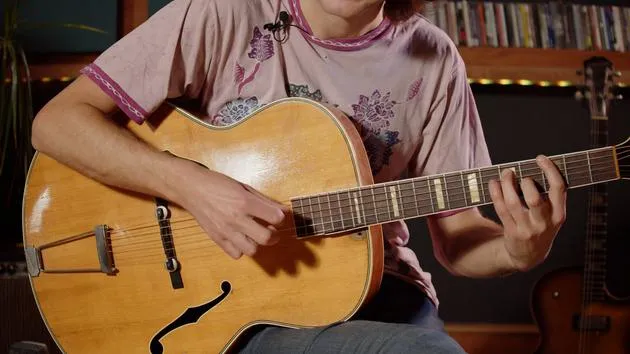
Rob LuftRob Luft repasa la melodía de 'Clouds', su pieza inspirada en Django Reinhardt, y cómo transformó la famosa frase de armónicos artificiales de Django en notas naturales.
Qué incluye el curso
28 lecciones (2h 7m) · 1 gratis
01. ¿Por qué estudiar a Django Reinhardt?
3:45
02. Acordes y armonía - Sección A
11:06
03. Acordes y armonía - Sección B
2:21
04. Técnicas de mano derecha - Europea vs. Americana
5:04
05. Cómo crear el feel de swing
1:51
06. Recorrido por la melodía
Estás aquí9:10
07. Solear - Arpegios y encierros cromáticos
Lección gratis10:40
08. Improvisación - La escala bebop de menor armónica
8:27
09. Solear - Uso de las pentatónicas
9:45
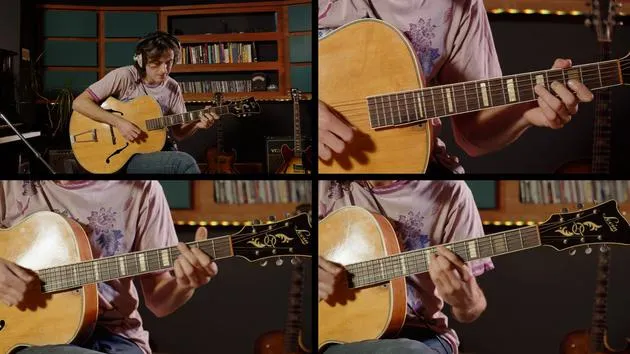
10. Clouds - Interpretación (pantalla dividida con acompañamiento)
3:48
11. Clouds - Interpretación
3:49
12. Clouds - Interpretación (versión simplificada)
2:40
01. ¿Por qué estudiar a Joe Pass?
2:23
02. Introducción al juego en solitario y la armonía paralela
4:00
03. Líneas disminuidas y "terceras sicilianas"
5:19
04. Tocar a tempo con voicings pianísticos
5:22
05. Cómo tocar la segunda mitad
5:06

06. Hybrid picking frente a fingerstyle
5:57
07. November in Norway - Interpretación
2:29
08. November in Norway - Interpretación (simplificada)
1:27
Transcripción de la lección
Melody for "Clouds"
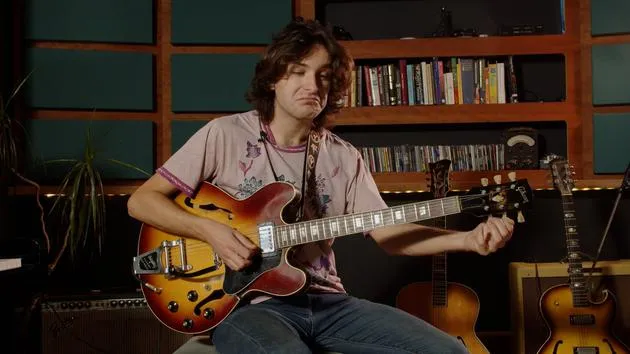
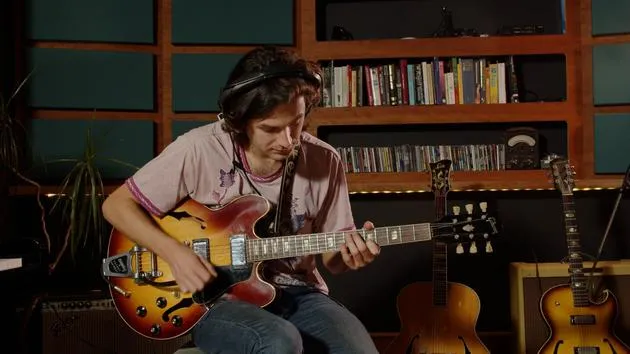
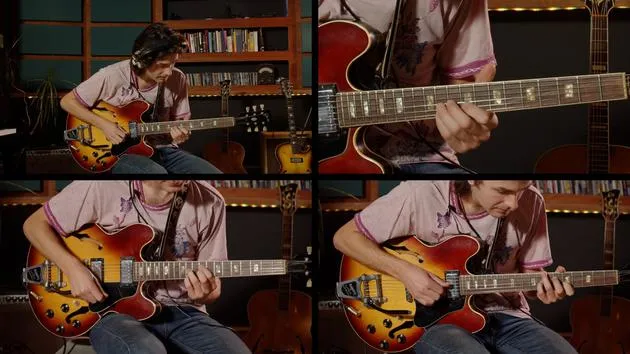
So here we are talking about the melody for this piece, which we call Clouds, very much inspired by Django Reinhardt's original and most famous recording in the key of F.
I based my melody on the actual guitar solo from the original, which very famously uses artificial harmonics with the right hand. Django starts his solo with this beautiful phrase, which is a legendary sort of early use of artificial harmonics in the story of the guitar. I mean, you know, the recorded story of the guitar in the 20th century.
I don't think many people had played down harmonics in that way in an improvised solo before Django. So I've based my melody on that. Rather than playing the artificial harmonic, I've just played the melody in natural notes and slightly altered a few things.
My First Phrase
As you hear, my first phrase is very close to Django's, but I'm just altering a few notes here and there to fit with my accompaniment.
- I showed you those tricks in the chordal part that we recorded earlier.
- I've got this passing C7, sharp 5.
So there I've altered my melody to reflect that little tension resolution. I go, which creates a nice feeling, and it's a nice melody as well.
We must always remember that melodies are just that, they should be singable, they should be whistleable. With a guitar, it can be pretty difficult to compose melodies that are still singable because of the nature of the instrument. We want to run away with our fingers.
But in jazz, melodies often have to have this singing quality that someone could really get that hook stuck in their ear, which I think this does.
Moving to D Minor
So that's my first eight bars of melody. Then, when we move to the relative minor key, to D minor, we've got this pretty much sort of quote from the original melody.
So I'll break that down quickly. What we've got here is this great use of chromaticism around the fifth of the relative minor, around that A, resolving to the D minor. We've got this lovely sort of, you could call it enclosure.
When we take a chord tone like this, A, and we enclose each note of the chord. So rather than just playing a phrase like this, where they enclose each note, I'm kind of alluding to this concept, we're enclosing that G, and we're also using chromaticism around the A.
The same thing there with that F. The F is the third of D minor, and we're enclosing it. That sound of G, E, F is very typical in classical music as well. It's a trick borrowed from Bach, using chromaticism to enclose our arpeggios and our chord tones.
It creates a very nice and elegant way to add complexity to very simple harmonies.
Melody Development
So we get this melody here, and then we run down an arpeggio basically down to that third, that B, which is the third of the G7.
Then our melody just goes down a semitone to a G, to a B flat over the G flat seventh chord, reflecting the changing harmony. You get again back up again when it goes back to the G7 and runs up sort of a scale.
It's not really an A scale; it's more of F major minus the B flat from C to C, removing the B flat there. Then the melody cycles back on itself.
Transition to B Flat
It's going to change a little bit this time because we're going into B flat.
- We use this A, which is the ninth of the G flat seventh.
- Then we've got F7 and we use the seventh and the third to resolve into the B flat major chord.
And then we're up to B flat minor, the IV minor, a sound typical of the 30s, really emphasizing these tones, which is the sixth, the minor sixth, very common in B flat minor 6 in this era.
Counterpoint Element
Then we use a bit of counterpoint here.
- We get this sort of almost like a double melody; the higher note goes up and the lower note goes down, which is what we call counterpoint (or contrapunto in Italian).
It simply means notes going in opposite directions. When you add the bass note in, it's very satisfying.
Conclusion
Then we're going to just repeat the last phrase, the first phrase, as our concluding phrase. Just to create a resolution.
And then that four minor comes back again, which is the way we finish our melody.
So I'll just play you that from the last eight bars of melody. You're going to hear this.
So that's our melody, and it's really up to you guys how you phrase it rhythmically. It's very open-ended.
As you can see, it's pretty easy to compose your own melodies on a chord sequence like this, simply choosing an attractive chord tone or an extension like a sixth on that four minor and resolving it using those simple techniques such as:
- Counterpoint, where your upper melody note goes up and your lower melody note goes down, or vice versa.
- Using simple chromatic enclosures and other chord tones.
- Incorporating little scalic runs.
I think it's well within everyone's reach to compose their own melody over a chord sequence such as this one.
28 lecciones
2h 7m de lecciones en vídeo estructuradas
Funciones de vídeo avanzadas
Ralentiza, repite un pasaje, sigue la partitura
Móvil, tablet y ordenador
Practica donde quieras
Garantía de satisfacción 100%
30 días de garantía de devolución
Conoce a tu gurú
Conoce a tu gurú
Rob Luft es un músico galardonado de Londres, ampliamente descrito como uno de los guitarristas de jazz contemporáneo jóvenes más destacados y talentosos del Reino Unido. Elogiado por The Times como llamado 'a lograr grandes cosas en el futuro', Rob ganó el Kenny Wheeler Jazz Prize de 2016 en asociación con Edition Records, y obtuvo el 2.º premio en el Montreux Jazz Guitar Competition de 2016. Su álbum de debut, 'Riser', se publicó en julio de 2017 y fue objeto de un amplio reconocimiento de la crítica en los medios de jazz europeos. John Fordham escribió en The Guardian que es un 'debut muy sofisticado, aunque, dados los logros de alma vieja de Luft desde su temprana adolescencia, deberíamos haberlo visto venir'.
'¡Tan joven y con tanto talento!' - Jamie Cullum, BBC Radio 2 (UK)
'...un talento extraordinario!' - Julian Joseph, BBC Radio 3 (UK)
'El virtuosismo de los tres [guitarristas Al di Meola, John McLaughlin y Paco de Lucia] recuerda al londinense de 23 años Rob Luft, celebrado como un nuevo "Wunderkind"' - Spiegel Online (D)
En Play Authentic Jazz Guitar, Rob abre el lenguaje armónico, el fraseo y los instintos improvisadores que hay detrás de ese sonido de 'alma vieja', mostrándote cómo piensa realmente el mástil para que puedas empezar a encontrar tu propia voz en el jazz.







