



II-V-I menor en una secuencia de acordes

Lesson time: (5min 4sec)
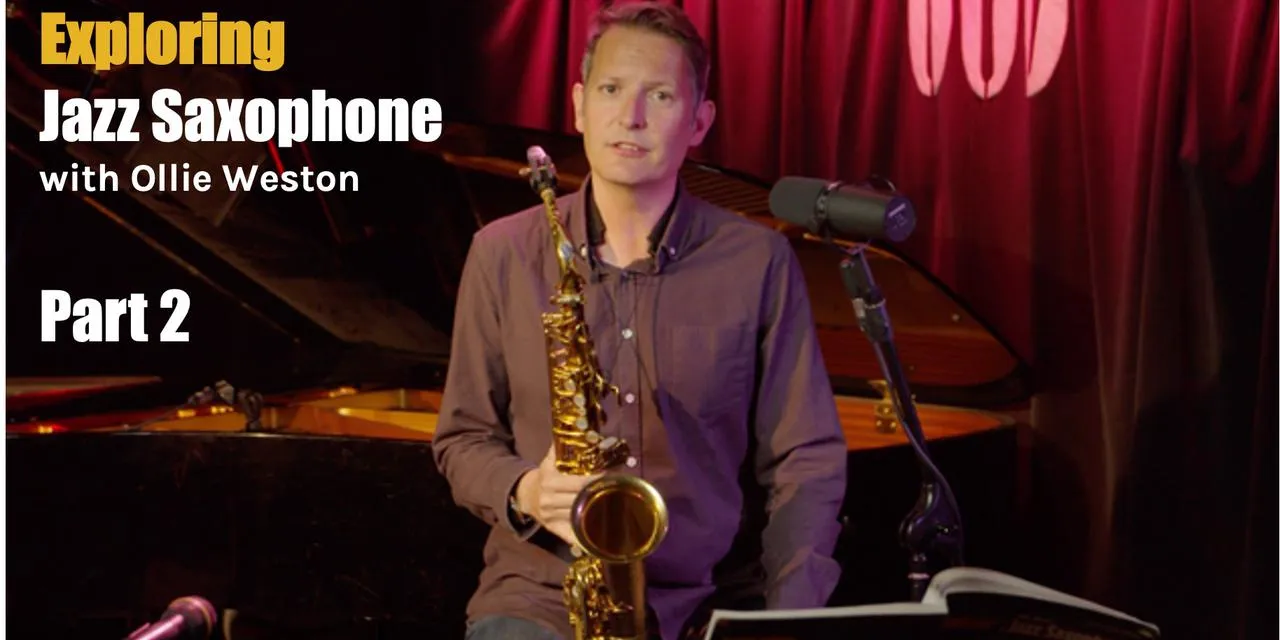
Ollie Weston muestra cómo usar un II-V-I menor, tocado aquí en La menor, como parte de un ciclo más largo que recorre los siete acordes y modos.
Course preview
This lesson is part of the course Explorando el saxofón jazz: Parte 2 - Solear sobre canciones y secuencias de acordes
Watch a preview of the full course below.
Lesson transcript:
Music Lesson: Minor Cadence and Chord Sequences
Introduction
In this lesson, we'll explore a minor cadence, specifically the A minor 2-5-1 sequence, within a cycle of chords that incorporates all seven chords and modes of the major scale.
Chord Sequence
The chord sequence will follow this order:
2, 5, 1, 4, 7, 3, 6
By familiarizing yourself with these Roman numerals, you should be able to voice a chord and find its corresponding mode on each degree of the scale.
Modes and Chords
- Chord II: Dorian mode (Minor 7 chord)
- Chord V: Mixolydian mode (7th type chord)
- Chord I: Ionian mode (Major scale)
- Chord IV: Lydian mode
- Chord VII: Locrian mode
- Chord III: Phrygian mode
- Chord VI: Aeolian mode
Playing the Cycle
Listen to this cycle of chords. I will start by playing the root notes, followed by the chord tones for each chord.
- 1, 2, 1, 2, 3
Key Modulation
While I described the last chord (E minor) as chord vi, it may be more helpful to think of it as chord I of the relative minor key.
Thus, instead of viewing our seven chords as a cycle strictly related to G major, we can interpret the second half as a 2-5-1 progression into E minor.
While we're still diatonic, we haven't added any notes outside of the G major/E minor key signature. This perspective allows for a flexible progression between the two keys.
Enhancing the Modulation
To make this modulation more effective, I will transform my III chord into a seventh type chord. Specifically, I want my F# minor 7 flat 5 (Locrian) and B chord to form an A II V into E minor.
If the B chord is now the V, I need it to be a seventh type chord. I'm going to make a subtle change by altering the minor seventh chord into a seventh chord.
Changing the Chord
I will raise the third of the B minor chord to a D sharp. This will create a leading tone, which provides a strong pull into E minor.
- B minor 7 chord sounds like this on the piano...
- After raising the third to D sharp, it will sound like this...
By adding that one note outside of our diatonic seven modes, the leading note from the harmonic minor scale, we enhance the sound quality, allowing for a smooth transition into E minor.
Final Sound
Over the track, our chord tones with the added seventh chord will now sound like:
2, 1, 2, 3, 4
I've emphasized the D sharp to highlight its role as the note outside our previously learned modes. Integrating this leading note into your seventh chord will vividly illustrate the modulation between G major (the tonic key) and E minor (the relative minor).
About the instructor
Desde que se graduó en el Leeds College of Music (BA Hons) y en la Guildhall School of Music (Post Graduate Diploma in Performance), Ollie ha construido una carrera intensa y variada en la música. Como saxofonista ha actuado en directo y en estudio con artistas tan diversos como Amy Winehouse, Tim Minchin, Bonobo, Frank Turner, la London Jazz Orchestra, la Hackney Colliery Band, el Ambient Jazz Ensemble y la Nelson Riddle Orchestra. También es colíder del cuarteto de jazz 'Time Is Of The Essence', y compone y arregla material para esta y otras agrupaciones. Ollie está activo en la educación musical, actualmente como responsable del curso del departamento de jazz de la Guildhall School of Music and Drama (escuela junior), donde dirige conjuntos de jazz, big band y clases de teoría. Ha escrito una serie de libros 'Exploring Jazz' para Schott Music que se publican en todo el mundo y figuran en los temarios de examen del Reino Unido. Ollie también ha impartido talleres para la Oxford University, Pro Corda Strings y BABSWE, así como en las escuelas de verano de la Guildhall School of Music. En sus cursos Exploring Jazz Saxophone, Ollie te lleva desde los primeros pasos hasta improvisar con confianza sobre canciones y secuencias de acordes, desarrollando las habilidades de improvisación que ponen a tu alcance el vocabulario de un auténtico músico de jazz. read more