



Introducción a Among the Stars

Lesson time: (3min 54sec)
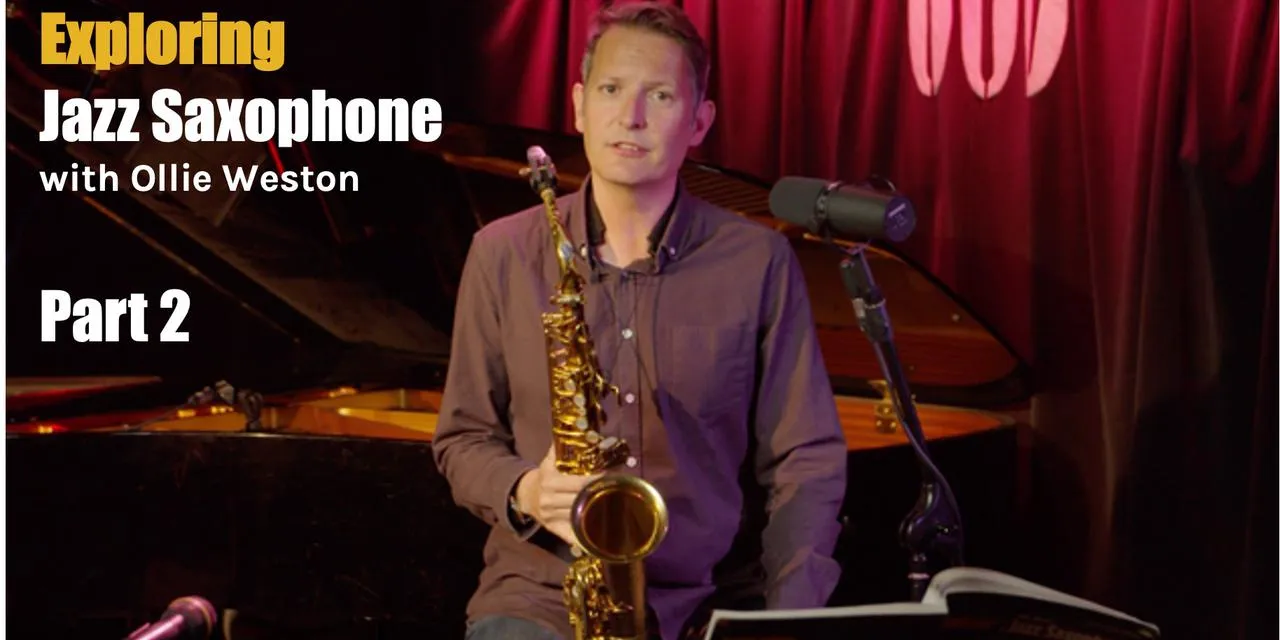
Ollie Weston presenta Among the Stars, su tema basado en Fly Me to the Moon, describiendo su estructura de 32 compases antes de tocar el tema y dos estribillos.
Course preview
This lesson is part of the course Explorando el saxofón jazz: Parte 2 - Solear sobre canciones y secuencias de acordes
Watch a preview of the full course below.
Lesson transcript:
Music Lesson: Among the Stars
Introduction
The first song I'm going to play is called Among the Stars. It's based on Fly Me to the Moon by Bart Howard, which was immortalized by Frank Sinatra and the Count Basie Orchestra on their Live at the Sands album. This is a great record from a Las Vegas nightclub called the Sands in the 1960s.
Structure
This tune is similar to others we've looked at before. It has a 32-bar structure, but rather than following an AABA format, it consists of two halves of 16 bars each:
- A section
- B section
I will play the head and two choruses of the written solo, and then the head to finish.
Chord Sequence
The chord sequence of Among the Stars is diatonic to C major. Once again, I'll switch between my major key and its relative minor.
Root Movement
You should be able to look through the root movement and identify the following progression:
- 6, 2, 5, 1, 4, 7, 3, 6
This progression is not dissimilar to Autumn Sun in that it suggests a major key initially and then modulates to the relative minor.
Two-Five-One Progressions
Throughout the sequence, there are many two-five-ones into C major and A minor.
Expanding Chord Sequences
There's one detail I want to show you to help expand your chord sequences: the treatment of chord VI. Typically, we would expect chord VI to be a minor chord since it is the relative minor of the key; however, it can be expanded into a seventh chord to create a cadence into D minor.
A Section Example
In the A section, the melody does the following:
- In the third line of the melody, I have a 2-5 D minor, G7 progression.
- Following that, I have an E minor, A7 progression.
I'm effectively transforming my sixth chord into a dominant to echo my 2-5-1 upward tone.
Sound Example
Here's what an E minor, A7 would sound like on the piano with the guide tones:
- Make sure to review the Among the Stars progression. Whenever you see the A chord as A6, I've frequently changed it to A7.
- Lines in the solo, such as this, help to bring out more detail on the A chord by incorporating a C sharp and A flat and treating it as a V chord into D minor.
Internal Modulations
Being able to perceive internal modulations within the overall umbrella key of the song (C major, A minor) while occasionally heading into D minor will enrich your understanding of jazz harmony. You'll begin to hear these elements in the players you listen to, as well as in my written solo.
Conclusion
Once again, have a listen to the solo and play through it. Feel free to lift any bits you like, but ultimately use the backing track as a resource for your own performances.
- Play the head
- Perform your own solo
- Close with the head again
About the instructor
Desde que se graduó en el Leeds College of Music (BA Hons) y en la Guildhall School of Music (Post Graduate Diploma in Performance), Ollie ha construido una carrera intensa y variada en la música. Como saxofonista ha actuado en directo y en estudio con artistas tan diversos como Amy Winehouse, Tim Minchin, Bonobo, Frank Turner, la London Jazz Orchestra, la Hackney Colliery Band, el Ambient Jazz Ensemble y la Nelson Riddle Orchestra. También es colíder del cuarteto de jazz 'Time Is Of The Essence', y compone y arregla material para esta y otras agrupaciones. Ollie está activo en la educación musical, actualmente como responsable del curso del departamento de jazz de la Guildhall School of Music and Drama (escuela junior), donde dirige conjuntos de jazz, big band y clases de teoría. Ha escrito una serie de libros 'Exploring Jazz' para Schott Music que se publican en todo el mundo y figuran en los temarios de examen del Reino Unido. Ollie también ha impartido talleres para la Oxford University, Pro Corda Strings y BABSWE, así como en las escuelas de verano de la Guildhall School of Music. En sus cursos Exploring Jazz Saxophone, Ollie te lleva desde los primeros pasos hasta improvisar con confianza sobre canciones y secuencias de acordes, desarrollando las habilidades de improvisación que ponen a tu alcance el vocabulario de un auténtico músico de jazz. read more