



Autumn Sun - Introducción y armonía

Lesson time: (3min 3sec)
Ollie Weston presenta 'Autumn Sun', un tema de 32 compases basado en los cambios de 'Autumn Leaves', y recorre sus 2-5-1 mayores y menores en sol.
Course preview
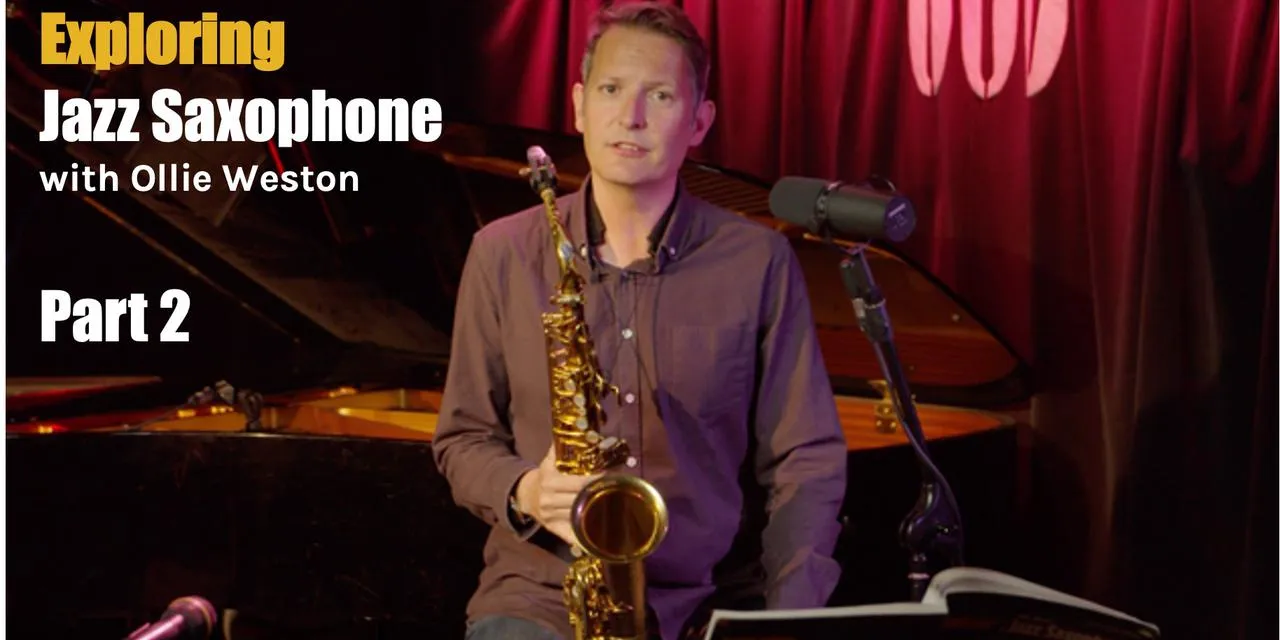
This lesson is part of the course Explorando el saxofón jazz: Parte 2 - Solear sobre canciones y secuencias de acordes
Watch a preview of the full course below.
Lesson transcript:
Introducing the Song: Autumn Sun
So I'm going to introduce a song now called Autumn Sun, which is loosely based on the great standard Autumn Leaves from 1945.
Structure
Form-wise, it's very similar to things we've played before:
- It's an A and B tune
- A 32-bar sequence
You'll notice that the 25 ones are exclusively major key and minor key. So I'm dealing with the keys of G major, specifically:
- II V: A minor, D7 to G
- Then A II V into the relative minor, which is E minor.
Chords
Here are the chords used:
- F sharp 7
- F sharp minor 7 flat 5
- B 7
- B 9
- E minor 7
These are all diatonic to the modes of G major, but I'm treating them as a modulation between the major and the relative minor.
Tune Overview
Have a look through the tune:
- It starts with a major 2-5-1
- Followed by a minor 2-5-1
- In the bridge, we reaffirm the minor key and then go back to the relative major.
It's really interesting to hear how the solo and the head move between these two.
Performance Structure
The performance runs as follows:
- Once through the head
- Two choruses of solo
- A head to finish off
Style Influence
The head and the solo of Autumn Sun are written to sound in the style of the great sax players of the 1950s:
- Dexter Gordon
- Sonny Rollins
- Cannonball Adderley
I've gone for a kind of relaxed swing feel, emphasizing the minor key.
Key Elements to Listen For
Listen out for:
- All those D sharps that will bring out the minor key.
- A little bit of blues in there, and otherwise, melodic lines based on chord tones and scales that we've looked at over the relevant chords.
A Special Technique
There's just one little trick that I used on an E minor chord in the second chorus:
- I put a C sharp over my E minor chord.
Now that's outside the key, but it's really just a little trick I borrowed from Miles Davis, which makes the root chord a Dorian chord. It adds a different kind of color to that chord.
Listening Suggestion
If you listen to Miles Davis play Autumn Leaves, Summertime, or minor tunes, he will often put that mysterious sounding Dorian note over his minor chords.
Key Takeaways
-
There are elements we've looked at: blues scales, chord tones, and scales from modes that we've covered before.
-
Remember to keep your swing feel nice and relaxed:
- We don't want a too short second note
- Aim for nice, smooth, and fluid playing.
Express Yourself
As always, after you've played the head and the solo, there's space for your own solo. So jump in, express yourself, and try to find those minor cadences.
Find your voice over those progressions!
About the instructor
Desde que se graduó en el Leeds College of Music (BA Hons) y en la Guildhall School of Music (Post Graduate Diploma in Performance), Ollie ha construido una carrera intensa y variada en la música. Como saxofonista ha actuado en directo y en estudio con artistas tan diversos como Amy Winehouse, Tim Minchin, Bonobo, Frank Turner, la London Jazz Orchestra, la Hackney Colliery Band, el Ambient Jazz Ensemble y la Nelson Riddle Orchestra. También es colíder del cuarteto de jazz 'Time Is Of The Essence', y compone y arregla material para esta y otras agrupaciones. Ollie está activo en la educación musical, actualmente como responsable del curso del departamento de jazz de la Guildhall School of Music and Drama (escuela junior), donde dirige conjuntos de jazz, big band y clases de teoría. Ha escrito una serie de libros 'Exploring Jazz' para Schott Music que se publican en todo el mundo y figuran en los temarios de examen del Reino Unido. Ollie también ha impartido talleres para la Oxford University, Pro Corda Strings y BABSWE, así como en las escuelas de verano de la Guildhall School of Music. En sus cursos Exploring Jazz Saxophone, Ollie te lleva desde los primeros pasos hasta improvisar con confianza sobre canciones y secuencias de acordes, desarrollando las habilidades de improvisación que ponen a tu alcance el vocabulario de un auténtico músico de jazz. read more