



V-I en La menor con una b9

Con
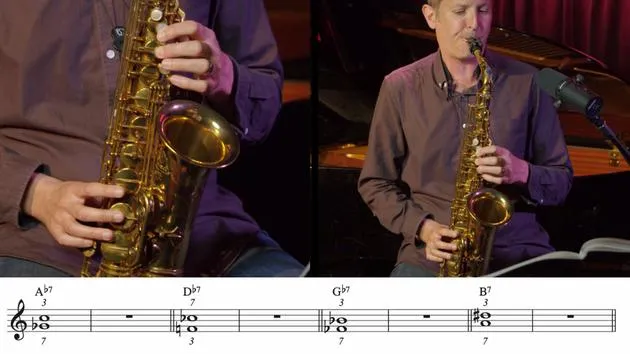
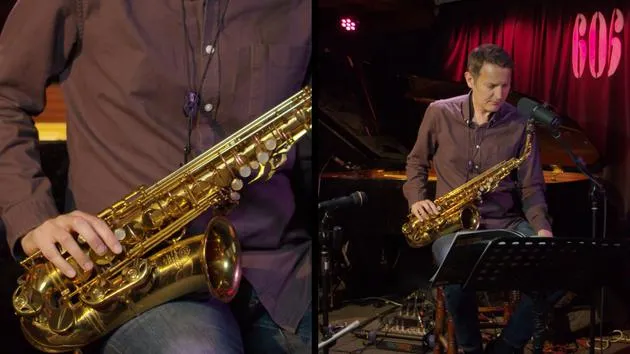
Ollie WestonOllie Weston demuestra una cadencia V-I en La menor, usando la escala menor armónica y una b9 sobre el E7 para crear una tensión que resuelve en el La menor.
Qué incluye el curso
47 lecciones (1h 48m) · 1 gratis
01. La cadencia 'perfecta' V-I
3:28
02. Dominante 7 - ejercicio del ciclo de 5tas
1:24
03. Dominante 7 - Ciclo de quintas usando terceras y séptimas
2:16
04. Variaciones rítmicas usando 3as y 7as
2:02
05. "Rhythm Changes" con séptimas dominantes y el ciclo de quintas
1:08
06. La progresión II-V-I
1:20
07. Licks II-V-I al estilo de Parker, Coltrane y Adderley
Lección gratis4:15
08. Dancing With Duke (ejercicio de II-V-I) - Introducción
1:15
09. Dancing With Duke (ejercicio II-V-I) - Interpretación
4:38
10. Conclusión de la progresión II-V-I
0:42
01. Encontrar el relativo menor
1:41
02. Usar la escala menor armónica sobre el acorde V
1:15
03. V-I en La menor con una b9
Estás aquí4:38
04. Ejercicio de V-I menor en las 12 tonalidades
1:43
05. Frase para practicar cadencias menores
1:17
06. II-V-I menor en una secuencia de acordes
5:04
07. Añadir el acorde de II
1:20
08. Autumn Sun - Introducción y armonía
3:03
09. Autumn Sun - Interpretación
4:44
01. Introducción a los standards
0:52
02. Introducción a Among the Stars
3:54
03. Interpretación de Among the Stars
4:23
04. Undying Love - Ampliar una secuencia de acordes
4:42
05. Undying Love - Interpretación
1:12
06. Undying love - Punto de control
0:47
07. Take the Express Train - El turnaround
3:21
08. Ejemplos de líneas melódicas para turnarounds
1:22
09. Take the Express Train - Introducción
1:28
10. Take the Express Train - Interpretación
1:12
11. Take The Express Train - Resumen
0:39
01. Introducción al bebop
1:04
02. 52nd Street Blues - Introducción y tema
0:29
03. 52nd Street Blues - Head con progresión I-IV-V
0:45
04. 52nd Street Blues - Añadir cromatismo
2:53
05. Añadir armonía jazz al blues
2:39
06. 52nd Street Blues - Tema con cambios II-V-I
1:05
07. 52nd Street Blues - Interpretación
3:01
Transcripción de la lección
Understanding the Harmonic Minor Scale in Context
To put the harmonic minor scale into context, let's have a listen to a perfect cadence in A minor.
Chord Progression:
- E7 chord resolving down to A minor.
Playing the Chords:
- Here's the E7 and the A minor.
- In playing the root, third, fifth, and seventh of E7, I'm already playing a G sharp.
Our standout note, G sharp, is contained in the chord. This gives you a sense of resolving it to A minor.
Cadence and Tension
By adding a G sharp to my minor scale, I'm creating the familiar tritone interval between the G sharp and the D.
In the same way that we create tension and resolution in a major key, we're doing exactly the same in a minor key by taking advantage of the tension contained within a harmonic minor scale.
Key Points:
- The harmonic minor scale is a great resource for playing over minor cadences.
- The inclusion of G sharp provides the tension and release required for a perfect cadence.
- This scale is excellent for crafting good jazz lines.
A Harmonic Minor Scale Example
Here's an A harmonic minor scale over an E7 to A minor chord progression:
- The only note that doesn't really work for me is actually the A.
- If you play that over the E7 chord, it's almost like giving away the ending before the chord resolves.
To avoid this, I will start on E this time and play the scale, which fits much better with the E7 chord.
How It Should Sound:
- By not starting and finishing on the A, we prevent giving away the resolution of the cadence too early.
Unusual Notes and Modes
There's one other note in our E7 chord that sounds a little unusual.
- In the Mixolydian mode, we would start with an E to F sharp interval.
- However, the harmonic minor starts with a semitone interval, moving from E to F.
The reason for this is that the minor chord can be suggested already over the V chord.
- Having an F sharp and a C sharp from a Mixolydian scale is a bit too bright.
- The harmonic minor gives you that darkness and minor sound needed for the minor key.
Suggesting the Destination
By using the harmonic minor scale, I can suggest that the destination resolution chord is going to be minor.
Here's what E7 with a flattened 9 and an F natural sounds like.
Practice Opportunity
- Get used to playing your harmonic minor scale over V-i chords.
- This practice will really open up the sound of these cadences for you.
47 lecciones
1h 48m de lecciones en vídeo estructuradas
Funciones de vídeo avanzadas
Ralentiza, repite un pasaje, sigue la partitura
Móvil, tablet y ordenador
Practica donde quieras
Garantía de satisfacción 100%
30 días de garantía de devolución
Conoce a tu gurú
Conoce a tu gurú
Desde que se graduó en el Leeds College of Music (BA Hons) y en la Guildhall School of Music (Post Graduate Diploma in Performance), Ollie ha construido una carrera intensa y variada en la música. Como saxofonista ha actuado en directo y en estudio con artistas tan diversos como Amy Winehouse, Tim Minchin, Bonobo, Frank Turner, la London Jazz Orchestra, la Hackney Colliery Band, el Ambient Jazz Ensemble y la Nelson Riddle Orchestra. También es colíder del cuarteto de jazz 'Time Is Of The Essence', y compone y arregla material para esta y otras agrupaciones.
Ollie está activo en la educación musical, actualmente como responsable del curso del departamento de jazz de la Guildhall School of Music and Drama (escuela junior), donde dirige conjuntos de jazz, big band y clases de teoría. Ha escrito una serie de libros 'Exploring Jazz' para Schott Music que se publican en todo el mundo y figuran en los temarios de examen del Reino Unido. Ollie también ha impartido talleres para la Oxford University, Pro Corda Strings y BABSWE, así como en las escuelas de verano de la Guildhall School of Music.
En sus cursos Exploring Jazz Saxophone, Ollie te lleva desde los primeros pasos hasta improvisar con confianza sobre canciones y secuencias de acordes, desarrollando las habilidades de improvisación que ponen a tu alcance el vocabulario de un auténtico músico de jazz.







