



Escalas de blues
Con
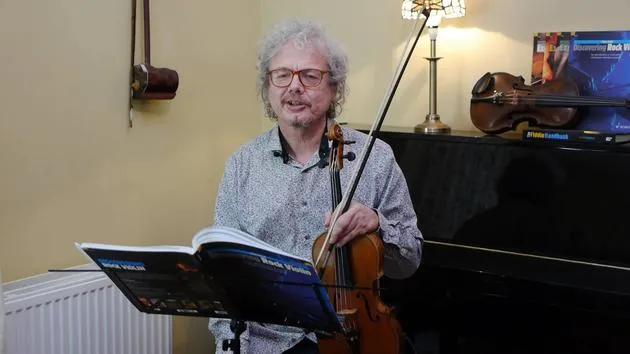
Chris HaighChris Haigh presenta la escala de blues en el violín y explica por qué tener sensibilidad para el blues es esencial para tocar rock, jazz y country de forma convincente.
© 2011 Schott Music Ltd, London
Qué incluye el curso
28 lecciones (2h 28m) · 1 gratis
Transcripción de la lección
Introduction to Blues and Blues Scales
Hi! In this chapter, we're going to talk about blues and blues scales.
The Importance of Blues
Now, you may think not many people play blues violin these days. There is a certain amount of truth to that. However, there are some fantastic blues players out there!
Blues has found its way into the core of:
- Jazz
- Rock
- Country
- A whole lot of other styles
And really, it is absolutely essential. Even if you never go to an actual blues gig in a blues club, that makes not the slightest bit of difference. Blues is absolutely essential if you're going to be any kind of a rock violinist.
It's very surprising how much interest there is in blues violin. Among my videos on my channel, the one on 20 blues licks has had 10 times more views than everything else put together, which surprised me a great deal.
But there's no doubt: blues is very important! It grows out of what we've discussed with the pentatonic scales.
Understanding the G Major Blues Scale
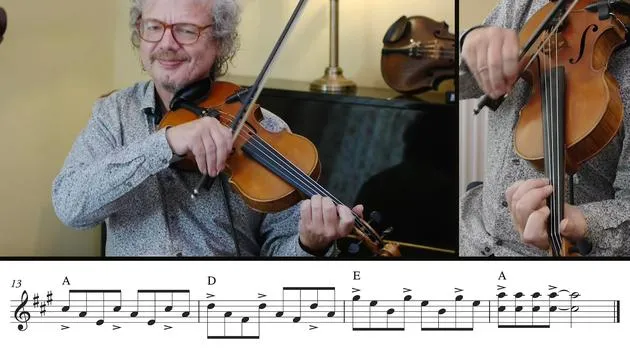
Let's look at the G major blues scale, which develops from the G major pentatonic scale.
- The pentatonic scale, if we add a blue note (the flattened third), becomes the G major blues scale.
If any of you are guitarists or have been taught by guitarists, warning bells may be going off because guitarists have a different way of explaining blues. They often don't believe there is any such thing as a major blues scale.
However, from experience, I know that for a violinist, this is a very useful way of explaining it. Blues is not a science! It was not developed in laboratories by professors; it was developed in fields by people with spades, implements, and the odd guitar here and there.
So, theory doesn't really come into it much. I have this way of explaining blues in terms of major and minor blues scales.
E Minor Blues Scale
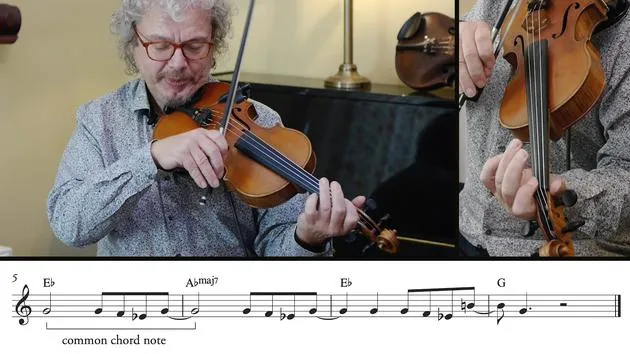
Your E minor blues scale consists of the E minor pentatonic with a flattened fifth, which intersects exactly with the scale we've just played.
- Thinking major and minor is very useful.
Blues Licks in E
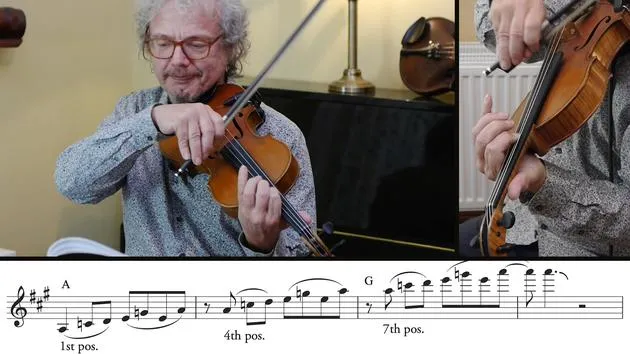
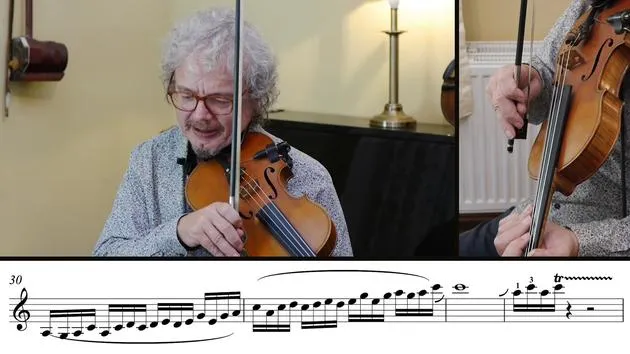
Now I'm going to give you three blues licks in E. You'll hear that:
-
One has the flattened fifth and flattened third.
I'll give it again...
-
Another one has the flattened third, flattened fifth, and flattened seventh.
And then finally, it has the flattened third and flattened fifth.
I can hear that all those licks fit really neatly together. They sound like they've been around for a long time.
All those licks work over surprisingly major chords, even though they are definitely minor licks because they have that minor third.
Finger Patterns
As with the pentatonic scales, you need to be familiar with:
- First position finger patterns
- Third position finger patterns
G Minor Blues Scale
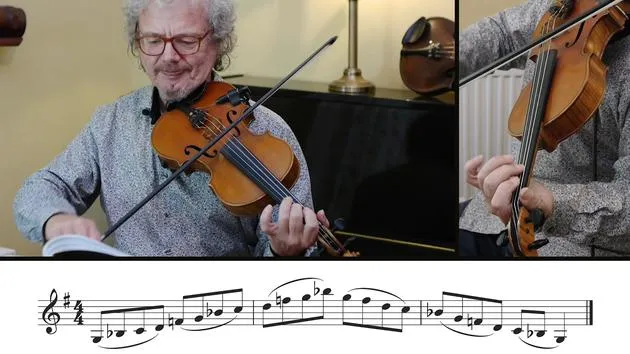
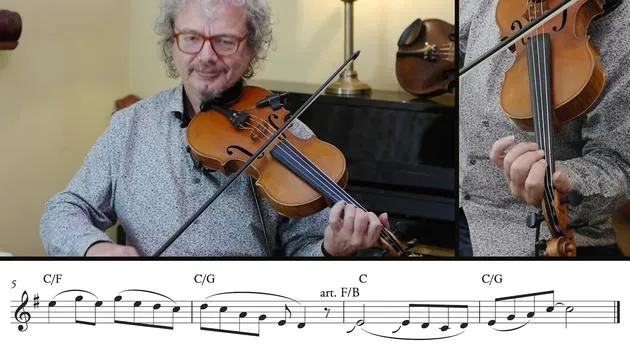
Let's look at the G minor blues scale in first position. Here's the A minor blues scale.
Notice that I came back up to the root. We've written out the B, C, D, and E.
This is something you can work on for yourself, do all of those in first position.
Playing Difficult Keys
Now, in some of the more difficult keys, you're better off not playing them in first position.
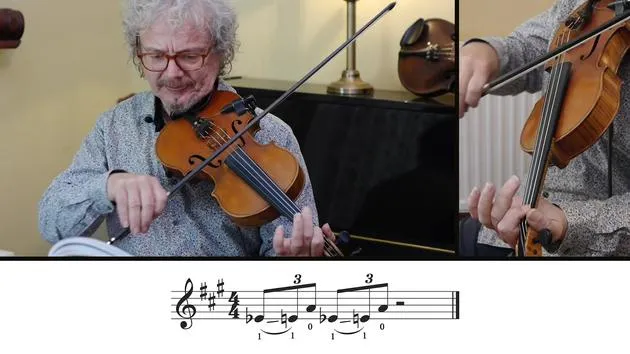
As before, we're going to use the fiddle capo, where the first finger locks onto the root.
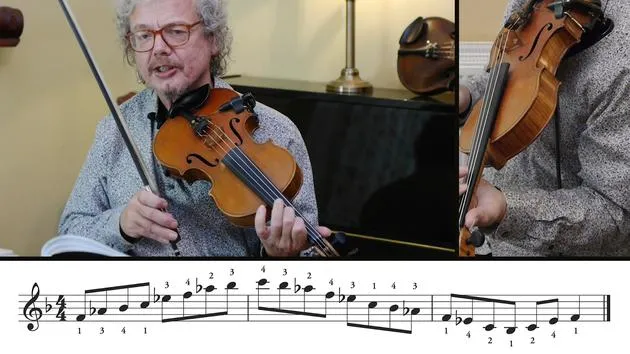
For the F minor blues scale:
- There's your F (second finger).
- There's your F (first finger).
So, we're going to do 1, 3, 4, 1. We're bending that first finger up and down.
Whenever you're playing both the blue note and the non-blue note, it's always a good idea to use the same finger. This allows you to bend the note, which is great to do!
Going Up and Down
Let's do the same thing again, going all the way up and down. This way, we can play F sharp just as easily as F.
- Avoid open strings when playing difficult keys.
Octave Jump
Now let's do the octave jump, which we did with the minor keys. We're in F, so when we get to the fourth finger, we'll replace that with the first finger.
That's how we go up the neck again, not knowing what the notes are but knowing they fit within the pattern and key.
A Minor Blues Licks
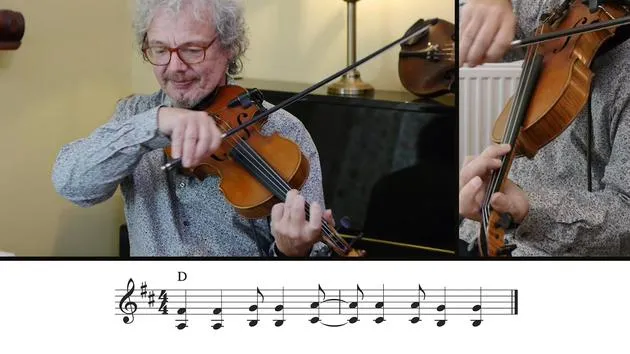
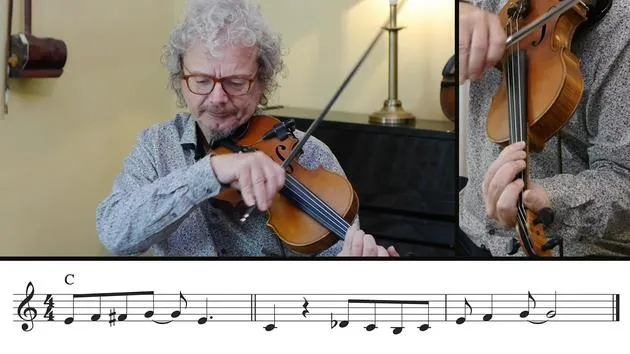
Let me give you some A minor blues licks: 1, 2, 3, 4.
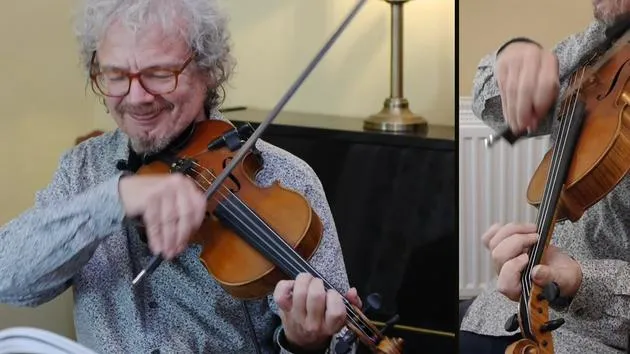
When you play one of these licks, you can often bend around the flattened third.
For example, in A, the third is C. If you bend up from the C, you're just hinting at that C sharp, which naturally fits into the key of A.
Just a hint is great! You can also do slides up to the blue note, both up and down within the same lick.
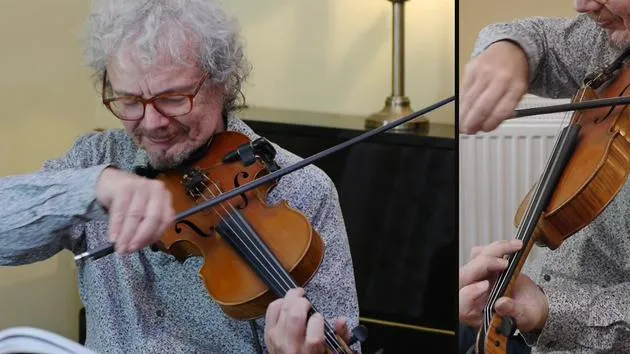
So we're going to use that fourth finger to slide up to the E flat and then down again. I'll give you that one more time:
3, 4...
Here's another example of slides in two directions. We're going to do slides both up and down.
Effective Blue Notes
These blue notes are often really effective when played as double stops.
So, there we've got an A, which we're holding down while sliding the second finger up. I'll give you that again. That's really effective!
Assignment
To finish off, I'm going to return to the key of A minor and demonstrate some minor blues licks over funkatonic.
Your assignment for this lesson is:
- Get familiar with the A minor blues scale.
- Look at all the A minor blues licks from this lesson and see if you can memorize them.
- Practice over funkatonic backing the different licks and fingerings we've used in this lesson.
See you in the next one!
28 lecciones
2h 28m de lecciones en vídeo estructuradas
Funciones de vídeo avanzadas
Ralentiza, repite un pasaje, sigue la partitura
Móvil, tablet y ordenador
Practica donde quieras
Garantía de satisfacción 100%
30 días de garantía de devolución
Conoce a tu gurú
Conoce a tu gurú
Chris Haigh es violinista profesional desde hace 25 años, con experiencia en muchos géneros distintos. Ha tocado en más de 75 álbumes, trabajando con artistas como Alison Moyet, Bob Geldof, All About Eve, Michael Ball, David Soul, Oumou Sangare, The Quireboys, Riverdance, Morcheeba, James Galway y Steps.
Ha tocado swing y jazz con The Kimbara Brothers, Diz Disley, Le Jazz, The Hot Club of London y los Quecumbar Allstars, y lidera una banda de swing soviético de siete integrantes, The Kremlinaires.
Chris imparte clases y talleres sobre técnica de violín de jazz y ha enseñado violín de jazz en las universidades de Middlesex, Brunel y Newcastle y en el Truro College. Entre sus créditos como autor figuran nueve libros de violín, entre ellos The Fiddle Handbook.
También dirige Fiddling Around (fiddlingaround.co.uk), probablemente la fuente de información sobre violín más completa y visitada de la red.







