



Die 'perfekte' Kadenz V-I
Lesson time: (3min 28sec)
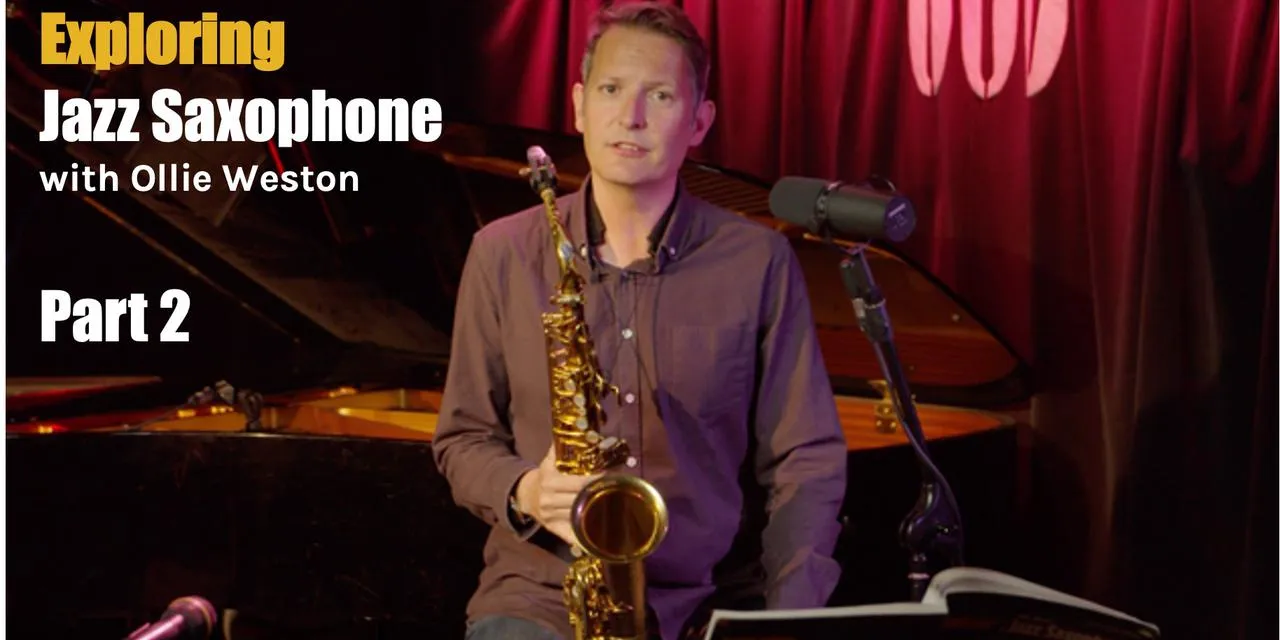
Ollie Weston erklärt die 'perfekte' Kadenz V-I: wie sie als musikalischer Schlusspunkt wirkt und wie du den Dominant-V-Akkord bildest, um das 2-5-1 im Jazz vorzubereiten.
Course preview
This lesson is part of the course Jazz-Saxofon entdecken: Teil 2 - Soli über Songs und Akkordfolgen
Watch a preview of the full course below.
Lesson transcript:
Common Chord Progressions in Jazz
In this lesson, we're going to introduce some common chord progressions that will come up in jazz tunes.
Overview of Chord Navigation
In the modal chapter, we learned how to build a palette of chords within a key. Now, we'll start looking at ways to navigate these chords to create progressions and allow phrases to develop within chord sequences.
The 2-5-1 Progression
The most common chord sequence in jazz is called a 2-5-1 progression.
- This progression gets its name from the roots that move from:
- Chord 2
- Chord 5
- Chord 1
The Perfect Cadence
Before we begin to plug these into some tunes and explore how they work in jazz, let's look at the V-I progression, which predates jazz music and is known as a perfect cadence.
- A perfect cadence serves as a kind of musical full stop.
Example in C Major
Thinking in C major, I'm going to play:
- Chord V: G
- Chord I: C
You might have heard a classical piece of music ending with this progression. The root movement really has a way of heralding the end of a piece, providing a sense of closure.
"Melodically, another way to think about this is if I play this phrase, you can feel a pull towards the last note, giving a sense of resolution, a musical full stop, if you like."
Listening Exercise
Check out the recorded examples that demonstrate this with the piano. You'll hear the chords underneath that famous melody, and notice how it doesn't resolve the first time, but does the second time, creating a more satisfying ending.
Building the V Chord
Now, how do we build a chord on our V?
- Thinking back to our modes, if it's a V chord, I want it to be a Mixolydian mode and therefore a seventh type chord.
- I will play a G7 chord that will pull towards my C major resolution.
Creating Tension
What really creates the tension in the V chord is the tritone interval, often referred to as the devil in music.
- In this case, the tritone is between the third and seventh of the G7 chord.
This sense of dissonance is created with the "devil in music" interval, which then resolves back to a lovely, comfortable major third.
About the instructor
Seit seinem Abschluss am Leeds College of Music (BA Hons) und an der Guildhall School of Music (Post Graduate Diploma in Performance) hat Ollie eine rege und vielseitige Karriere in der Musik aufgebaut. Als Saxofonist ist er live und im Studio mit so unterschiedlichen Künstlern wie Amy Winehouse, Tim Minchin, Bonobo, Frank Turner, dem London Jazz Orchestra, der Hackney Colliery Band, dem Ambient Jazz Ensemble und dem Nelson Riddle Orchestra aufgetreten. Er ist zudem Co-Leader des Jazzquartetts 'Time Is Of The Essence' und komponiert und arrangiert Material für dieses und andere Ensembles. Ollie ist in der Musikpädagogik aktiv, derzeit als Studiengangsleiter der Jazzabteilung an der Guildhall School of Music and Drama (Junior School), wo er Jazzensembles, Big Band und Theorieklassen leitet. Er hat für Schott Music eine Reihe von 'Exploring Jazz'-Büchern geschrieben, die weltweit veröffentlicht werden und in britischen Prüfungslehrplänen enthalten sind. Ollie hat außerdem Workshops für die Oxford University, Pro Corda Strings und BABSWE sowie für die Sommerschulen der Guildhall School of Music geleitet. In seinen Exploring-Jazz-Saxophone-Kursen führt dich Ollie von den ersten Schritten bis hin zum selbstbewussten Improvisieren über Songs und Akkordfolgen und baut dabei die Improvisationsfähigkeiten auf, die dir das Vokabular eines echten Jazzmusikers in die Finger legen. read more