



Autumn Sun - Einführung und Harmonik

Lesson time: (3min 3sec)
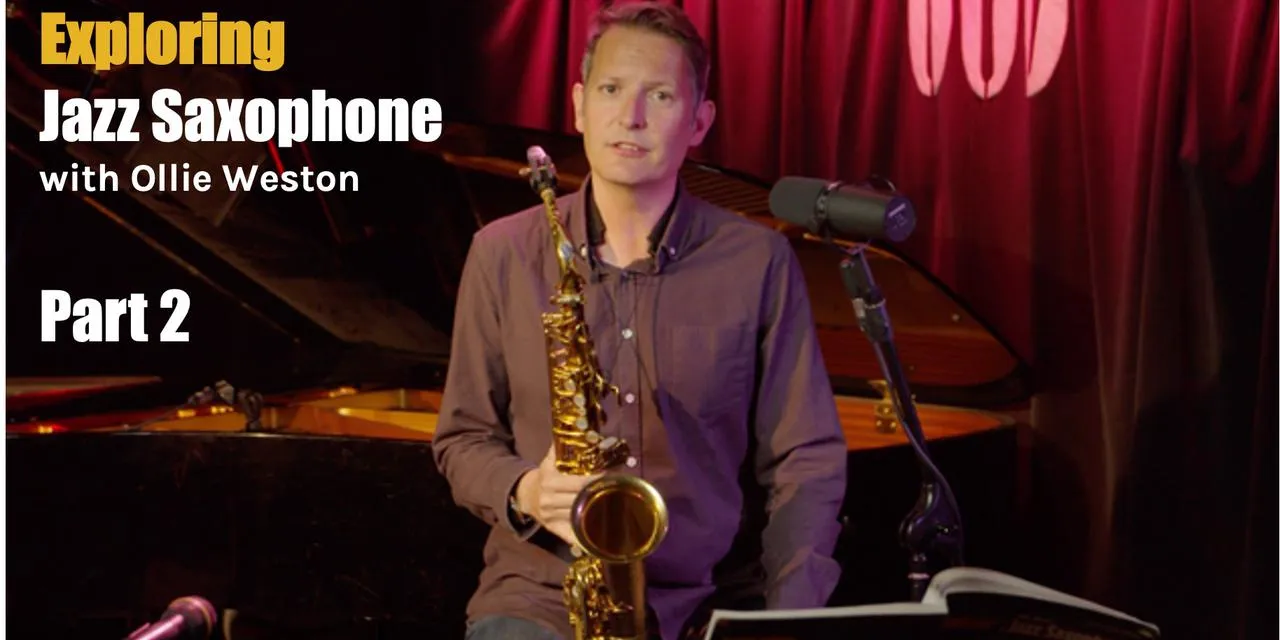
Ollie Weston stellt 'Autumn Sun' vor, ein 32-taktiges Stück auf Basis der Changes von 'Autumn Leaves', und geht seine Dur- und Moll-2-5-1 in G durch.
Course preview
This lesson is part of the course Jazz-Saxofon entdecken: Teil 2 - Soli über Songs und Akkordfolgen
Watch a preview of the full course below.
Lesson transcript:
Introducing the Song: Autumn Sun
So I'm going to introduce a song now called Autumn Sun, which is loosely based on the great standard Autumn Leaves from 1945.
Structure
Form-wise, it's very similar to things we've played before:
- It's an A and B tune
- A 32-bar sequence
You'll notice that the 25 ones are exclusively major key and minor key. So I'm dealing with the keys of G major, specifically:
- II V: A minor, D7 to G
- Then A II V into the relative minor, which is E minor.
Chords
Here are the chords used:
- F sharp 7
- F sharp minor 7 flat 5
- B 7
- B 9
- E minor 7
These are all diatonic to the modes of G major, but I'm treating them as a modulation between the major and the relative minor.
Tune Overview
Have a look through the tune:
- It starts with a major 2-5-1
- Followed by a minor 2-5-1
- In the bridge, we reaffirm the minor key and then go back to the relative major.
It's really interesting to hear how the solo and the head move between these two.
Performance Structure
The performance runs as follows:
- Once through the head
- Two choruses of solo
- A head to finish off
Style Influence
The head and the solo of Autumn Sun are written to sound in the style of the great sax players of the 1950s:
- Dexter Gordon
- Sonny Rollins
- Cannonball Adderley
I've gone for a kind of relaxed swing feel, emphasizing the minor key.
Key Elements to Listen For
Listen out for:
- All those D sharps that will bring out the minor key.
- A little bit of blues in there, and otherwise, melodic lines based on chord tones and scales that we've looked at over the relevant chords.
A Special Technique
There's just one little trick that I used on an E minor chord in the second chorus:
- I put a C sharp over my E minor chord.
Now that's outside the key, but it's really just a little trick I borrowed from Miles Davis, which makes the root chord a Dorian chord. It adds a different kind of color to that chord.
Listening Suggestion
If you listen to Miles Davis play Autumn Leaves, Summertime, or minor tunes, he will often put that mysterious sounding Dorian note over his minor chords.
Key Takeaways
-
There are elements we've looked at: blues scales, chord tones, and scales from modes that we've covered before.
-
Remember to keep your swing feel nice and relaxed:
- We don't want a too short second note
- Aim for nice, smooth, and fluid playing.
Express Yourself
As always, after you've played the head and the solo, there's space for your own solo. So jump in, express yourself, and try to find those minor cadences.
Find your voice over those progressions!
About the instructor
Seit seinem Abschluss am Leeds College of Music (BA Hons) und an der Guildhall School of Music (Post Graduate Diploma in Performance) hat Ollie eine rege und vielseitige Karriere in der Musik aufgebaut. Als Saxofonist ist er live und im Studio mit so unterschiedlichen Künstlern wie Amy Winehouse, Tim Minchin, Bonobo, Frank Turner, dem London Jazz Orchestra, der Hackney Colliery Band, dem Ambient Jazz Ensemble und dem Nelson Riddle Orchestra aufgetreten. Er ist zudem Co-Leader des Jazzquartetts 'Time Is Of The Essence' und komponiert und arrangiert Material für dieses und andere Ensembles. Ollie ist in der Musikpädagogik aktiv, derzeit als Studiengangsleiter der Jazzabteilung an der Guildhall School of Music and Drama (Junior School), wo er Jazzensembles, Big Band und Theorieklassen leitet. Er hat für Schott Music eine Reihe von 'Exploring Jazz'-Büchern geschrieben, die weltweit veröffentlicht werden und in britischen Prüfungslehrplänen enthalten sind. Ollie hat außerdem Workshops für die Oxford University, Pro Corda Strings und BABSWE sowie für die Sommerschulen der Guildhall School of Music geleitet. In seinen Exploring-Jazz-Saxophone-Kursen führt dich Ollie von den ersten Schritten bis hin zum selbstbewussten Improvisieren über Songs und Akkordfolgen und baut dabei die Improvisationsfähigkeiten auf, die dir das Vokabular eines echten Jazzmusikers in die Finger legen. read more