



Moll-II-V-I in einer Akkordfolge

Lesson time: (5min 4sec)
Ollie Weston zeigt, wie du ein Moll-II-V-I, hier in a-Moll gespielt, als Teil eines längeren Zyklus verwendest, der durch alle sieben Akkorde und Modi läuft.
Course preview
This lesson is part of the course Jazz-Saxofon entdecken: Teil 2 - Soli über Songs und Akkordfolgen
Watch a preview of the full course below.
Lesson transcript:
Music Lesson: Minor Cadence and Chord Sequences
Introduction
In this lesson, we'll explore a minor cadence, specifically the A minor 2-5-1 sequence, within a cycle of chords that incorporates all seven chords and modes of the major scale.
Chord Sequence
The chord sequence will follow this order:
2, 5, 1, 4, 7, 3, 6
By familiarizing yourself with these Roman numerals, you should be able to voice a chord and find its corresponding mode on each degree of the scale.
Modes and Chords
- Chord II: Dorian mode (Minor 7 chord)
- Chord V: Mixolydian mode (7th type chord)
- Chord I: Ionian mode (Major scale)
- Chord IV: Lydian mode
- Chord VII: Locrian mode
- Chord III: Phrygian mode
- Chord VI: Aeolian mode
Playing the Cycle
Listen to this cycle of chords. I will start by playing the root notes, followed by the chord tones for each chord.
- 1, 2, 1, 2, 3
Key Modulation
While I described the last chord (E minor) as chord vi, it may be more helpful to think of it as chord I of the relative minor key.
Thus, instead of viewing our seven chords as a cycle strictly related to G major, we can interpret the second half as a 2-5-1 progression into E minor.
While we're still diatonic, we haven't added any notes outside of the G major/E minor key signature. This perspective allows for a flexible progression between the two keys.
Enhancing the Modulation
To make this modulation more effective, I will transform my III chord into a seventh type chord. Specifically, I want my F# minor 7 flat 5 (Locrian) and B chord to form an A II V into E minor.
If the B chord is now the V, I need it to be a seventh type chord. I'm going to make a subtle change by altering the minor seventh chord into a seventh chord.
Changing the Chord
I will raise the third of the B minor chord to a D sharp. This will create a leading tone, which provides a strong pull into E minor.
- B minor 7 chord sounds like this on the piano...
- After raising the third to D sharp, it will sound like this...
By adding that one note outside of our diatonic seven modes, the leading note from the harmonic minor scale, we enhance the sound quality, allowing for a smooth transition into E minor.
Final Sound
Over the track, our chord tones with the added seventh chord will now sound like:
2, 1, 2, 3, 4
I've emphasized the D sharp to highlight its role as the note outside our previously learned modes. Integrating this leading note into your seventh chord will vividly illustrate the modulation between G major (the tonic key) and E minor (the relative minor).
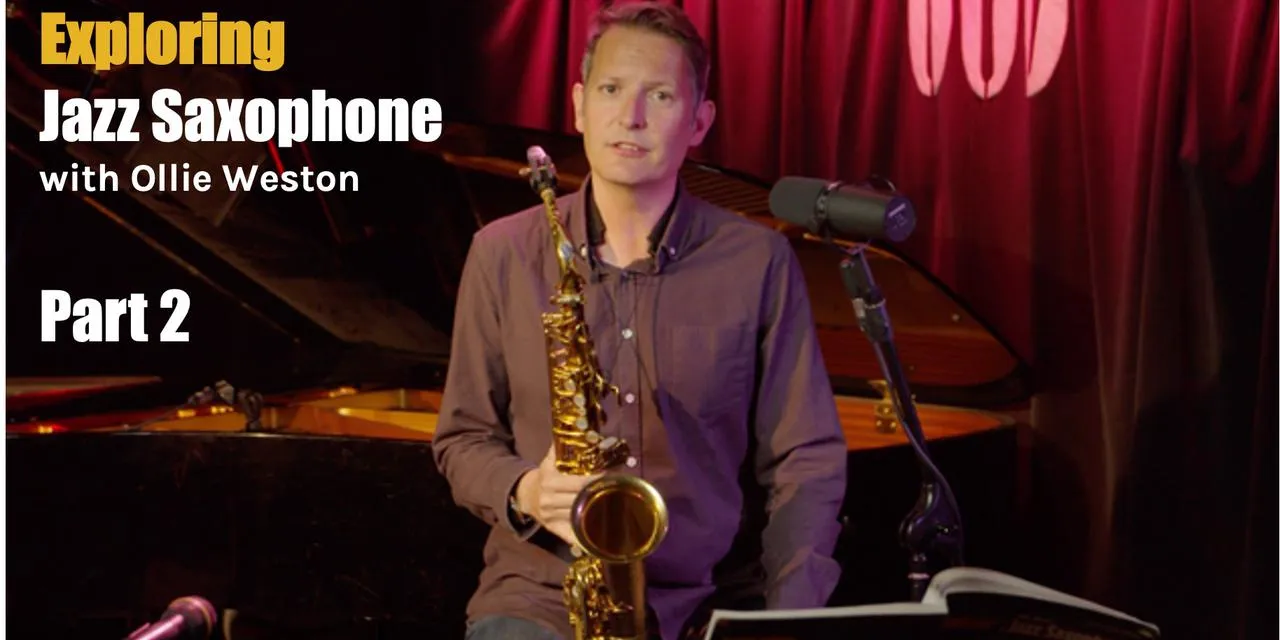
About the instructor
Seit seinem Abschluss am Leeds College of Music (BA Hons) und an der Guildhall School of Music (Post Graduate Diploma in Performance) hat Ollie eine rege und vielseitige Karriere in der Musik aufgebaut. Als Saxofonist ist er live und im Studio mit so unterschiedlichen Künstlern wie Amy Winehouse, Tim Minchin, Bonobo, Frank Turner, dem London Jazz Orchestra, der Hackney Colliery Band, dem Ambient Jazz Ensemble und dem Nelson Riddle Orchestra aufgetreten. Er ist zudem Co-Leader des Jazzquartetts 'Time Is Of The Essence' und komponiert und arrangiert Material für dieses und andere Ensembles. Ollie ist in der Musikpädagogik aktiv, derzeit als Studiengangsleiter der Jazzabteilung an der Guildhall School of Music and Drama (Junior School), wo er Jazzensembles, Big Band und Theorieklassen leitet. Er hat für Schott Music eine Reihe von 'Exploring Jazz'-Büchern geschrieben, die weltweit veröffentlicht werden und in britischen Prüfungslehrplänen enthalten sind. Ollie hat außerdem Workshops für die Oxford University, Pro Corda Strings und BABSWE sowie für die Sommerschulen der Guildhall School of Music geleitet. In seinen Exploring-Jazz-Saxophone-Kursen führt dich Ollie von den ersten Schritten bis hin zum selbstbewussten Improvisieren über Songs und Akkordfolgen und baut dabei die Improvisationsfähigkeiten auf, die dir das Vokabular eines echten Jazzmusikers in die Finger legen. read more