



Take the Express Train - Das Turnaround
Lesson time: (3min 21sec)
Ollie Weston stellt das Turnaround vor, die I-VI-II-V-Bewegung, die am Ende eines A-Teils Schwung erzeugt, demonstriert an seinem Stück 'Take the Express Train'.
Course preview
This lesson is part of the course Jazz-Saxofon entdecken: Teil 2 - Soli über Songs und Akkordfolgen
Watch a preview of the full course below.
Lesson transcript:
Lesson: Introducing Turnarounds
In this lesson, I'm going to introduce you to the turnaround, which is another way to expand your chord sequence and to create momentum in an otherwise static section of music.
What is a Turnaround?
- Turnarounds usually happen at the end of an A section in a tune.
- They help to transition back to the main part of the song.
Listening Exercise
I'm going to play you two versions of a song called Take the Express Train, inspired by Duke Ellington's Take the A Train.
Listen for the Turnaround
- Just have a listen to what happens in the last two bars when the melody resolves and the chord has two bars to get back to the A section.
First Version:
1, 2, 1, 2, 3, 4.
Second Version (with a turnaround at the end of the first section):
1, 2, 1, 3.
Observations
If you listen to what the rhythm section is doing, particularly the bass, in those last two bars:
- Instead of sitting on my I chord on A, the bass player is playing what we call a turnaround.
Notes Played
The notes are:
- 1, 6, 2, 5, and then back to 1.
A bass player, instead of playing two notes on each, might join them up in a walking style.
This creates momentum in the chord sequence and gives the illusion of movement without any essential digression from the main key.
Key Points
- We start in A and we end in A.
- There are two variations on a turnaround:
- I VI 2, 5 (the first one I played).
- Starts on 3 (a subtle difference).
Practicing Turnarounds
You might hear from the bass player.
- You could practice these turnarounds to get used to sounding like a bass player.
- It's a great exercise to sit and listen to what the other instruments in your band are doing, as well as opening up your ears to these turnarounds.
About the instructor
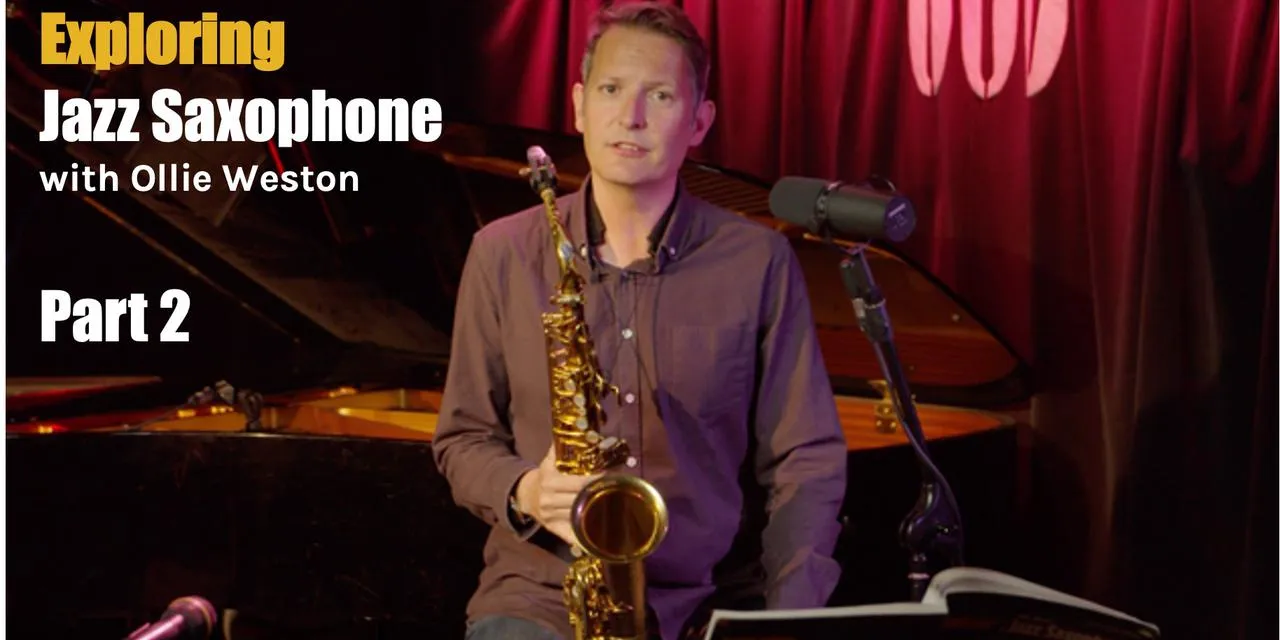
Seit seinem Abschluss am Leeds College of Music (BA Hons) und an der Guildhall School of Music (Post Graduate Diploma in Performance) hat Ollie eine rege und vielseitige Karriere in der Musik aufgebaut. Als Saxofonist ist er live und im Studio mit so unterschiedlichen Künstlern wie Amy Winehouse, Tim Minchin, Bonobo, Frank Turner, dem London Jazz Orchestra, der Hackney Colliery Band, dem Ambient Jazz Ensemble und dem Nelson Riddle Orchestra aufgetreten. Er ist zudem Co-Leader des Jazzquartetts 'Time Is Of The Essence' und komponiert und arrangiert Material für dieses und andere Ensembles. Ollie ist in der Musikpädagogik aktiv, derzeit als Studiengangsleiter der Jazzabteilung an der Guildhall School of Music and Drama (Junior School), wo er Jazzensembles, Big Band und Theorieklassen leitet. Er hat für Schott Music eine Reihe von 'Exploring Jazz'-Büchern geschrieben, die weltweit veröffentlicht werden und in britischen Prüfungslehrplänen enthalten sind. Ollie hat außerdem Workshops für die Oxford University, Pro Corda Strings und BABSWE sowie für die Sommerschulen der Guildhall School of Music geleitet. In seinen Exploring-Jazz-Saxophone-Kursen führt dich Ollie von den ersten Schritten bis hin zum selbstbewussten Improvisieren über Songs und Akkordfolgen und baut dabei die Improvisationsfähigkeiten auf, die dir das Vokabular eines echten Jazzmusikers in die Finger legen. read more