



Einführung in den Latin Jazz
Mit
Ollie WestonEine Einführung in den Latin Jazz und das Bossa-Nova-Feel - die geraden Achtel und der Clave-Rhythmus, der aus dem Brasilien der 1960er hervorging.
Das steckt im Kurs
47 Lektionen (1h 48m) · 1 gratis
01. Die 'perfekte' Kadenz V-I
3:28
02. Dominant 7 - Quintenzirkel-Übung
1:24
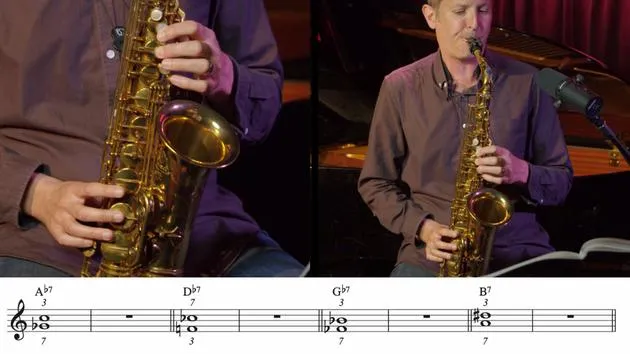
03. Dominant 7 - Quintenzirkel mit Terzen und Septimen
2:16
04. Rhythmische Variationen mit Terzen und Septimen
2:02
05. "Rhythm Changes" mit Dominantseptakkorden und dem Quintenzirkel
1:08
06. Die II-V-I-Progression
1:20
07. II-V-I-Licks im Stil von Parker, Coltrane und Adderley
Gratis-Lektion4:15
08. Dancing With Duke (II-V-I-Übung) - Einführung
1:15
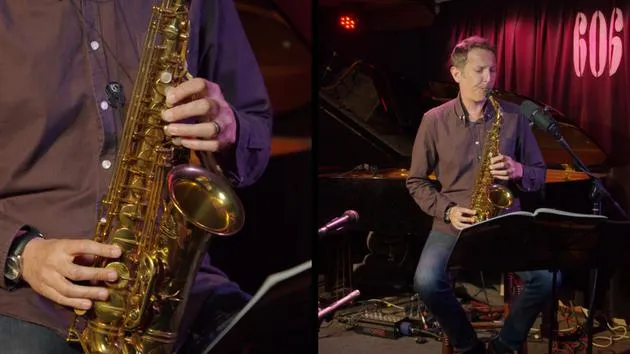
09. Dancing With Duke (II-V-I-Übung) - Aufführung
4:38
10. Fazit zur II-V-I-Verbindung
0:42
01. Die Moll-Paralleltonart finden
1:41
02. Die harmonische Moll-Tonleiter über den V-Akkord spielen
1:15
03. V-I in a-Moll mit einer b9
4:38
04. Moll-V-I-Übung in allen 12 Tonarten
1:43
05. Phrase zum Üben von Moll-Kadenzen
1:17
06. Moll-II-V-I in einer Akkordfolge
5:04
07. Die II-Stufe hinzufügen
1:20
08. Autumn Sun - Einführung und Harmonik
3:03
09. Autumn Sun - Performance
4:44
01. Einführung in die Standards
0:52
02. Einführung zu Among the Stars
3:54
03. Performance von Among the Stars
4:23
04. Undying Love - Eine Akkordfolge erweitern
4:42
05. Undying Love - Interpretation
1:12
06. Undying love - Checkpoint
0:47
07. Take the Express Train - Das Turnaround
3:21
08. Beispiele für melodische Linien über Turnarounds
1:22
09. Take the Express Train - Einführung
1:28
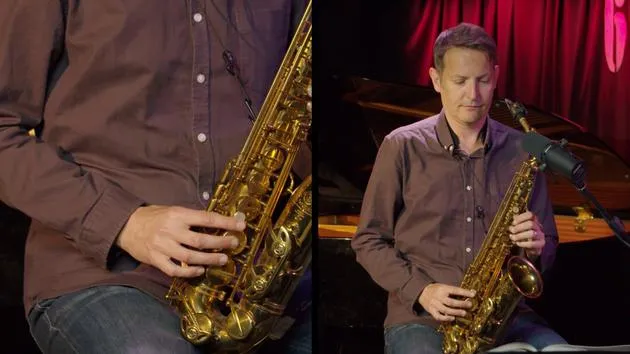
10. Take the Express Train - Performance
1:12
11. Take The Express Train - Zusammenfassung
0:39
01. Einführung in den Bebop
1:04
02. 52nd Street Blues - Einleitung und Thema
0:29
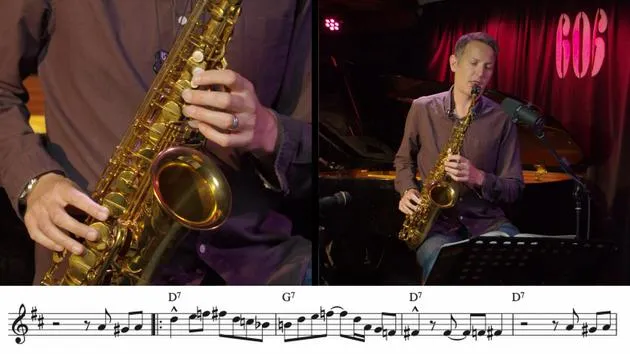
03. 52nd Street Blues - Head über eine I-IV-V-Verbindung
0:45
04. 52nd Street Blues - Chromatik hinzufügen
2:53
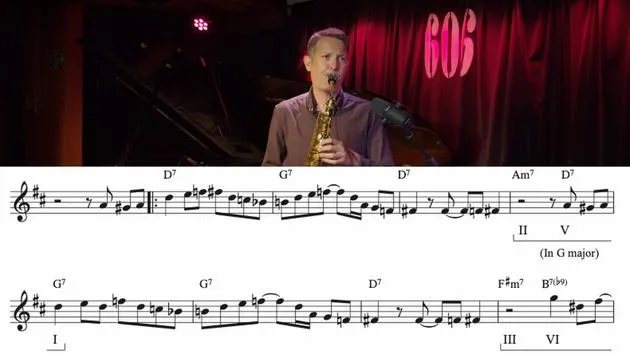
05. Jazz-Harmonik zum Blues hinzufügen
2:39
06. 52nd Street Blues - Thema mit II-V-I-Wechseln
1:05
07. 52nd Street Blues - Performance
3:01
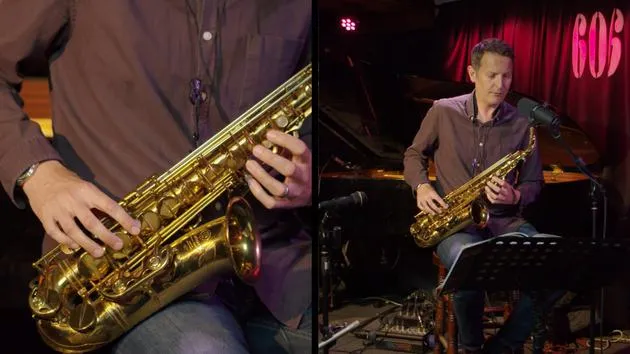
Transkript der Lektion
Latin Jazz: Bossa Nova
Next, I'd like to show you a Latin jazz tune. The term "Latin" refers to music that comes from South America. In this case, we're going to look at bossa nova, a style that evolved in Brazil in the 1960s.
Historical Context
You may have heard "Girl From Ipanema" by Astrud Gilberto and Stan Getz, which was a huge hit in the 1960s. Jazz musicians began to fuse bossa nova into their styles.
Rhythm Differences
Rhythmically, bossa nova is slightly different from swing. Like the rock tunes we explored before, the quavers are now straight. Quite often in bossa nova, you might have what's called a clave backbeat.
- If we have a beat, we're going:
- bat, bat, bat, bat, bat
- G, G, G.
Listen to the intro of my tune Supernova; you might hear some of these rhythms that Richard, the drummer, is playing on the rim shot of his snare. Just listen for those clicks!
These clave rhythms are really evocative of bossa nova music. Throughout the track, you'll notice those rim clicks outlining our clave rhythms, which are characteristic of Brazilian music.
You might also hear Dave the Bass playing those sorts of bass rhythms rather than a more standard swing walking bass line. It's a fascinating fusion of styles: the harmony and style of jazz mixed with the rhythms of bossa nova.
Song Structure
In my song Supernova, I've been inspired by Blue Bossa, a tune by Kenny Dorham, a legendary trumpet player in the 1950s and 60s.
- The structure is a very simple 16-bar format, just A and B, loosely based around A minor.
- Look out for your 2, 5, 1 progression:
- B minor 7, Bb5, E7 to A.
Then, in the bridge, I modulate to the A major key, B flat major. Watch for a change of texture, a bit of a change of gear there.
- The bridge consists of:
- C minor 7, F7, B flat major.
Performance Notes
Here's the tune:
- Twice through the head,
- Four choruses of solo,
- Twice through the head to finish.
47 Lektionen
1 Std. 48 Min. strukturierte Videolektionen
Erweiterte Videofunktionen
Verlangsamen, Passagen loopen, mitlesen
Handy, Tablet & Desktop
Üben, wo du willst
100 % Zufriedenheitsgarantie
30 Tage Geld-zurück-Garantie
Lern deinen Guru kennen
Lern deinen Guru kennen
Seit seinem Abschluss am Leeds College of Music (BA Hons) und an der Guildhall School of Music (Post Graduate Diploma in Performance) hat Ollie eine rege und vielseitige Karriere in der Musik aufgebaut. Als Saxofonist ist er live und im Studio mit so unterschiedlichen Künstlern wie Amy Winehouse, Tim Minchin, Bonobo, Frank Turner, dem London Jazz Orchestra, der Hackney Colliery Band, dem Ambient Jazz Ensemble und dem Nelson Riddle Orchestra aufgetreten. Er ist zudem Co-Leader des Jazzquartetts 'Time Is Of The Essence' und komponiert und arrangiert Material für dieses und andere Ensembles.
Ollie ist in der Musikpädagogik aktiv, derzeit als Studiengangsleiter der Jazzabteilung an der Guildhall School of Music and Drama (Junior School), wo er Jazzensembles, Big Band und Theorieklassen leitet. Er hat für Schott Music eine Reihe von 'Exploring Jazz'-Büchern geschrieben, die weltweit veröffentlicht werden und in britischen Prüfungslehrplänen enthalten sind. Ollie hat außerdem Workshops für die Oxford University, Pro Corda Strings und BABSWE sowie für die Sommerschulen der Guildhall School of Music geleitet.
In seinen Exploring-Jazz-Saxophone-Kursen führt dich Ollie von den ersten Schritten bis hin zum selbstbewussten Improvisieren über Songs und Akkordfolgen und baut dabei die Improvisationsfähigkeiten auf, die dir das Vokabular eines echten Jazzmusikers in die Finger legen.







