



Die Beziehung zu Plattenlabels
Charlie Rapino erzählt Geschichten aus seinen eigenen Erfahrungen mit Plattenlabels und warum es sich gegen einen Künstler wenden kann, den Label-Leuten zu nahe zu kommen.
Das steckt im Kurs
16 Lektionen (2h 16m) · 1 gratis
Transkript der Lektion
Music Lesson Formatting
Introduction to the Record Experience
We get a call one day out of this record.
We really get high up into BMG consideration for distributing the record. So we're making a lot of money because, obviously, you know, let's give it a shot. They called us and, okay. They didn't know they found themselves with a big record in which they were giving away a lot of points.
Understanding the Industry Dynamics
Big conglomerates don't like that; they're greedy. You know, they were going like, "Fuck, we're losing money." They didn't think about the money they were earning. They were losing money because they gave 10 points more to these two little whippersnappers here.
Then Stephen calls us and he goes like, "Look, the chairman of A&R, whatever that is, Mike McCormack, and Nick Raymond want to see you at RCA."
At the time, I was still convinced that the worst thing you can do as a producer and songwriter, or as an artist, is to hang out with record company people because you become too close and they know they can have you.
The Importance of Perception
I was saying, "You know, Steve, let's apply that marketing concept that if they can't have us, they will want us." So, obviously, I said, "I'm not going to see them," very arrogantly.
Steve said, "Come on, guys, do me a favor. They're calling every day; they want to see you."
Career Advice: Choose Your Connections Wisely
There were just a few people we knew. If I can give you some advice, can I digress for a second, please?
- Career Advice: Choose who you hang out with in record companies.
- Choose a couple of guys you like, you know, that you have some empathy with.
- If you're an artist or whatever the rest of it, get your bloody manager to deal with them.
These executives? Just stay very out. Choose a couple of guys that you think, "I can hang out with this guy; actually, he's cool; he's one of us." Because it is us and them. You know, and it's highly important there because they gotta hear about you, not from you, but from someone else. Then they'll want you. So the manager's role is extremely important.
The Delicate Role of a Manager
The manager's role is extremely important, and not just that, it's very delicate.
I've been working as, you know, a manager. It's about how I can push it and how can I hustle without being hustled. The sales process is highly difficult.
The Meeting Experience
So in this unusual world, we did go into this meeting.
It's 11:00 in the morning now. At that time, going at 11:00 in the morning was just basically asking for trouble. Because, you know, we were at the Ministry. The Minister just opened at that time. We used to do a bit of DJing together with this massive sound system; you know, that they had. It was probably the best club I'd ever been to.
It was very difficult to get in; you had to be part of a certain set to go in. It was absolutely barking mad. I think we went to bed at 10 o'clock in the morning, and Marco and I took my bike. At the time, I was fully dressed as a biker, and we arrived at this RCA office with one hour of sleep.
The Arrival at RCA
At the time, I had long hair and a beard that looked more like, I don't know what sort of Rick Rubin would look like today. You know, that sort of look, with all my biker gear on. Marco had his hair styled in a way that made him look like a mad professor or something.
So we're in there, and the best thing that can happen is Marco is falling asleep basically on the sofa. I said, "You deal with this; you know I don't like him."
The Discussion Begins
We go in very happy and say, "Can we do something together?" "Sure! What's not working? What's not working?"
In other words, you're asking RCA, "What have you got that's not working for you?"
- What's the worst thing you've got?
- Because there's no worse or best.
They did a good job; they were touring the schools. But it's a boy band, you know? In other words, what needs an injection? What needs a boost?
"93, you know, boy band? What are you talking about?"
And he goes like, "Well, play me what you got. Play me that ex-single."
The Review of the Single
And he plays this single, which was a high-energy version, no offense to the original producer, of a very obvious Italo disco high-energy version of... that's terrible.
What was the track?
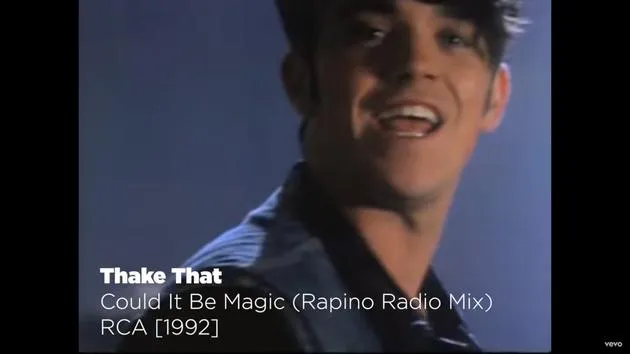
- Could it be Magic?
Barry Manilow's couldn't say anything and Marco woke up at that point; it was a piece of garbage and went back to sleep.
So there's this very surreal meeting, with these two looking at us. We had already done the mix for them on Take That, which was a gay club version.
I said, "What do you think of the single?" I said, "That's fucking terrible, sorry mate."
He was like, "Oh, can you do better than this?"
"Oh yeah, yeah, yeah. I mean, a daze, you know, I slept one hour and a half."
The Aftermath of the Meeting
Mike is laughing and Nick Ravel goes like, "Okay. These two are completely deranged."
Then they wrap up the meeting. I get a call from Bud when we go back to our studio. Obviously, not to work, but to sleep.
Bud says, "Okay, you gotta do a demo of it."
They thought it was outrageous beyond any limit or decency but if you can do better, then, yeah. Send the vocal.
Preparing for the Demo
And we had the Robbie vocal:
"Spirits move me every time I meet you,
Whirling like a cyclone in my mind.
You're my lifeline, angel of my lifetime.
Listen to all answers I can find.
Baby, I want you.
Come, come, come into my arms.
Let me feel the wonder of all of you.
Could it be magic now?"
16 Lektionen
2 Std. 16 Min. strukturierte Videolektionen
Erweiterte Videofunktionen
Verlangsamen, Passagen loopen, mitlesen
Handy, Tablet & Desktop
Üben, wo du willst
100 % Zufriedenheitsgarantie
30 Tage Geld-zurück-Garantie
Lern deinen Guru kennen

Lern deinen Guru kennen
Charlie begann seine Karriere in der Musikindustrie als frisch gebackener Anwalt und veranstaltete Konzerte, indem er Künstler wie Iggy Pop und Patti Smith vor ein radikales italienisches Universitätspublikum brachte.
Nach seiner Arbeit im legendären Record Plant NYC und dem Eintauchen in die House-Szene gründete er mit Marco Sabiu die Rapino Brothers, zog 1990 nach London und blickte nie zurück. Dort eroberten sie das Jahrzehnt im Sturm, produzierten und nahmen Platten auf. Nach ihrem ersten Hit mit Kym Mazelles Love Me The Right Way steckten sie hinter Take Thats erstem Hit und produzierten, mischten und feilten in den 1990er-Jahren an zahlreichen großen Pop-Acts, von Kylie bis Primal Scream.
1997 war Charlie der „On-Air“-Produzent von „Get Your Act Together“ der BBC, gefolgt von „Full Frontal“ auf Channel 4. Von 1999 bis 2004 war er A&R Director bei Sony Music International.
Seine Energie lässt nie nach. Über die Jahre hat er seine Zeit aufgeteilt zwischen Management-Beratung für Ennio Morricone, Beratung für das Magazin Rolling Stone, Arbeit an Soundtracks und Produktionsberatung für Filme und Spiele (darunter Iggy Pop dafür zu gewinnen, die Voice-overs für das Videospiel Driver 3 zu übernehmen) sowie dem Verpflichten und Managen von Acts über sein Joint-Venture-Label mit Sony, Stud Records.
In Get signed! zieht Charlie den Vorhang zurück auf jahrzehntelange Erfahrung in Produktion und A&R, um dir genau zu zeigen, worauf Labels hören, wie du deinen Act formst und präsentierst und was wirklich nötig ist, um aufzufallen und einen Vertrag zu bekommen.







